


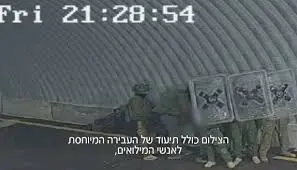
Israel’s military detention system is once again under fierce global scrutiny after authorities opened a criminal investigation this week — not into the uniformed reservists who raped a blindfolded Palestinian detainee at the Sde Teiman military camp in mid-2024, but into suspected whistle-blowers believed to have leaked the surveillance footage.
The assault, recorded continuously for roughly 15 minutes, occurred while the detainee was handcuffed, blindfolded, and physically restrained.
The footage was first leaked and broadcast in late July 2024 by Channel 12, prompting an explosion of outrage — and a heated, globally watched Knesset response.
Who committed the assault?
The perpetrators were IDF reservists assigned as detention guards inside Sde Teiman — not civilian Israel Prison Service employees. Because the site is run by the army, responsibility flows up the military chain of command, increasing exposure to international criminal prosecution.

First wave of fallout: July 29–30, 2024
After the surveillance excerpt aired, military police detained nine reservists in connection with the sexual assault. Reuters confirmed the detainee required hospitalization for severe injuries.
Far-right activists and politicians rushed to the scene, some even entering the base to pressure investigators. Demonstrations erupted outside the facility.
The infamous Knesset exchange: July 29–30, 2024
During a parliamentary debate on the revelations, Likud MK Hanoch Milwidsky was confronted about reports the detainee was sexually assaulted with an object.
He was asked on the Knesset floor whether it was legitimate to “insert a stick into a person’s rectum.”
Milwidsky replied:
“Yes! If he is Nukhba, everything is legitimate to do! Everything!”
“אם הוא נוכבה, הכל מותר לעשות לו!”
Video clips circulated immediately on X (formerly Twitter). Hebrew outlets, including המקום הכי חם בגיהנום, documented the exchange.
Human-rights lawyers described the moment as “state-level normalization of sexual torture.”
Politicians who defended the suspects (not explicit rape advocacy)
Itamar Ben-Gvir (Otzma Yehudit; National Security Minister) — July 29, 2024
After the arrests, Ben-Gvir posted that the spectacle of detaining “our best heroes” was “shameful” and urged authorities to “take your hands off the reservists.”
(The Times of Israel)
Bezalel Smotrich (Religious Zionism; Finance Minister) — July 29, 2024
Smotrich attacked the arrests, writing in Hebrew:
“IDF soldiers will not be arrested like common criminals… take your hands off our heroic fighters!”
(X/Twitter)
Zvi Sukkot (Religious Zionism MK) — July 29, 2024
Entered Sde Teiman, argued investigators should not question the soldiers, and demanded unrelated “failures” be probed first.
(hakolhayehudi.co.il)
Amichai Eliyahu (Otzma Yehudit; Heritage Minister) and
Nissim Vaturi (Likud; Deputy Knesset Speaker) — July 29, 2024
Both joined or encouraged protests, with reporting noting their presence in the break-in at the facility.
(Wikipedia aggregate of coverage; contemporary Hebrew press)
This wave of political protection demonstrated institutional solidarity with the accused.
The TV interview (late July 2024)
Days after the broadcast, one of the IDF reservists seen in the footage appeared on Israeli television, smirking, refusing to deny involvement, and calling detainees “terrorists who deserve worse.” The studio panel applauded.
International audiences perceived the segment as the public normalization of sexual torture.
Second wave of fallout: late 2024 – early 2025
Indictments were later filed against five reservists for “severe abuse” that caused:
- broken ribs,
- a punctured lung,
- a torn rectum.
Yet no rape charges were submitted.
Public rallies supporting the accused swept Tel Aviv and Be’er Sheva, with chants of:
- “Don’t touch our boys!”
- “No trials for heroes!”
Accountability became politically radioactive.
This Week (late October / early November 2025): Whistle-blowers targeted
On October 30, 2025, the IDF finally opened a criminal investigation — aimed at those who leaked the footage.
Chief Military Prosecutor Maj. Gen. Yifat Tomer-Yerushalmi took leave the same day, triggering speculation about internal pressure.
An Israeli legal scholar told independent media:
“The system tolerates rape on camera. Transparency is the crime.”
This Week: Red Cross access banned
Also on October 30, 2025, Defense Minister Israel Katz formally banned the International Committee of the Red Cross (ICRC) from visiting detainees held as “unlawful combatants” — including children.
Observers warn the move:
- removes the final independent witness,
- violates Geneva obligations,
- increases the risk of unseen torture.
Deaths in custody
Since October 7, 2023, at least 76 Palestinians have died in Israeli custody. Causes include:
- blunt-force trauma,
- chest compression,
- hypothermia,
- medical neglect.
Several families received bodies with restraint trauma and rectal injuries.
Others never received the remains.
Sexualized torture patterns
Legal aid groups describe:
- rape by military dogs while detainees are restrained,
- genital electrocution,
- forced diapers,
- prolonged blindfolding,
- solitary confinement without charge.
Doctors documented permanent nerve damage from cuffs.
Children behind bars
As of late-2025, Israel detains:
- 9,500–10,500 Palestinians, including
- 200–350 children
Some children:
- are shackled,
- sign confessions in Hebrew,
- receive no family contact for months,
- are interrogated alone.
A system with cameras — and no justice
The internal footage proves:
- the assault was recorded,
- supervisors saw it,
- nothing happened until exposure.
A former military police investigator explained:
“Cameras protect the army, not the prisoner.”
International legal exposure
By November 1, 2025, ICC staff requested:
- chain-of-custody records,
- guard duty logs,
- supervisory rosters.
Because the perpetrators are uniformed state actors, sexual assault constitutes a grave breach of international law.
Priorities inverted
The current hierarchy appears to be:
- Filming torture → tolerated
- Committing torture → normalized
- Revealing torture → criminalized
The political meaning
Three phases define the Sde Teiman scandal:
- Mid-2024: The rape — recorded by state cameras.
- Late-2024: Explicit parliamentary advocacy for sexual assault and national television applause.
- Late-2025: Sealing the prison system — banning monitoring, hunting whistle-blowers.
A Haifa University scholar summarized:
“Once parliament debates rape as policy, a country is debating what it has become, not what it does.”
The central unresolved question:
Will Israel prosecute the torturer — or the witness?