


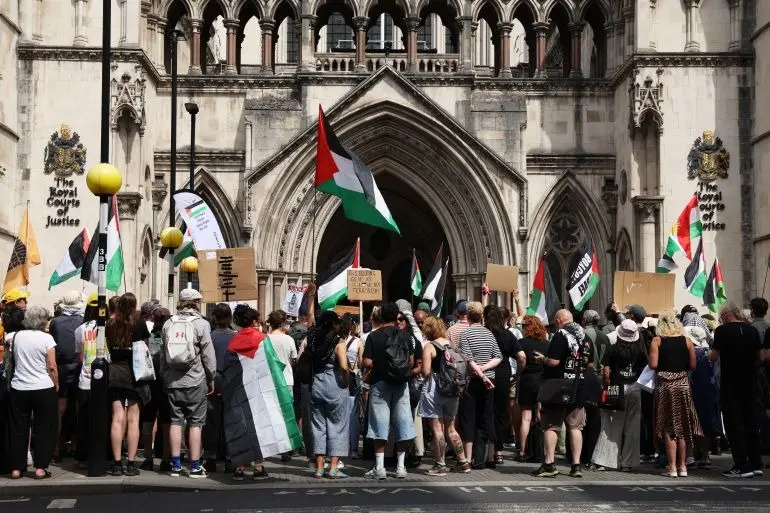
The British judicial system is facing intense scrutiny following the unexplained removal of a High Court judge set to preside over the most significant challenge to UK counter-terrorism powers in over a decade. At the centre of the storm is the Palestine Action Judicial Review—a legal test of the government’s controversial proscription of the direct-action network, which has spent four years targeting factories involved in supplying components to Israel’s arms industry.
The case was initially granted permission to proceed by Mr Justice Chamberlain, a constitutional law specialist described as independent but not radical. Days before the hearing, however, Chamberlain was abruptly taken off the case. No reason was given. No statement issued. No conflict declared. Instead, a three-judge panel was quietly installed—one that legal observers say reflects the state’s strongest institutional instincts rather than judicial neutrality.
It is the kind of move that rarely happens in British administrative courts. When a judicial review is approved, the judge who grants permission ordinarily remains with the case unless illness, conflict of interest, or unavoidable scheduling prevents it. In those situations, protocols typically require clear public explanations. This time, none were offered.
For critics, the silence is louder than any ruling.
A Pattern of Judicial Displacement
This was not the first time Chamberlain was removed from a case involving UK-Israel military cooperation.
Earlier this year, he green-lit a challenge to British exports of parts used in the F-35 fighter jet fleet deployed over Gaza. Before the case could reach a substantive hearing, he was taken off that one too—again without explanation.
Two cases. Same judge. Same subject matter: UK complicity in Israeli military operations. And in both instances, Chamberlain was replaced before the government was compelled to defend itself openly.
“It doesn’t require conspiracy,” one legal scholar observing the shift told this newspaper. “It only requires an understanding of how power behaves under pressure.”
The Replacement Bench
In Chamberlain’s place now sit Dame Victoria Sharp, Dame Karen Steyn, and Sir Jonathan Swift—one of the most senior and security-aligned judicial formations seen in a terrorism-powers challenge in years.
Swift, formerly the government’s first Treasury Counsel, built his career defending Home Office national security decisions against public challenge. His instincts, critics argue, reflect a lifetime of arguing for deference to executive power.
Steyn previously replaced Chamberlain in the F-35 judicial review, ultimately ruling that even where the government admitted export-rule breaches, the court should not intervene due to foreign policy sensitivity.
Sharp, President of the King’s Bench Division, brings institutional authority—but also controversy. Her twin brother Richard Sharp, the former BBC chairman forced to resign over a secret loan arrangement linked to Boris Johnson, has long-standing financial ties to investment sectors connected to Israeli defence manufacturing. He sits alongside Sir Trevor Chinn—major donor to Labour Friends of Israel and to Keir Starmer’s leadership campaign—on the board of One Million Mentors.
None of this amounts to proven bias. But the legal test is not whether bias exists—only whether a reasonable member of the public might suspect it.
In a case about a movement exposing the UK–Israel arms pipeline, that perception is impossible to ignore.
What the Stakes Really Are
The Starmer government has built its political identity on restoring authority after years of Conservative disorder—cracking down on protest, expanding public order measures, and framing dissent as extremism. The proscription of Palestine Action is the centrepiece of that posture.
If the court finds the ban unlawful:
- up to 2,000 arrests could collapse
- the Home Office could be found to have abused terrorism powers
- the UK’s alignment with Israel could be legally implicated
- foreign policy and arms exports could face unprecedented scrutiny
Such an outcome would strike directly at the core narrative Labour has constructed: that it is tough, decisive, and secure.
In private, government figures acknowledge the risk. In public, they press on.
“The judicial switch tells you everything you need to know about confidence,” said one former Whitehall lawyer. “If the government believed it could win this case cleanly, it would not need a new bench.”
Pressure Without Orders
No one alleges ministers phoned judges. They don’t need to. In the UK system, influence does not arrive as instruction—it operates through gravity. National security cases generate a reflexive instinct within institutions: protect the state, avoid diplomatic friction, don’t interfere with foreign policy.
When a case touches Israel, arms exports, or counter-terror powers, the system tilts.
This time, it tilted hard.
A Bigger Crisis Than One Case
If the government wins under this panel, the ruling may stand legally—but collapse publicly. Appeals will follow. Confidence will fall. And the perception that the judiciary bends when Israeli military interests are involved may harden into political fact.
Britain’s constitutional order rests not on force, but on trust—trust that courts are independent, that judges are insulated, that law stands apart from government.
This moment tests all three.
Because the controversy here is not only whether the state stitched up Palestine Action. It is whether the state has learned that judicial pressure works—and may use it again.
Once that precedent is normalised, it does not go back.
The Quiet Scandal Behind the Noise
What this case reveals is larger than one movement or one ruling. It exposes a structure in which national security language, foreign policy alignment, and arms industry interests merge into a single political logic—and where judicial independence appears conditional, not absolute.
Whether intentional or not, the removal of Chamberlain signifies a system protecting itself.
The question now is whether the public will accept that—or whether this will be remembered as the moment Britain’s separation of powers slipped, silently, into something else.