
A flagship international plan to rebuild and govern Gaza is now entering a phase of deep uncertainty, as funding shortages, political deadlock, and a rapidly expanding regional war combine to undermine what had been presented only months ago as a historic framework for post-conflict recovery and stabilization.
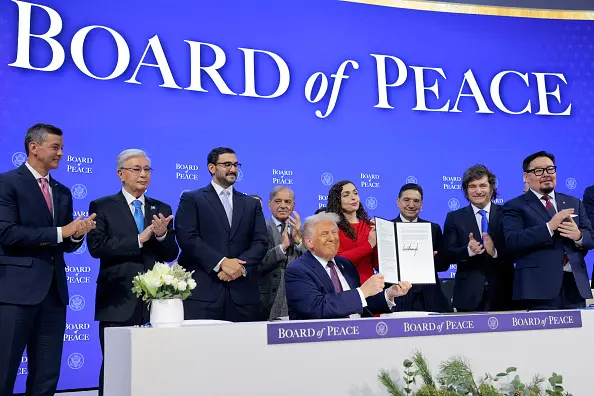
New reporting indicates that Donald Trump’s “Board of Peace” has received only a small fraction of the billions pledged for Gaza, a shortfall that has effectively paralysed implementation and prevented the transition to a functioning governance structure, even as U.S. and Israeli military escalation against Iran continues to dominate regional politics and push the question of Gaza reconstruction further to the margins of international attention.
At the center of the controversy surrounding the plan remains a phrase that has come to define both its critics’ interpretation and its broader political meaning, first articulated by Norman Finkelstein, who argued that the UN resolution underpinning the initiative amounted to the international community having “handed Gaza to Donald J. Trump,” a formulation that, while not intended as a literal legal description, has increasingly come to resonate with the reality of how the plan has unfolded.
A Plan Undermined by a Collapse in Funding and Momentum
The latest developments highlight the extent to which the project has been weakened at a structural level, with sources familiar with the Board’s operations indicating that less than $1 billion has been received out of approximately $17 billion pledged for Gaza’s reconstruction and governance, a gap that has left the initiative unable to move beyond its initial design phase and into practical implementation.
One source with direct knowledge of the situation described the impact of the widening regional conflict in stark terms, stating that the Iran war “has affected everything,” not only disrupting funding flows but also diverting political attention and reducing the willingness of key actors to commit resources to a project whose future now appears increasingly uncertain.
A Palestinian official familiar with the matter confirmed that the U.S.-backed National Committee for the Administration of Gaza, which had been intended to assume governance responsibilities, has been unable to enter the territory due to the lack of available funds, adding that Board representatives had communicated directly to Palestinian factions that “no money is currently available,” a statement that sharply contradicts the public position of the Board itself.
In response, the Board of Peace issued a statement insisting that it is “a lean, execution-focused organization” and that “there are no funding constraints,” a claim that stands in clear tension with accounts from those directly involved in the process and underscores the widening gap between official messaging and operational reality.
A Governance Structure That Exists Only on Paper
The failure to secure funding has had immediate consequences for the broader governance framework established under Resolution 2803, which had envisaged a transition from military conflict to a structured system of administration overseen by the Board of Peace and implemented through a Palestinian technocratic body.
In practice, that transition has not begun, and the administrative structure remains effectively frozen, with the NCAG, led by Palestinian figure Ali Shaath, still based outside Gaza and unable to establish any presence within the territory, its members reportedly confined to Cairo “under supervision by American and Egyptian handlers,” according to diplomatic sources familiar with the situation.
Without the ability to deploy personnel, establish ministries, or assume control of basic administrative functions, the governance plan has become, in effect, a framework without a functioning government, leaving Gaza in a state of administrative limbo despite the formal existence of an internationally endorsed structure.
Deadlock, Disarmament, and the Risk of Renewed War
At the same time, the political conditions required to activate the plan remain unresolved, with negotiations over the disarmament of Hamas continuing to stall amid fundamental disagreements between the parties involved, as Israel insists that Hamas must lay down its weapons prior to any withdrawal of its forces, while Hamas maintains that it will not disarm without firm guarantees of Israeli withdrawal and a complete cessation of hostilities.
According to a diplomatic source involved in the talks, the negotiations remain at an impasse, with growing concern that Israel may be preparing “an excuse to relaunch a full-scale offensive,” a development that would not only derail the governance plan entirely but also further entrench the cycle of conflict that the resolution was intended to address.
Israeli military officials have indicated that preparations for renewed large-scale operations are underway, reinforcing the sense that the ceasefire underpinning the entire framework is fragile and potentially temporary.
From Legal Framework to Political Controversy
As implementation falters, attention has increasingly turned to the underlying structure of the plan and the legal and political assumptions on which it is based, with critics arguing that the Board of Peace represents a departure from established principles of international law and raises serious questions about the future of Palestinian sovereignty.
This critique is most forcefully articulated by Finkelstein, who has argued that the resolution represents not merely a flawed policy initiative but a fundamental rupture in the international legal order, writing that “the Security Council stands… as an accessory to genocide” and accusing the UN of legitimizing the outcome of the war rather than resolving it.
In his interviews with Chris Hedges, Finkelstein expanded on this argument, stating that the resolution had “abolished 70 years of its own history” and framing the Board of Peace as a mechanism through which Gaza would be governed under a U.S.-dominated authority, an interpretation encapsulated in his claim that the UN had effectively “handed Gaza to Donald J. Trump.”
He also described the United Nations itself as “a rotting corpse,” arguing that it had abandoned its foundational commitment to self-determination and international law in favor of accommodating geopolitical power.
While most legal scholars do not adopt Finkelstein’s language, many have acknowledged elements of his analysis, noting that the resolution leaves Palestinian sovereignty undefined and conditional, and that the governance structure lacks clear mechanisms for representation, accountability, and transition to genuine self-rule.
A Regional War That Has Shifted the Agenda
The broader regional context has played a decisive role in shaping the fate of the plan, as the escalation of conflict involving Iran has redirected diplomatic attention, disrupted funding flows, and reduced the urgency of Gaza reconstruction within international policy discussions.
Just ten days before the outbreak of the current war, Trump had hosted a high-profile conference in Washington at which Gulf states pledged billions toward Gaza’s reconstruction, a moment that appeared to signal momentum behind the initiative but which has since been overtaken by events, with those pledges largely failing to translate into concrete financial commitments.
As one source involved in the process observed, the war has “affected everything,” not only in practical terms but also in the sense that it has reshaped priorities and pushed Gaza down the list of immediate concerns for key international actors.
A Territory in Ruins, A Plan in Limbo
The consequences for Gaza remain severe and immediate, with the territory still bearing the impact of two years of sustained Israeli bombardment that has destroyed approximately four-fifths of its buildings, displaced the majority of its population, and left reconstruction costs estimated at around $70 billion.
Despite the existence of a ceasefire, Israeli forces continue to control large areas of Gaza, while Hamas retains authority in a limited coastal zone, creating a fragmented and unstable environment in which no single authority is able to govern effectively.
More than 72,000 Palestinians have been killed, according to local health authorities, and humanitarian conditions remain critical, with aid delivery, reconstruction, and basic services all dependent on a governance framework that has yet to materialize.
A Phrase That Now Reflects the Reality
In this context, the phrase that once appeared to be rhetorical exaggeration has taken on a more complex significance, as the idea that Gaza was “handed to Donald Trump” comes to reflect not a literal transfer of sovereignty but a broader reality in which Palestinian agency has been constrained and decision-making authority concentrated in external hands.
The Board of Peace continues to exist in formal terms, and Resolution 2803 remains the legal basis for the plan, yet in operational terms the initiative has stalled, overshadowed by a widening regional conflict and undermined by its own structural weaknesses.
As Gaza remains trapped between devastation and uncertainty, the question that increasingly confronts policymakers is not simply whether the plan can succeed, but whether it was ever capable of delivering the outcome it promised in the first place.