


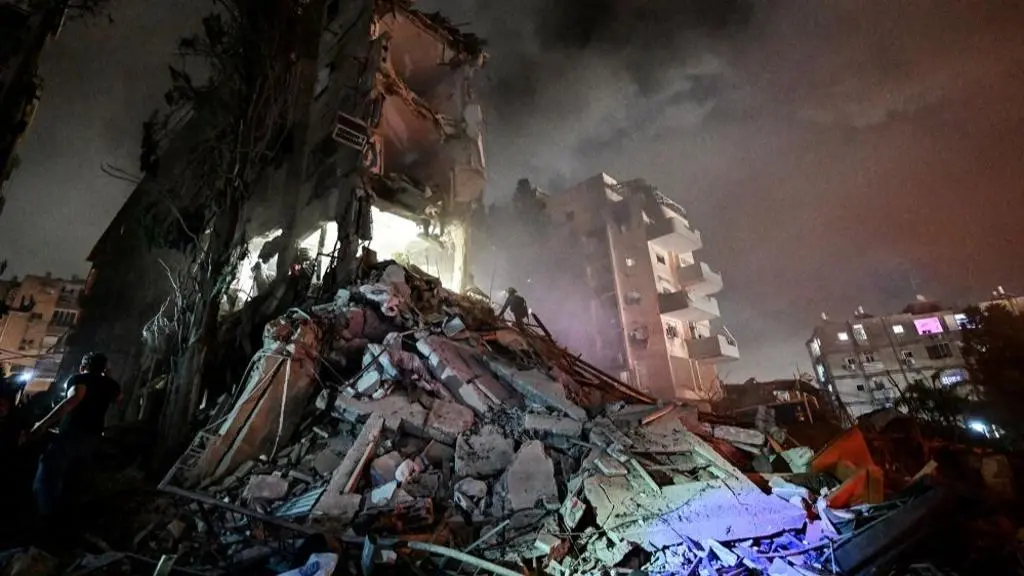
It did not arrive with a single thunderclap or a column of smoke visible from Tel Aviv. The collapse announced itself quietly, in ways that only logisticians and fuel officers would notice at first: a tank running dry on a ridge it was supposed to hold, a field kitchen serving half rations, a young soldier in a forward position wondering why the resupply convoy had not come for the third straight night.
What happened in five days — from the first precision strike on Ashdod port to the moment when 120,000 deployed Israeli soldiers found themselves unable to advance, unable to be resupplied, and unable to safely withdraw — is not a battle that went badly for one side. It is, according to retired US Army Colonel Lawrence Wilkerson, “the operational proof of a strategic transition that has been building for two decades.”
Wilkerson is not a cable news talking head. He served as chief of staff to Secretary of State Colin Powell. He sat in rooms where real decisions were made. He has spent decades studying war plans and intelligence assessments. And he says, with the measured finality of someone who has seen too much to be impressed by drama, that what Iran executed between a Tuesday morning and the following Sunday will be studied in war colleges for a generation.
“Not because it was dramatic,” he says. “Because it was devastatingly, almost surgically complete.”
THE FIVE PHASES OF A FORENSIC COLLAPSE
The operation was not improvised. Wilkerson insists on this point because he has watched Western analysts instinctively attribute non-Western military success to luck or confusion — anything but skill. “That instinct is wrong in this case,” he says. “What Iran executed was the product of years of systematic intelligence collection, target development, and operational planning.”
He breaks it into five phases. The first opened at 2:40 on the morning of day one, when simultaneous precision strikes hit Israel’s three functioning port facilities. Ashdod, which handles approximately 55 percent of IDF equipment and munitions imports by sea, absorbed 34 impacts in 28 minutes. The container cranes serving the military cargo terminal were struck individually. The fuel offloading pier was destroyed in a sequencing pattern designed to produce complete structural collapse. The bonded military warehouse complex received penetrating warheads that detonated stored munitions from within.
Haifa, the northern port that serves as the primary logistics gateway for forces on the Lebanese border, took 41 strikes — focusing on its military fuel terminal and the rail connection to forward logistics bases. Israel’s only non-Mediterranean maritime import pathway, a Red Sea port, was hit by 18 weapons that destroyed its container handling infrastructure and severed its road and rail links to the rest of the country.
By sunrise on day one, 90 percent of Israel’s maritime import capacity was gone. The IDF’s logistics system — which depends on continuous seaborne resupply — had lost its primary replenishment pathway before most people in Tel Aviv were awake.
Phase two targeted the overland network. Twelve major road-bridge crossings on primary logistics routes were struck by precision weapons, achieving structural collapse at the deck level — not damage requiring repair, but destruction requiring complete reconstruction. Rail lines serving the northern corridor were hit at nine separate points, each chosen to maximize the length of track rendered unusable by a single impact.
“This is sophisticated targeting,” Wilkerson says. “Instead of attacking vehicles on the road — a tactic that is operationally costly and produces only temporary disruption — Iran’s planners attacked the infrastructure that the vehicles must use. A destroyed bridge cannot be bypassed by a different route when every bridge on every alternate route has also been destroyed. The IDF’s overland logistics capability was not degraded. It was structurally eliminated.”
Phase three, operating between hours 18 and 36, struck the forward logistics depots — the hardened, dispersed stockpiles maintained in theater to sustain operations without resupply. Their locations are among the most closely held operational secrets in the IDF system. “The fact that Iranian targeting databases included accurate location data for the majority of these facilities is itself a finding whose intelligence implications extend far beyond the immediate military situation,” Wilkerson says.
Eleven of Israel’s 14 identified forward logistics depots were hit. The three that survived did so only because they were located within urban areas where collateral damage constraints limited the strike package — a constraint Iran’s planners had consciously incorporated. The surviving depot inventory represented supply availability of between three and seven days at current consumption rates. The clock was already running.
Phase four addressed the emergency resupply pathway that American and Israeli planners had identified as the primary compensating mechanism: air logistics. The runways at Ben Gurion International Airport were struck at six separate points with penetrating warheads designed to create subsurface detonations — craters resistant to emergency repair. Ramon airport in the south was struck simultaneously. The military airfields at Nevatim and Tel Nof, which have the runway capacity to handle heavy cargo aircraft, had already been rendered nonoperational in preceding strikes on IDF bases.
By the end of phase four, Israel had no functional air cargo terminal capable of receiving the heavy-lift aircraft that emergency military resupply requires. The airbridge that Washington needed did not exist. “And Washington did not create this problem for itself,” Wilkerson says. “It was created for them.”
Phase five was not a discrete action but a sustained campaign of targeted strikes against repair attempts and improvisations. When Israeli engineering units attempted emergency bridge repairs, follow-on strikes destroyed the repair equipment and the partially completed work. When commercial vessels attempted improvised approaches to Ashdod, interdiction assets made clear the approach was not viable.
“The supply chain interdiction was not a one-time event,” Wilkerson says. “It was a sustained operational condition, enforced until the strategic objectives that motivated it were achieved.”
THE ARITHMETIC OF STARVATION
What followed was not drama but cold mathematics. And the mathematics, Wilkerson says, tells a story that no amount of tactical skill can overcome.
An IDF armored brigade in active operations consumes approximately 180,000 liters of diesel fuel per day. Israel has approximately eight armored brigades currently deployed. At that consumption rate, the fuel inventory surviving the strikes — estimated at 40 percent of pre-campaign levels — represented between four and six days of operational consumption. By day five, fuel availability had fallen below the minimum threshold required to sustain offensive operations. Armored vehicles began being immobilized not by enemy action but by empty fuel tanks.
Aviation fuel presented an even more acute constraint. IDF air operations consume approximately 2.4 million liters daily. The surviving inventory was assessed at about eight days of consumption. By day five, sortie rates had been reduced by over 60 percent. The F-35s that represent Israel’s most capable strike platform were being flown at a fraction of their operational tempo, their missions rationed against a supply that was visibly counting down.
Ammunition consumption in sustained combat runs to thousands of tons per day. The surviving forward depot inventory represented about five days of reduced-tempo operations. By day five, multiple artillery units had reported exhaustion of available stocks and cessation of fire missions.
And then there is food. Military ration supply for 120,000 personnel requires approximately 360 tons of food daily. By day four, units in the most forward positions were consuming emergency reserves intended for genuine last-resort situations. By day five, operational assessments across multiple sectors included words no military commander wants to write: “Personnel combat effectiveness degraded by nutritional insufficiency.”
“Let me say that plainly,” Wilkerson says. “Soldiers were hungry. Soldiers who are hungry make different decisions than soldiers who are fed. And an army whose soldiers are making different decisions is not the army that its commanders have planned for.”
Medical logistics added a further layer of acute concern. Field surgical units, trauma treatment facilities, and casualty evacuation systems all depend on continuous resupply of blood products, surgical supplies, and pharmaceuticals. By day three, multiple field medical facilities were operating on reduced capacity. By day five, commanders were factoring casualty treatment capacity into their assessment of which operations could be sustained.
THE IRONY THAT HISTORY WILL NOT FORGET
There is a bitter irony here that Wilkerson raises unprompted, and his voice takes on an edge of something like grim wonder when he speaks of it.
For months before this campaign, Israel had prosecuted a war in Gaza that international bodies — including UN special rapporteurs and the International Court of Justice — characterized as involving the deliberate denial of food, water, fuel, and medicine to a trapped civilian population. Whether one calls it a blockade, a siege, or a starvation policy, the effect was the same: over two million people placed into a condition where their basic survival depended on a trickle of aid that Israel controlled and repeatedly choked off.
And then, having weaponized hunger against Gaza’s civilians, Israel attacked Iran. “For no reason that international law would recognize,” Wilkerson adds. “There was no UN Security Council authorization. There was no act of armed attack by Iran that triggered Article 51 self-defense under the UN Charter. By any honest reading of international law, Israel’s attack on Iran was an unlawful act of aggression.”
What did Israeli planners think would happen? “That Iran would fight by the Marquis of Queensberry rules?” Wilkerson asks. “That Iran would not notice that Israel had just demonstrated — live on global television — how devastating a logistics siege could be? That Iran’s military planners, who have been studying Western and Israeli doctrine for decades, would not ask themselves a very simple question: ‘If starvation worked so effectively against Hamas in Gaza, why wouldn’t it work against the IDF?’”
He leans into the point. “Iran observed what Israel did in Gaza — the systematic targeting of supply lines, the choking of fuel and food — and they reverse-engineered it. They applied the same strategic logic, but with one critical difference: they applied it against the supply lines of a conventional army, not against a besieged civilian population.”
The irony cuts to the bone. Israel’s entire military doctrine has always rested on the assumption that it would fight short, sharp wars because it lacks strategic depth. It cannot survive a prolonged conflict without continuous resupply. So when Israel deliberately weaponized starvation against Gaza, it was not just committing what many legal experts call a war crime. It was also publishing, for anyone with eyes to see, a detailed blueprint of how to cripple a force by cutting its supply of food, fuel, and medicine.
“Iran read that blueprint,” Wilkerson says. “And then they executed it — not against civilians in an open-air prison, but against the IDF’s own forward-deployed soldiers. The same starvation logic that Israel applied to Gaza has now been turned back on Israel’s military.”
He pauses. “There is something almost biblical about it. Not to be theological, but I have been around long enough to recognize when a strategic action produces the exact opposite of its intended result. Israel tried to demonstrate that it could impose unbearable costs on any enemy by cutting off their access to basic necessities. Instead, they demonstrated to Iran exactly how to impose unbearable costs on a modern military force by cutting off its logistics.”
And now, he says, you have IDF soldiers — young men and women who may have served in Gaza, who may have been part of the system that restricted food and water to Palestinian civilians — sitting in forward positions, hungry, watching their fuel gauges hit empty, wondering where their next meal is coming from. “That is not just an operational catastrophe,” Wilkerson says. “That is a moral and psychological reckoning that no army can easily survive.”
WHY THE AMERICAN RESCUE NEVER CAME
The assumption for decades has been that if Israel ever got into deep trouble, American airpower and logistics would save the day. That did not happen. And Wilkerson, a retired Army officer who understands the Pentagon’s capabilities as intimately as anyone, says the failure was not political. It was physical.
He outlines three sequential problems that compounded into an insurmountable operational constraint.
The first was throughput capacity. American C-17 and C-5 heavy-lift aircraft can each carry approximately 70 to 80 tons of cargo per flight. Israel’s military fuel requirement alone — 2.4 million liters of aviation fuel daily — translates to about 2,000 tons of fuel that must be delivered every single day just to maintain reduced sortie rates. At 75 tons per C-17 sortie, that fuel requirement alone demands 27 heavy-lift sorties per day before accounting for ammunition, food, medical supplies, and spare parts. The entire USAF C-17 fleet numbers about 220 aircraft, not all available for any single operation. “The airlift throughput required to compensate for the loss of maritime logistics is physically beyond what available American heavy-lift assets can provide,” Wilkerson says. “That is not a policy failure. That is mathematics.”
The second problem was receiving infrastructure. The strikes that destroyed Ben Gurion’s runway systems eliminated the primary entry point for air-delivered cargo. Ramon airport was similarly nonfunctional. The military airfields with adequate cargo handling capacity were destroyed in earlier base strikes. American military engineers can repair cratered runways — but not in the timeframe relevant to an acute supply crisis, and not while the repair operation itself is subject to follow-on strikes against repair equipment and personnel.
The third problem was the threat environment. American C-17s are large, slow, radar-conspicuous aircraft that require permissive airspace to operate safely. The same Iranian air defense and strike assets that executed the interdiction campaign had demonstrated both the capability and the will to engage targets across the operational theater. Operating heavy-lift aircraft into a non-permissive environment without fighter escort is not viable. Operating fighter escort requires functional air bases. Those air bases had already been destroyed.
“The circular dependency is complete,” Wilkerson says. “The Pentagon was not speechless because it lacked will. It was operationally checkmated — because the Iranian campaign had been specifically designed, not accidentally arranged, to defeat the American resupply response before American resupply planning could transition from assessment to execution.”
He lets that land. “Iran did not just attack Israel. It attacked the American guarantee that underwrites Israel’s security — and it did so with sufficient precision to render that guarantee operationally meaningless without triggering the direct American military retaliation that would have escalated the conflict to an entirely different level.”
THE PSYCHOLOGY OF COLLAPSE
Wilkerson has studied military collapses across decades. He is careful not to reach for drama. But he offers a distinction that he considers essential.
“Armies do not break when they run out of supplies,” he says. “They break when they lose the belief that the supplies will eventually come.”
The physical reality of empty ammunition crates and dry fuel tanks is severe but survivable if the soldiers holding those positions believe that resupply is imminent and that their sacrifice serves a purpose that justifies the cost. When that belief evaporates — when the soldier in the forward position understands that the ports are destroyed, that the roads are impassable, that the airfields are cratered, and that the Americans cannot get through — the organizational coherence that sustains military performance begins to dissolve in ways no amount of tactical training can reverse.
“That is where I suspect the IDF is right now,” he says. “Not every unit. Not every soldier. But enough. And once that erosion starts, it feeds on itself.”
The contrast with Iranian forces is stark. Iran’s operational planners executed from a position of strategic initiative. They chose the timing, selected the targets, controlled the sequencing, and maintained operational coherence without command disruption.
Iranian military culture, Wilkerson notes, has been shaped by something specific: the experience of having survived, adapted, and ultimately prevailed against pressure designed to break it. Fifty years of sanctions, assassinations of senior commanders, sabotage of industrial facilities, and continuous military threats have not produced a demoralized institution. They have produced an institution with a deeply internalized conviction that external pressure — regardless of its severity — is a problem to be solved rather than a condition to be accepted.
“That conviction, expressed operationally as the willingness to execute complex, sustained, high-risk operations against heavily defended targets, is the human foundation of the military capability that has just collapsed the IDF supply chain,” Wilkerson says.
WHAT COMES NEXT
When asked what the Middle East looks like on the other side of this collapse, Wilkerson does not hesitate.
“This is not a battle that went badly for one side. It is the operational proof of a strategic transition that has been building for two decades and that the Western foreign policy establishment consistently refused to acknowledge — because acknowledgment would have required a fundamental revision of the assumptions on which its entire strategic architecture was built.”
Iran has now demonstrated at scale, he says, that it possesses the precision strike capability, the operational doctrine, and the strategic will to conduct sustained interdiction campaigns against critical infrastructure with a completeness and speed that Western planning models had not assessed as operationally achievable.
Who holds the initiative now? “Iran does,” he says. “And the Middle East on the other side of this collapse will not look like the Middle East that existed before it.”
The American guarantee has been shown to be operationally hollow in exactly the scenario it was designed to cover. Israel’s deterrent credibility — built on the promise of swift, overwhelming force — is in tatters because that force cannot move, cannot fly, cannot shoot without fuel and supplies that no longer exist. Every non-state actor aligned with Iran, every hostile capital from Beirut to Sana’a, is doing the same calculation: if Iran can paralyze the IDF in five days, what can we do?
Wilkerson does not offer false comfort. Rebuilding a logistics network from scratch — new ports, new roads, new fuel infrastructure, new ammunition stockpiles — takes years, not weeks. And those reconstruction efforts would themselves be targetable by the same Iranian capabilities that caused the collapse in the first place.
“The logistical architecture that took Israel and the United States 50 years and hundreds of billions of dollars to build has been functionally destroyed in five days,” he says. “You don’t just order a new one from Amazon.”
The soldiers who are hungry today will remember being hungry for the rest of their lives. The commanders who could not move their armored brigades will remember the shame of abandoning equipment because there was no fuel to drive it back. And the enemy that did this to them will not forget either.
“This is not the end of the conflict,” Wilkerson says. “But it is the end of an era. And the next era will be written by Tehran, not Tel Aviv.”