


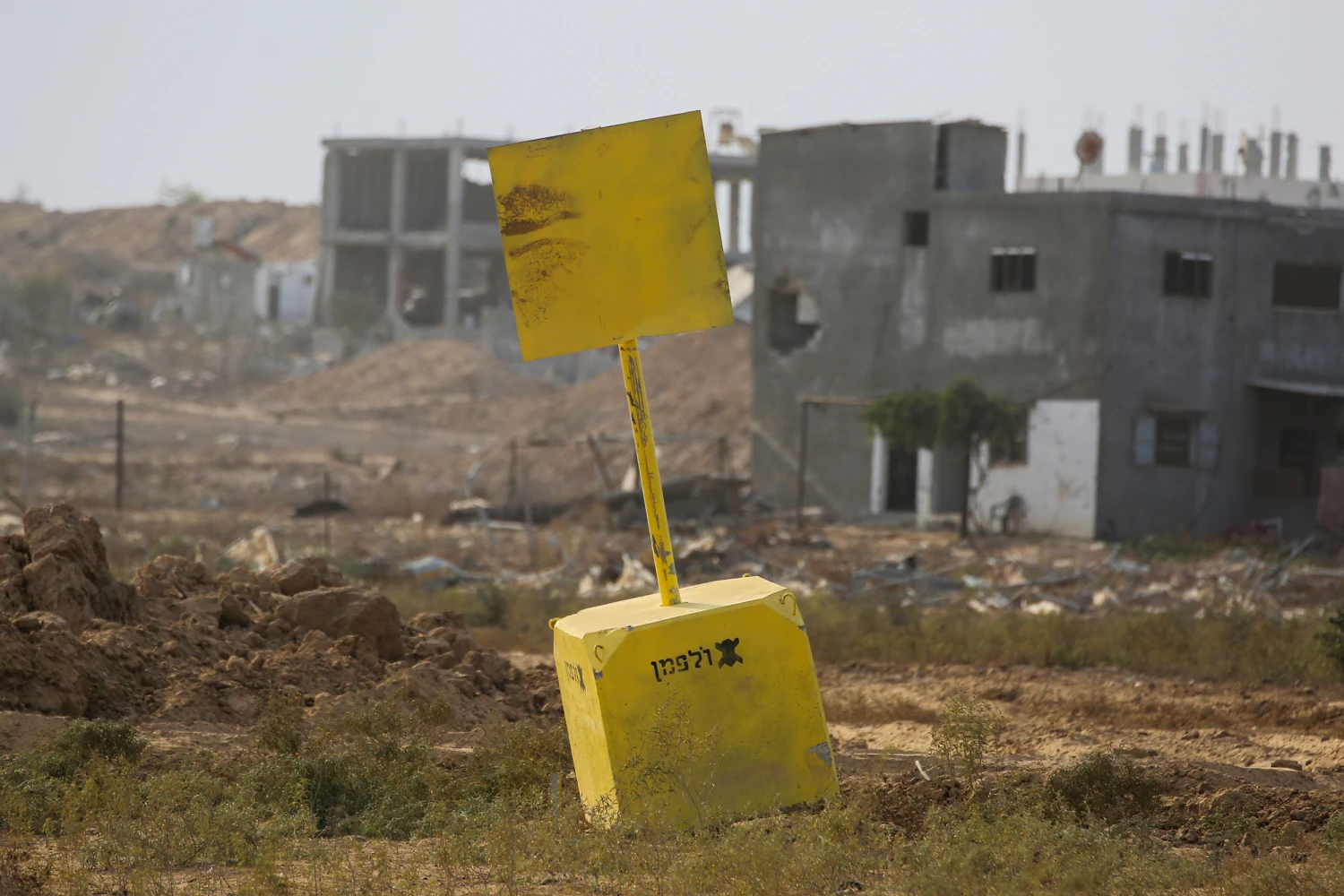
Israel has effectively torn up the US-backed ceasefire framework governing Gaza, announcing plans to expand its military control over the besieged territory to 70 percent while senior officials openly discuss the large-scale removal of Palestinians from the enclave.
The move, unveiled by Israeli Prime Minister Benjamin Netanyahu, has been condemned by critics as a major escalation of what they describe as an ongoing campaign of ethnic cleansing, directly violating the terms of the ceasefire agreement endorsed by the UN Security Council and overseen by the Trump-appointed Board of Peace.
Speaking at a conference in an Israeli settlement in the occupied West Bank, Netanyahu declared that Israeli forces would continue expanding their hold over Gaza.
“We are currently squeezing Hamas. We now control 60% of the territory in the strip. You know, we were at 50, we moved to 60. My directive is to move to … 70%.”
The statement represents one of the clearest indications yet that Israel intends to permanently alter the territorial map of Gaza rather than adhere to the ceasefire framework established in October.
Under that agreement, brokered by the United States and endorsed by a UN Security Council resolution, Israeli forces withdrew to a temporary demarcation line that left Israel controlling approximately 53 percent of Gaza while further negotiations were intended to determine the territory’s future. The arrangement formed a central pillar of a broader peace framework designed to end the war and facilitate reconstruction.
Netanyahu’s declaration appears to signal that Israel no longer considers itself bound by those territorial provisions.
Muhammad Shehada, a visiting fellow at the European Council on Foreign Relations, argued that the implications could not be clearer.
“Netanyahu is now declaring the whole Trump deal, the framework for Gaza, to be null and void. That’s what it means in a nutshell. There’s no other way to spell it out.”
The announcement comes amid growing concern over Israeli plans for Gaza’s civilian population.
Israeli Defence Minister Israel Katz confirmed this week that the government’s long-term objective remains the departure of large numbers of Palestinians from the territory through what he described as “voluntary migration.”
Human rights advocates have rejected that description, arguing that there can be nothing voluntary about displacement carried out under conditions of war, blockade, destruction and military occupation. Critics say the strategy amounts to creating conditions so intolerable that Palestinians are effectively forced to leave their homeland.
The proposed expansion of Israeli-controlled territory would leave Gaza’s 2.2 million residents confined to less than one-third of the strip. Large areas already under Israeli control have been systematically demolished, with entire neighbourhoods reduced to rubble.
Shehada warned that further territorial seizures could have catastrophic consequences for the civilian population.
“The conditions there are already appalling. It is the single most overcrowded place on the face of the planet,” he said.
“Every square metre has another displaced family, another makeshift tent, or some sort of improvised shelter on it. So it would be a death sentence for a lot of people who physically have no place to go.”
Throughout the ceasefire period, Israeli forces have continued military operations near and beyond the designated separation line. According to reports cited by humanitarian agencies, tanks have steadily advanced deeper into Palestinian-controlled areas while drones and airstrikes have continued to target locations throughout Gaza.
The situation has been compounded by the emergence of Israeli-backed armed militias operating along the ceasefire line.
These groups have reportedly been used to pressure Palestinian communities into abandoning their homes and moving further west. Witnesses describe armed men arriving in neighbourhoods and informing residents they must leave within hours.
Wael Nayef Abu al-Ajeen, a 26-year-old resident east of Deir al-Balah, said his family was among those forced to flee.
“It was at around 1pm when armed men affiliated with the militias entered our area. They went to the homes of the Abu al-Ajeen family there and informed them that they had until 10pm to evacuate all the houses in the area,” he said.
“They instructed them to take whatever furniture and belongings they could carry and to empty the houses as much as possible. They also told them not to return until they were contacted and informed that it was permitted.”
“As a result, everyone panicked, and people gradually began leaving and moving their furniture and whatever belongings they could carry until the area was almost completely emptied.”
Researchers monitoring developments in Gaza say such incidents are becoming increasingly common.
Nasser Khdour of the Armed Conflict Location and Event Data Project said militias were increasingly involved in pushing civilians away from contested areas.
“We have seen that the militias are not only attacking Hamas, but also they are contributing to pushing the residents who are living close to their line, further to the west,” Khdour said.
“We have seen killing, arresting and kidnapping of civilians living in these areas, and recently, there’s an increase also in the militias’ patrolling activities.”
The developments have raised serious questions about the future of the ceasefire mechanism itself.
The Board of Peace, established by the UN Security Council to monitor implementation of the agreement, appointed former UN diplomat Nickolay Mladenov as High Representative in Gaza. However, critics argue that international oversight has failed to prevent repeated violations of the ceasefire’s territorial provisions.
Meanwhile, some observers believe negotiations between Israel and Hamas have effectively collapsed.
Gershon Baskin, an Israeli analyst involved in previous Israeli-Palestinian negotiations, said he believes the diplomatic track is nearing its end.
“My understanding is that the negotiations with Hamas are over,” Baskin said.
He warned that a new reality may be emerging in which reconstruction takes place only in Israeli-controlled zones while Palestinians undergo extensive screening before being allowed to enter.
“At the end of the day, the only people remaining in the yellow zone, according to the Americans, are Hamas and other armed groups. And then Israel will be free to deal with them as they want. This is the thinking, this is the planning, and this is what I see happening in the coming weeks and months.”
For Palestinians and international observers alike, Netanyahu’s declaration appears to mark a decisive turning point. What was presented as a temporary military arrangement under a US-backed peace plan is now being replaced by an openly stated objective to seize most of Gaza, further concentrate its civilian population into shrinking enclaves, and pursue policies that critics argue amount to the permanent displacement of Palestinians from their homeland.
Whether the international community responds to what many legal experts and human rights organisations view as a direct challenge to the ceasefire agreement may determine not only the future of Gaza, but also the credibility of the international system that was supposed to protect it.