
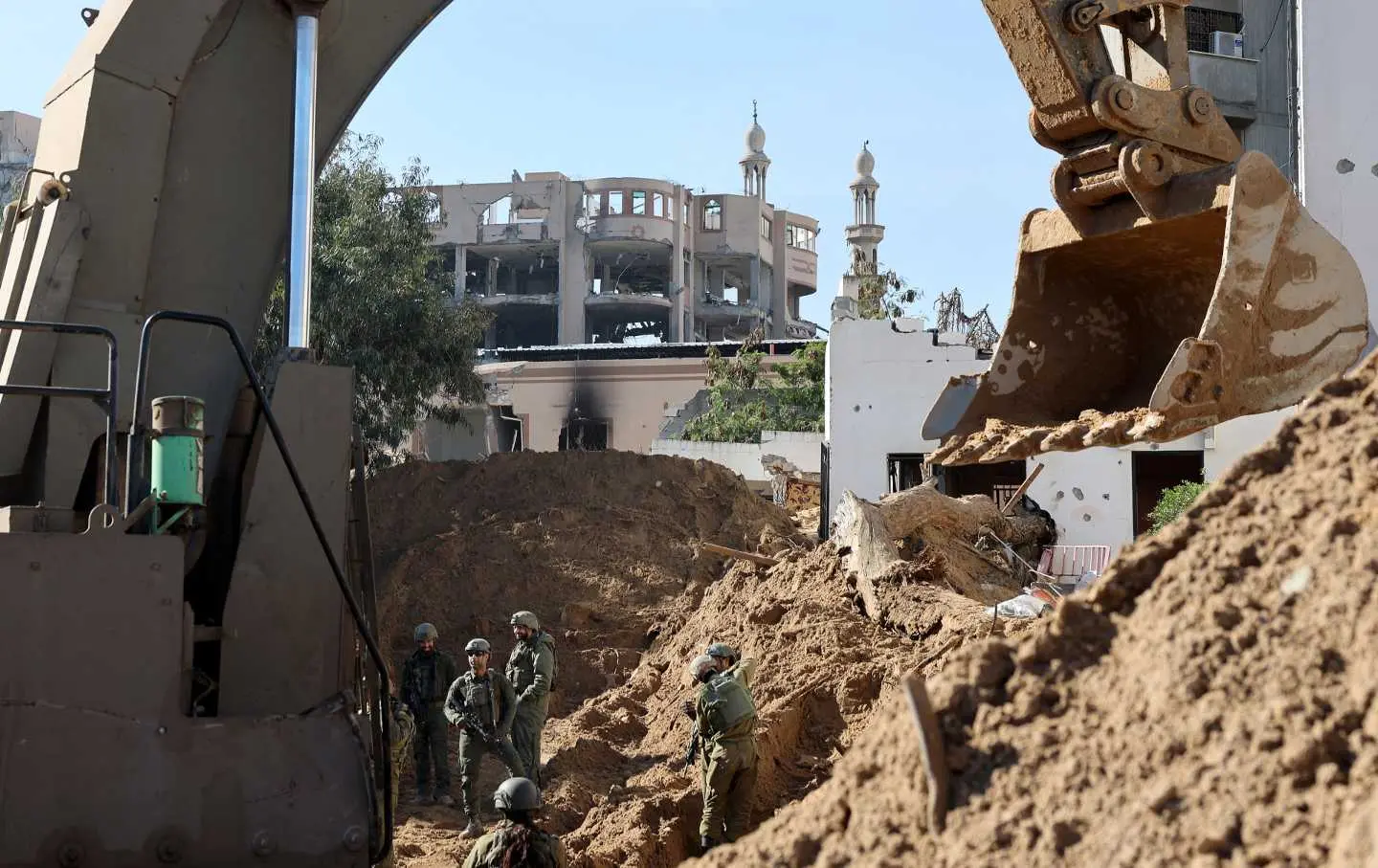

The so-called ceasefire in Gaza has not ended the genocide. The bombing runs may be quieter, but the bulldozers roar on. Israel is tearing up homes, orchards, schools and hospitals, then flattening the rubble to erase the memory that Palestinian life was ever there.
Beneath the surface of Gaza lie the bodies of perhaps fourteen thousand people. They are folded into an estimated 61 million tonnes of rubble – roughly twenty times the debris generated by every other conflict on earth since 2008 – and with each passing week the chance that they will ever be named grows slimmer. In an exclusive published on 14 June, the Guardian reported that the International Committee of the Red Cross now believes many of these dead may never be identified. Search teams are working with shovels, pickaxes and their bare hands. Israel has not answered repeated requests to allow excavators in, and it bars the DNA-testing materials that would let the living attach a name to the dead.
Cristina Cattaneo, a forensic pathologist at the University of Milan, put the problem plainly to the paper: “Time, ultimately, is the greatest enemy of identification.” Ahmed Dahir, Gaza’s forensic medicine director, described retrieving a body of someone reported missing for only two weeks that had already “turned into bones bearing signs of animal scavenging” – a state that should take six months to a year to reach. And then there is the detail that turns a humanitarian tragedy into something colder. Witnesses told the Guardian that Israeli military bulldozers operating in the zones it controls may be moving the bodies that are still buried, scattering them further. Wael Radwan, who lost his father and brother to artillery fire in December 2024, went back for their remains after the siege lifted. The site, he said, “had been bulldozed and I could not find their bodies.”
To understand why a bulldozer should be moving the dead eight months into a ceasefire, you have to stop thinking of the earth as a backdrop and start thinking of it as a weapon. That is the argument of Eyal Weizman, founder of Forensic Architecture and author of Ungrounding: The Architecture of Genocide, a book that runs a hundred years deep into the soil of Palestine. His research agency, based at Goldsmiths, University of London, builds painstaking three-dimensional reconstructions of atrocities out of the scattered traces of an event – a survivor’s situated testimony, a fragment of shaky phone footage, every documented piece of shrapnel – assembled into a single coherent model. Their work has been used as evidence in court, and forms part of South Africa’s submission against Israel at the International Court of Justice.
When I asked Weizman what was happening on the ground right now, in the supposed lull, he did not reach for the language of aftermath.
“The survivors of the genocide, the Palestinians in Gaza – just under two million people – are living on the sand dunes in the west part of Gaza, in about forty per cent of the area of the strip,” he said. “That area is continuously being shrunk.” All the conditions of life, he went on, have been dismantled. There is no agriculture. People shelter in and among the ruins of their own multi-storey homes, or in tens of thousands of tents pitched between them. Israel denies entry to the chemicals needed for pest control. “When we speak to people inside, to friends who are still inside, we hear about an incredible rat epidemic. Rats are everywhere in the tents.” A wet winter flooded the camps; overflowing sewage runs through them. “People are dying of hypothermia and infection, and out of things that in any other normal circumstances contemporary cities, with all their infrastructure, are able to contain.”
What endures, he said, is held together not by institutions but by people. “Schools, primary schools, universities exist more as notions than as institutions. They exist in the relation between people. People are the infrastructure of resistance.” Family relations, social relations, political relations are sustaining a kind of life despite everything.
This is the crucial point, and Weizman returned to it repeatedly: the ceasefire has not frozen anything. “This is not a static situation. It’s a situation in which time and denial amplify each other, and in which the space itself becomes a mechanism designed to eject the population out of Gaza. There is nowhere to go.” Israel, he argues, counts every calorie, every megawatt of electricity, every litre of petrol, in order “to calibrate life, and to use the conditions of life as means of control, as attempted expulsion.”
Conditions of life, calculated
That phrase – conditions of life – is not incidental. It is lifted almost verbatim from the 1948 Genocide Convention, which lists among the acts of genocide the deliberate infliction on a group of “conditions of life calculated to bring about its physical destruction in whole or in part.” The word that matters, Weizman insists, is calculated.
To understand it, he goes back to Raphael Lemkin, the Polish-Jewish lawyer who coined the term genocide in his 1944 book Axis Rule in Occupied Europe. Lemkin, Weizman notes, built his concept partly out of the settler-colonial destruction of the Americas – a process he understood as slower than outright massacre, one “in which the environment itself is conceived as a mechanism of destruction.” Indigenous peoples dislocated from the forests and waters they lived by, pushed into barren land, their numbers falling away through malnutrition and epidemic. “A slow-motion genocide that happens over decades, if not centuries.”
Lemkin fused that colonial logic with the modern instrument of the camp. And here Weizman, the architect, makes his sharpest move. The same modernist conviction that produced the humane city – Le Corbusier’s dictum that a house is “a machine for living in”, the Frankfurt kitchen engineered to feed a family, the floor plan designed to enhance a family’s life – was inverted by architects working inside the Nazi administration to engineer death. “The minute you conceive architecture and space, or the environment, in relation to life,” he said, “you can either amplify life or you can extinguish life with it.” The ghetto was the slower form, destruction through enforced starvation. The camp accelerated it, “all the way to the extermination camp.”
So when Weizman speaks of conditions of life, he wants the reader to picture a control, a dial. “It’s like a tap. You can bring in more calories or less. You can take the heat up or down, and in that way try to control the population through the environmental conditions imposed on them.”
There is, he is careful to say, no single template. “It’s probably right to think about genocide as having different speeds and intensities.” Auschwitz-Birkenau is Germany’s most famous genocide, but not its only one. Earlier, in German South-West Africa, the Herero and Nama were driven by imperial forces after the siege of the Waterberg in 1904 into the Kalahari, “where the majority are destroyed.” The Armenians were marched into the Syrian desert. In each case, he argues, the desert itself does the killing – the relationship between space and life turned, in his words, into a totisraum, a death-space. Even the Nazi project in the east, General Plan Ost, he reads as a settler-colonial scheme on European soil: Slavic populations displaced or enslaved so that Germans could expand into the bread basket of Ukraine, across what Timothy Snyder called the bloodlands.
A line drawn by a plough
If genocide can be an environmental project, then its master instrument is not the gun but the bulldozer. This is why the construction firm Caterpillar sits so prominently on the boycott, divestment and sanctions list, and why Weizman opens his book not with a bomb but with a Caterpillar D6.
“If colonialism is an earth-shaping project,” he told me, “the main instrument for it is the bulldozer, because the bulldozer conducts not only the demolition of homes but terraforming. It takes soil from one place to another. It shapes soil into mountains.”
The Gaza Strip, in his telling, was itself drawn by a blade. In 1949 and 1950, in the wake of the Nakba, bulldozers dragged a ripper plough deep into the ground to score a line in the sand around the territory – “turning the earth into a drawing.” Into that strip, just over one per cent of historic Palestine, some 200,000 refugees were crowded: farmers from the northern coastal plain and Bedouin from the Wadi Gaza basin, people whose agricultural knowledge gives the lie to Israel’s founding ecological myth that it made an empty desert bloom.
The land they were driven from was anything but empty. The Wadi Gaza basin, Weizman explains, was so productive in the nineteenth century that its barley was exported to Britain to brew the beer that lubricated the industrial revolution; the trade collapsed only with American prohibition in the 1920s. His guide through that vanished world is the great Palestinian researcher Salman Abu Sitta, born in the village of al-Ma’in. “He’s my alter ego in this book,” Weizman said – a man who speaks “with the moral force of a refugee and the eye of an engineer.” Together with the farmer Mohammed Abu Jayab, the Forensic Architecture team rebuilt al-Ma’in’s system of wells and cultivation as a digital model, using the act of modelling itself as a mnemonic device, a way of recalling a society from the soil up.
Al-Ma’in was ploughed over by a Caterpillar D6 on the eve of Israel’s declaration of independence. “What’s under the teeth of these ploughs,” Weizman said, “are the roots, the cemeteries, the homes, the traces of Palestinian life. There is nothing better than a plough to turn the earth around.” The ploughs were used as erasers.
What those agricultural ploughs did in 1948, he argues, the monstrous D9 and D10 bulldozers are doing in Gaza now. “They’re not simply destroying the home. They’re taking it from under its foundation and turning it over.” This is the central concept of his book – ungrounding – the terraforming, earth-shaping force of settler-colonial war. “The invasion is a force of desertification. They are desertifying Gaza from the fences inwards.” The destruction is not the random scarring of a battlefield but a tide flowing from the perimeter towards the centre, “shaving all orchards, flipping all fields, destroying all homes.”
Demolition as construction
The most disorienting thing Weizman has documented is that the destruction is also a building project. Walking me through Forensic Architecture’s satellite analysis of Rafah and the Morag corridor, he described a process that is simultaneously demolition and construction. The bulldozers shave the agricultural land, flip it, and pile it into berms – great walls of soil and pulverised rubble.
“Everything that Palestinian life was” goes into those mounds: crushed concrete, plaster, dead plants, soil. And, sometimes, people. Where homes were bombed with families inside who could never be retrieved, the rubble is a mass grave – “and that rubble, which contains human remains, is being reused.” He called it “a really devilish kind of soil.” The Israeli military, he says, does not merely invade and then build; it builds as it invades, protecting its corridors and outposts with embankments raised from the wreckage of Palestinian homes, even constructing its detention and interrogation facilities out of earth. Such was the scale of it, he said, that “Israel is running out of bulldozers and has had to privatise the acts of destruction.”
It was in this context that he described the case that, more than any other, fuses his argument together: the massacre of the paramedics in March 2025, at the moment Israel broke the previous ceasefire.
“One of the first mass atrocities it commits is ambushing a convoy of ambulances and other first-responder vehicles,” he said. “Massacring those workers – unarmed, clearly marked medics – shooting them, as we discovered through the investigation, at point-blank range. Executing them, literally standing above them and shooting them. And then burying the bodies and the vehicles under earth.”
“So the earth here becomes a mode of negation. Changing the earth breaks the memory, the relation between society and space.” What he calls in the book the earth-storm – waves of soil crashing over bodies and vehicles – “becomes a means of genocide denial.”
The cruelty of ungrounding, he argues, reaches into the survivors themselves. Forensic Architecture documents a form of torture in which young men are seized, blindfolded, taken away while their neighbourhood is reshaped, then returned, their eyes uncovered, and told: you are standing where your home once stood. “Many Palestinians we spoke to describe that as the most unsettling experience,” Weizman said. “It ungrounds them.” He likened it to the dysmorphia of First World War soldiers who could not recognise their own disfigured faces in a mirror – the self, and the society, losing the anchor it was built around.
Because the ground of the March massacre no longer exists – a flat site turned hilly and bermed – the only place left to reconstruct it was a computer. Working with the Palestinian Red Crescent and two survivors over the internet, the team rebuilt the scene as a shared digital model. Then they traced what became of that very soil. It was reshaped, Weizman says, into one of the notorious “feeding stations” where starving Palestinians were funnelled and shot at through the summer of 2025. And after the October 2025 ceasefire, that same earth was piled into the largest berm in Gaza – the structure now known as the yellow line, dividing the territory Israel permanently occupies from the shrinking coastal strip into which Palestinians are penned.
“The earth is not simply the backdrop against which things happen,” Weizman said. “The earth and its shaping is the mechanism by which this genocide is perpetrated.” His book, he told me, covers a hundred years, from the 1920s to the 2020s – “a story of the way in which Zionist settler colonisation has reshaped the soil of Palestine, turned the environment into a weapon and into a death-space for Palestinians.”
The reporting bears him out. CNN has documented the yellow line creeping towards the Mediterranean, cramming Gaza’s population into an ever-narrower margin. The UN’s humanitarian office recorded more than 900 killed since the October ceasefire began. And the Guardian’s account of bulldozers shifting the unrecovered dead is, in Weizman’s framework, not a separate scandal but the same process: bury a people, then bury the evidence that you have buried them.
The architecture of resistance
Against this stands a counter-project, and it runs in the opposite direction – downwards. The tunnels of Gaza, Weizman argues, are routinely flattened into propaganda, treated as if they were merely military and as if Hamas faced some simple trade-off between digging them and feeding people. He reads them instead as a continuation of the oldest Palestinian knowledge of the land: “a way of turning a desert space into a lived environment.”
Beneath Gaza lies a second, hidden landscape – ridges of clay, subterranean rivers, the aquifers he calls subterranean lakes, the line of salt water. It was mapped not by satellite, which cannot see below the surface, but by touch: by the landless Bedouin farmers expelled from Wadi Gaza, whose ancestors dug the Tarabin wells a hundred metres down to reach the water table. When Israel’s blockade severed Gaza from the world, that same knowledge reopened the ancient Via Maris trade route underground – “like the bypass of a heart attack,” Weizman said – carrying medicine, food and fuel beneath the siege.
He is scrupulous about what he will not claim. The book includes no original mapping of the tunnel network and no interviews with those who dug the military tunnels. “The subsoil is there because it is not seen,” he said, and he wanted to respect that darkness rather than become another camera descending into it. What he will say is that Israel vastly exaggerates the network in order to justify total destruction. He quotes an Israeli official’s claim that every school has a tunnel beneath it – “and the idea of every is what generates that genocidal, indistinguishable carpet of destruction.” Every school becomes a target; every mosque becomes a target. He also documents an Israeli experiment to pump Mediterranean seawater into the tunnels, a tactic that ends up poisoning the aquifers on which all life on the surface depends.
In the end, this is what ungrounding meets: incalculability. “The mode of resistance to a life that is calculated,” Weizman said, “is to make yourself incalculable. The mode of resistance to visibility is to make yourself invisible.”
I asked him, finally, for the one technique he would want people to learn – the show, after all, asks them to do their own research. He did not name a software package. He named memory.
“When erasure is trying to destroy the spirit, the life of a people, the relation between architecture and memory is the one I would refer to,” he said. “Build models of places that have disappeared. Walk through them. You will see how much a place can exist through the memory of the community that inhabited it.” That, he believes, is also the ground on which return is built – the architecture of liberation that might one day follow reparations and the right of Palestinians to come home and rebuild the landscape that was destroyed.
The bulldozers, for now, are still running. They are flattening the orchards, flipping the fields, piling the homes into walls, and somewhere in that devilish soil are the fourteen thousand who may never be named. Israel is betting that if it moves enough earth, the evidence will become as unrecoverable as the dead. Weizman’s wager – the wager of a forensic architect – is that it will not.