


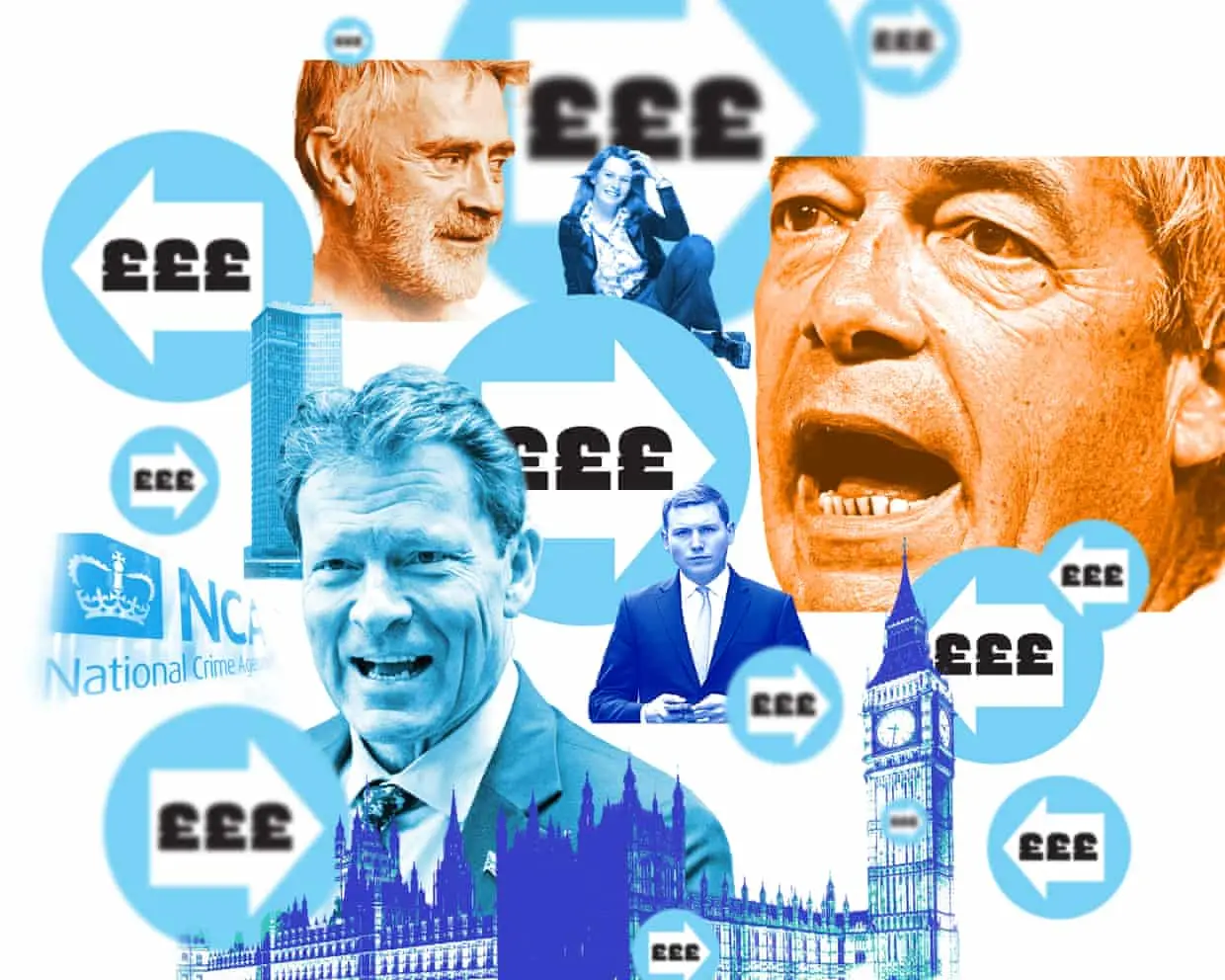
For years, Nigel Farage has positioned himself as the ultimate political outsider, a tribune of the common man railing against a detached Westminster elite. His party, Reform UK, has built its brand on this very premise—a populist insurgency threatening to dismantle the status quo. However, a comprehensive investigation by Lowkey of Double Down News, now buttressed by explosive revelations from The Guardian, reveals a startling contradiction: the financial arteries of this so-called anti-establishment movement are not only fed by offshore tax-haven wealth but are now the subject of multiple criminal intelligence reports filed with the National Crime Agency (NCA).
The scandal surrounding Reform UK is not a story of one man bending parliamentary rules; it is the visible tip of a melting iceberg. While public attention has been fixated on Farage’s personal controversies—including his shock resignation from Parliament to trigger a by-election—a vast network of opaque offshore finance, former Conservative donors, convicted fraudsters, and media titans is quietly propping up the party. The ultimate deception, it seems, is that Reform UK offers a solution to a problem it is itself a part of.
The NCA Scrutiny: A System of Alarms
The Guardian has revealed that bankers have filed at least four Suspicious Activity Reports (SARs) with the National Crime Agency concerning transactions involving Reform UK’s most senior figures. SARs are a formal mechanism by which banks, solicitors, and other regulated parties can alert the NCA to “knowledge or suspicion of money laundering”. They are not proof of wrongdoing but rather “a vital source of intelligence” that provides law enforcement with visibility into otherwise opaque private-sector transactions.
The scale of these concerns is staggering. Analysis of Electoral Commission records reveals that Reform UK received nearly £15 million from 18 donors with offshore links in 2025 alone—almost 80 per cent of the £18.6 million donated to the party that year. Five Reform donors responsible for £12.55 million—67 per cent of the party’s annual donations—provided addresses overseas to Companies House. According to analysis by The Observer, approximately 66 per cent of all money donated to Reform during this parliament has come from donors who are resident overseas or with offshore interests overseas.
openDemocracy found that ex-Tory donors account for around a quarter of the £4.8 million Reform has received in large donations since 2023. The Conservative Party is fighting desperately to stem the loss of high-value donors to Reform. One Conservative source described the past few months as “one of the worst periods ever for the party in terms of bringing in donations”. There is particular worry about donors who have already started contributing to Reform, “as it can be almost impossible to bring back donors who switch to another party”. A Mayfair fundraiser attended by former Conservative donors raised more than £1 million in a single evening.
The Four Suspicious Activity Reports
According to finance industry sources speaking to The Guardian, at least four SARs have been filed relating to concerns about transactions involving senior figures in Reform:
1. The £1 Million Donation to Britain Means Business
One SAR relates to a £1 million donation made to Britain Means Business, a fundraising organisation for Reform UK, before the last general election. Half of the £1 million was then transferred by Richard Tice, the party’s deputy leader and a director of the company, to Reform UK. The £1 million seemingly came from the aristocrat and Reform UK donor Fiona Cottrell. In this instance, The Guardian understands bank staff were not satisfied that the funds had ultimately come from her. The NCA has sought help from a foreign partner agency to trace the original source of the funds.
2 & 3. The George Cottrell Loan to Richard Tice
Two other SARs relate to a loan from George Cottrell to Richard Tice. The loan was made shortly before Tice finalised a property purchase and made a party donation, and was not repaid until after those two transactions were completed, according to sources. George Cottrell is the son of Fiona Cottrell, a convicted fraudster, former deputy treasurer of Ukip and close associate of Farage.
4. The £5 Million Harborne Gift to Farage
A fourth SAR relates to the £5 million gift from the Thailand-based businessman Christopher Harborne to Farage, which was first revealed by The Guardian in April. The Guardian understands bankers raised this SAR with the NCA on 16 May 2024. In correspondence with The Guardian, Harborne’s lawyers have claimed Farage received the money on 5 April 2024.
Labour chair Anna Turley called the development “an astonishing and deeply serious allegation”, adding: “The Reform leader must finally come clean. He should publicly commit to cooperating with the National Crime Agency”.
The Metropolitan Police Investigation
The scandal has now escalated beyond the NCA to the Metropolitan Police. Scotland Yard has been investigating £500,000 in donations made to Reform UK by Fiona Cottrell for more than a year. The force opened an inquiry in February 2025 following a referral by the Electoral Commission “relating to donations made to a political party ahead of the 2024 UK general election”.
Detectives from the Met’s Special Enquiry Team are investigating alleged offences under Section 61 of the Political Parties, Elections and Referendums Act 2000. Two people have so far been interviewed under caution, and early investigative advice has been sought from the Crown Prosecution Service, but no arrests have been made.
The two £250,000 payments made by Fiona Cottrell to Reform before the last general election appear to be separate to the £1 million that she gave to Britain Means Business.
The Kingpins: A Rogue’s Gallery
Christopher Harborne (aka Chakrit Sukunit)
Reform UK’s top donor, Christopher Harborne, is a British-Thai businessman and crypto investor in his early 60s, educated at Westminster School and Cambridge. He has donated a total of £19.2 million to Farage and his party—including a record-breaking £9 million single donation in August 2025, the largest political donation from a living person in British history.
Harborne has citizenship in Thailand, where he is based and chairs the investment company Sherriff Global Group. He controls up to 12 per cent of the shares in the company behind the Tether stablecoin. Between 2001 and 2022, he donated close to £2 million to the Conservatives, including £1 million to a private company associated with Boris Johnson.
Harborne’s business empire includes AML Global, a Hong Kong-registered entity that secures multi-million dollar contracts to fuel US armed forces, and a significant stake in QinetiQ, the former Ministry of Defence offshoot that derives over 80 per cent of its arms-related revenue from UK taxpayers. QinetiQ received nearly £1 billion from the UK government in 2023/24 alone. Its CEO, Steve Wadey, took home £2.93 million that year—nearly 16 times the salary of the Chief of the General Staff of the British Army.
The circular flow of money is deeply troubling: British taxpayers underwrite QinetiQ’s success through Ministry of Defence contracts, while its biggest shareholder bankrolls a political party that—if it gets into power—would seek to reshape defence policy with even more spending. Unearthed reports also reveal that a company owned by Harborne is contracted to supply the US military with jet fuel from refineries that take oil from Russia and Iran.
Farage is currently under investigation by Parliament’s standards commissioner for not declaring the £5 million gift from Harborne. He has argued that the money was for personal security and “wasn’t political in any sense at all” because it was received when he was “not involved in politics”. Farage has consistently denied any wrongdoing, stating: “I have no reason to doubt the ultimate source of the money”.
Richard Tice
The deputy leader of Reform UK, Richard Tice, has found himself at the centre of the NCA scrutiny. Tice, via lawyers, threatened to injunct The Guardian to stop it publishing details of the SARs. Without responding to any of the questions put to him, Tice then appears to have shared the allegations contained in The Guardian’s requests for comment with The Telegraph, which wrote them up without credit or contact ahead of publication.
This was an extreme example of a Fleet Street “spoiler”—a term used to describe a party handing a problematic story to a more sympathetic outlet. It was not the first time Reform had used the tactic. In April, after The Guardian had approached Farage over a story revealing the undisclosed £5 million gift, The Telegraph ran an interview with Farage in which he claimed his home had been firebombed.
Tice has dismissed the allegations as a “politically motivated smear campaign”. He has insisted that Fiona Cottrell is a “permissible donor” who comes from a “very successful aristocratic family”. Pressed on whether any due diligence was done on where Ms Cottrell had got the money from, Tice said: “I’ve known the Cottrell family, my family have known the Cottrell family and the broader Hesker family, for more than 50 years”.
On Wednesday morning, Tice accused the NCA of leaking his financial information to The Guardian. “You know, I’ve got the National Crime Agency who have leaked to the Guardian copies of my company bank statements, individual bank transfers, private conversations between my bankers and myself,” he told Times Radio.
Nick Candy
The treasurer of Reform UK, Nick Candy is a billionaire property developer who donated £990,000 to the party in 2025. His property empire includes companies based in Luxembourg and Guernsey. A former Conservative donor, Candy shifted to Reform UK in 2024 and now serves as their treasurer, even promising the party a massive sum to support their bid for office.
Candy’s involvement, however, takes a darker turn. Newly released Epstein files reveal that Candy met Jeffrey Epstein associate Sarah Kellen in 2004 and was in touch with Ghislaine Maxwell, currently serving a 20-year prison sentence in the US for child sex trafficking. Emails show Candy asking for Maxwell’s email address and phone number. Candy also appears to have exchanged emails with Epstein over a potential property sale.
When pressed on the matter, a Reform UK candidate stormed off a TV interview. Farage has insisted he has “no concerns” over the revelations, stating that Candy “never met Epstein, has never spoken to Epstein, never engaged with Epstein”. Yet the emerging Epstein links reveal how Reform’s relationships with unaccountable transnational ruling elites allow them to “play politics on easy mode”.
Sir Paul Marshall
The co-owner of GB News—Farage’s primary media employer, which has paid him approximately £585,000 since he became an MP—Marshall is a multi-millionaire hedge fund manager who has poured tens of millions into the channel since it launched in 2021. He donated £500,000 to the central Conservative Party during the 2019 general election and financially backed Michael Gove’s 2016 Conservative leadership bid.
Marshall’s financial empire, Marshall Wace LLP, is ultimately controlled by MW Group LLP, a corporate entity permanently based in the Cayman Islands tax haven. GB News itself is operated by a parent company—All Perspectives Limited—owned by Marshall and Legatum Ventures, which operates out of the Dubai International Financial Center, a tax-free zone in the UAE. Together, Marshall and Legatum have lost well over £100 million on the channel.
Jeremy Hosking
Jeremy Hosking has pumped millions into Reform UK. His company, Hosking and Co., is based in Ireland, and his other business interests are based in the tax havens of Jersey, the Channel Islands, and the Cayman Islands. He also previously funded the Conservative Party. Hosking also bankrolls The Critic, a right-wing magazine.
Bassim Haidar
Businessman Bassim Haidar, who relocated from Britain to Dubai following Labour’s changes to non-dom tax rules, donated £355,000 to Reform after leaving the UK. He previously said his “biggest concern was tax on global assets and inheritance tax on global assets”. Haidar paid £25,000 to join a top table with Farage at a Reform fundraiser.
The ‘Like a Son’ Problem
Even Farage’s inner circle is compromised. His close aide, George Cottrell—whom Farage has described as “like a son”—is a convicted criminal at the centre of the latest controversy surrounding the Reform UK leader.
Cottrell, now 32, was arrested at Chicago’s O’Hare airport in 2016 while traveling with Farage after the Republican convention. He had been caught agreeing to launder money for undercover FBI agents posing as drug traffickers. Cottrell faced 20 years in jail for 21 counts related to money laundering, fraud, blackmail and extortion, but brokered a plea deal, admitted guilt to a charge of wire fraud and served just eight months in prison.
Upon his release, Cottrell moved to Montenegro, where he has reportedly become a “key player” in Tether.bet, an online bookmaker and casino—a cryptocurrency partly owned by Christopher Harborne. He has built connections to both the crypto sector and local gambling operations.
The Sunday Times reports that Cottrell supplied support—including security, drivers, staff and accommodation—to Farage in the year before he became an MP. Under parliamentary rules, new members must declare financial interests and “registrable benefits” received in the 12 months before their election. Farage reportedly failed to declare these benefits. Cottrell recruited and paid three staff to work on Farage’s social media before the general election and has continued to allow Farage to use a five-storey Georgian townhouse he rented near Buckingham Palace.
Tony Mack, who was initially Reform UK’s candidate for Clacton in 2024, told The Guardian that Cottrell was introduced as Farage’s chief of staff during meetings. “I remember thinking that it was an odd term to use for someone who was unelected at that point,” said Mack. Mack recalled Cottrell as being “polite and cordial” and echoed long-repeated claims that the younger man sometimes referred to Farage, who is no relation, as “daddy”.
A Reform spokesperson said: “George Cottrell has no official role in Reform UK, nor has he previously held any official role. He has never been a party employee, he is an unpaid volunteer like many thousands of party members”. The party did not address other claims put to it by The Guardian, including that Cottrell arranged for the Land Rovers that took Farage and the four other Reform MPs to Westminster.
His mother, Fiona Cottrell, a UK resident, has donated over £750,000 to Reform UK—a sum that Scotland Yard is investigating after a referral from the Electoral Commission. Because George Cottrell permanently resides in Montenegro, a low-tax jurisdiction outside UK regulatory reach, he cannot legally donate to UK parties, which is widely cited as the reason his mother makes the direct financial contributions instead.
A Revolving Door of Power
The investigation further exposes a “revolving door” of political operatives. The party’s treasury and leadership are stacked with figures who served in senior roles under Conservative governments.
Key defectors include Suela Braverman, a former cabinet minister now shadowing the education brief for Reform; Nadhim Zahawi, the former Chancellor of the Exchequer; and Robert Jenrick, another ex-minister, now designated as Farage’s pick for Chancellor. These are not radical outsiders; they are career politicians from the very establishment Farage claims to despise. As one analyst puts it, Reform UK’s goal appears to be “replacing conservative politicians with conservative politicians.”
The Media Nexus and the Spoiler Tactic
The role of media is paramount. Farage’s substantial income from GB News (estimated at £80,000 per month) ties him directly to this same web. The news channel is owned by Sir Paul Marshall and Legatum Ventures, which operates out of a tax-free zone in Dubai. The symbiotic relationship between Farage, the media moguls, and the offshore donors creates a self-reinforcing echo chamber of influence that bypasses traditional democratic scrutiny.
Reform has developed an aggressive media strategy to control the narrative. When The Guardian approached the party with questions about the NCA SARs, Reform supplied The Telegraph with a different story—one in which Tice accused the NCA of leaking financial information. This “spoiler” tactic was designed to pre-empt damaging revelations by framing them as part of an establishment conspiracy.
Farage has also confronted both The Times, for publishing a picture of one of his houses, and Sky News, for knocking on the door of a property where his daughter lives. Sky News later took the unusual step of issuing a statement, saying it had approached the property without a camera operator and “the adult occupant chose not to engage”. Ben Taylor, the Sunday Times editor, accused Farage of “appalling” tactics and said the Reform leader had to decide whether he wanted to “go down the Trumpian route”.
Farage’s Resignation: A Strategic Escape?
In a dramatic move, Farage recently resigned his parliamentary seat—a decision that effectively pauses the parliamentary investigation, as the watchdog loses jurisdiction over non-members. All major British political parties announced they would boycott the resulting Clacton by-election, refusing to grant Farage the high-profile platform he craves.
Farage had been given a deadline of 1pm on Tuesday to respond to The Guardian before it reported that bankers had contacted the NCA about the £5 million gift. He gave a video address at 2pm announcing he would force a by-election in Clacton.
The prime minister, Keir Starmer, and the Conservative leader, Kemi Badenoch, have led cross-party calls for Farage to “come clean” over his financial affairs. Chancellor Rachel Reeves said: “If he wants to spend the summer arguing with a bin, I won’t stop him”.
The Broader Context: A System Under Strain
The influence of big money in UK politics “can no longer be ignored,” said Dale Vince, whose Babelfish analysis uncovered the scale of offshore donations to Reform. “Wealthy people, big business, and foreign-linked money are finding new ways into the system—from companies to cryptocurrency. The danger is clear: politicians make decisions based on who funds them, not who votes for them.”
Economic crime, tax evasion and corruption are draining £290 billion from the UK economy each year—the same as the entire education and health budgets combined. The tax avoidance of the super-rich represents a significantly larger financial threat to the UK economy than benefit fraud, costing roughly five times more in lost revenue every single year.
Sources who spoke to The Guardian about the transactions said they believed it was in the public interest for the electorate to be able to judge whether a major political party had been fully transparent about its finances. They also raised concerns that any potential NCA investigation could take years to conclude because of the agency’s strapped resources, potentially meaning it would not be sufficiently thorough or complete in time for the next general election, due by July 2029.
Several of the senior figures flagged in the reports are known in the industry as politically exposed persons, according to sources. This means they are treated by banks as being at higher risk for bribery, corruption and other illicit activity. As a result, they are subject to what is termed enhanced due diligence, meaning their transactions and activities are given closer scrutiny by the finance industry.
The evidence paints a clear picture: Nigel Farage and Reform UK are not a grassroots revolt against a corrupt system. They are a re-branding of the establishment’s most powerful elements, now facing unprecedented criminal intelligence scrutiny. The anti-establishment rhetoric is a convenient facade for a project funded by the very offshore wealth and political veterans who built and sustained the Westminster system.
As long as the narrative remains focused on Farage as an individual rule-breaker, the deeper, more systemic rot is allowed to fester. The ultimate lesson is clear: Reform UK is not the solution. It is the problem itself.
Key Figures at a Glance
- Nigel Farage: Leader of Reform UK, former MP for Clacton. Paid substantially by GB News. Subject of an NCA SAR over a £5 million gift. Under parliamentary and police investigation over donations. Resigned his seat to trigger a by-election.
- Christopher Harborne: Top donor (£19.2 million total); Thailand-based; funds come via offshore companies; major shareholder in QinetiQ, which derives 80%+ of revenue from UK taxpayer-funded MoD contracts. His £5 million gift to Farage was reported to the NCA.
- Richard Tice: Deputy Leader of Reform UK. Director of Britain Means Business. Subject of multiple NCA SARs relating to loans and donations. Accused the NCA of leaking his financial information.
- Nick Candy: Party Treasurer and top donor (£990,000); met Jeffrey Epstein associate; in touch with Ghislaine Maxwell; property empire based in Luxembourg and Guernsey tax havens.
- Sir Paul Marshall: Co-owner of GB News; hedge fund wealth ultimately controlled via Cayman Islands entity; donated £500,000 to Conservatives.
- George Cottrell: Farage’s aide; convicted US money launderer living in Montenegro; introduced as Farage’s chief of staff; subject of NCA SARs relating to loans to Tice.
- Fiona Cottrell: George Cottrell’s mother; donated over £750,000 to Reform UK; subject of a Metropolitan Police investigation into £500,000 in donations; her £1 million donation to Britain Means Business was flagged in an NCA SAR.
- Jeremy Hosking: Multi-millionaire donor; businesses based in Ireland, Jersey, Channel Islands, and Cayman Islands; previously funded Tories.
- Bassim Haidar: Donor (£355,000); relocated to Dubai after non-dom tax changes; ex-Tory donor.