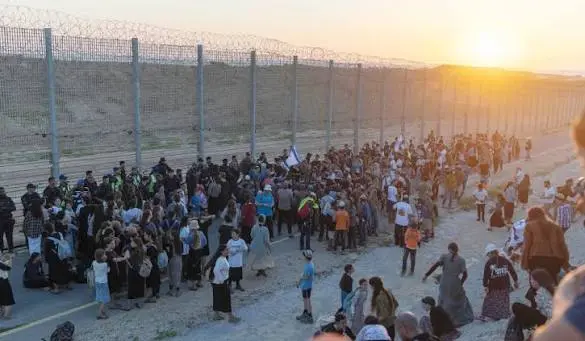

Thousands of Israeli nationalists advanced from the lands of the destroyed Palestinian village of Hiribya towards Gaza as senior government ministers called for Palestinian emigration and Jewish settlement across the devastated enclave.
Thousands of Israeli settlers and far-right activists marched towards the Gaza Strip on Sunday, accompanied by senior government ministers and members of the Knesset demanding the establishment of Jewish settlements inside the occupied Palestinian territory.
The demonstration on 19 July began on the lands of Hiribya (هربيا), a Palestinian village whose inhabitants were expelled or forced to flee during the Nakba in November 1948.
The Israeli settlement now called Zikim was established on Hiribya’s land in 1949. The nearby settlement of Yad Mordechai, founded before the Nakba, subsequently expanded onto the depopulated village’s territory. The beach from which many participants advanced towards Gaza lies on the same Palestinian land and should properly be identified as the beach of Hiribya, Shati Hiribya (شاطئ هربيا).
The march was organised by the Nachala settlement movement under the slogans “After 21 years, we’re returning home” and “Settling Gaza now”. Participants carried Israeli flags, sang religious nationalist songs and advanced towards the northern Gaza boundary despite a military order declaring the surrounding area a closed zone.
National Security Minister Itamar Ben-Gvir, Finance Minister Bezalel Smotrich, Economy Minister Nir Barkat and Communications Minister Shlomo Karhi were among the senior political figures who joined the march. Nachala claimed that 28 ministers and coalition lawmakers participated, demonstrating how a proposal once associated with the furthest margins of Israeli politics has moved into the heart of government.
Ben-Gvir published footage from the demonstration carrying an unequivocal message: “Gaza is ours.”
Speaking close to the border, he went considerably further.
“There will be Jewish settlement in all of Gaza,” Ben-Gvir declared before calling on Israel to “encourage voluntary immigration” among Palestinians.
“We return home. Gaza is ours,” he said, according to The Times of Israel.
For Gaza’s approximately two million Palestinians, most of whom have already endured repeated displacement, widespread destruction and more than two years of Israeli military attacks, the demand for “voluntary immigration” is widely understood as a euphemism for forced population transfer.
Marchers push through military roadblocks
The Israeli military designated much of the Gaza border region a closed military zone from 8am on Sunday until 8am on Monday.
The order covered the northern border area near Hiribya and extended southwards towards Karam Abu Salem (كرم أبو سالم), which Israel calls Kerem Shalom.
A military source said the closure was imposed because organisers or participants intended to enter Gaza illegally. Previous Nachala demonstrations have resulted in activists crossing the boundary or entering Israeli-controlled territory inside the enclave.
Hundreds of police officers and soldiers were reportedly deployed, but the restrictions were only loosely enforced. Eyewitnesses said marchers passed the first military roadblock within minutes before circumventing at least three further checkpoints.
Younger participants climbed across sand dunes, moved through scrubland and crossed barbed wire to avoid roads blocked by military vehicles. Families carrying Israeli flags subsequently followed along paved routes after security forces appeared to retreat.
Despite the open defiance of the military order, there were no reported arrests.
Soldiers and police prevented most of the demonstrators from crossing the final boundary into Gaza, but many reached a hill overlooking the territory where an Israeli flag was erected. Some participants reportedly came within a short distance of the fence.
The apparent tolerance shown towards the marchers contrasted sharply with the live ammunition, arrests and military violence routinely employed against Palestinians approaching fences, checkpoints or areas declared closed by the Israeli military.
Nachala later claimed that it had reached an agreement with the army allowing the event to end at an observation point overlooking Gaza. Israeli officers at the scene reportedly denied that permission had been granted for the procession to advance through the restricted area.
Attendance estimates differed considerably. Haaretz reportedly estimated approximately 2,000 participants, while Israeli police placed the number at around 5,000. Nachala claimed between 10,000 and 15,000 people attended.
Reuters photographs confirmed Ben-Gvir’s participation and showed substantial groups of pro-settlement activists marching near the beach on Hiribya’s land.
Whatever the final attendance, the political significance of the demonstration lay less in its size than in the seniority of the politicians leading it.
The unresolved October 7 killings at Hiribya Beach
The location chosen for the march carries another, more troubling significance.
The beach on the lands of Hiribya was the scene of chaotic fighting and unresolved allegations of Israeli friendly fire during the opening hours of 7 October 2023.
A GreatReporter investigation published in October 2025 examined testimony and survivor material suggesting that Israeli civilians may have been caught in indiscriminate Israeli fire after Palestinian naval commandos came ashore near the Bahad 4 military training base.
Journalist Max Blumenthal alleged that an Israeli naval vessel swept the shoreline with gunfire while Palestinian fighters and Israeli civilians were present, potentially killing an unknown number of Israelis.
He further claimed that some of the most important telephone recordings made at the beach were erased and that the Israeli military has refused to release its complete, unedited footage from the incident.
Official Israeli investigations have presented a different account, attributing the deaths of 17 civilians at the beach to Palestinian fighters. Those investigations acknowledged serious command, intelligence and security failures but made no reference to Israeli naval fire striking civilians.
The conflicting accounts have never been resolved through a fully independent investigation.
The allegations are particularly important because of evidence that Israeli commanders issued orders associated with the Hannibal Directive at several locations on 7 October. The controversial doctrine was designed to prevent Israelis, particularly soldiers, from being taken captive, even when the force employed could endanger the captives themselves.
Palestinian naval commandos appear to have targeted the Bahad 4 training base adjacent to the beach. The base is one of the Israeli military’s principal training centres for new conscripts, many of whom are subsequently deployed to enforce the Gaza blockade, operate checkpoints or participate in military operations inside occupied Palestinian territory.
According to Blumenthal’s account, an Israeli naval craft opened fire across the beach as the Palestinian landing took place, creating a lethal environment in which the military may not have distinguished between fighters and Israeli civilians.
If established, the incident would represent one of the most serious friendly-fire episodes of 7 October and would raise further questions about Israel’s official accounting of the day’s casualties.
The lack of released footage, forensic evidence and an independent inquiry means that the number of Israelis killed by their own military at Hiribya Beach remains unknown.
The location therefore represents more than a convenient assembly point for the settlement movement. It is also a place where Israel’s official account of 7 October remains contested and where its own rules of engagement may have contributed to Israeli deaths.
That history gives the march’s security narrative a bitter irony.
Ben-Gvir, Smotrich and Nachala presented the colonisation of Gaza as the necessary answer to 7 October, yet they assembled at the site of one of the Israeli military’s least examined operational failures of that day.
Instead of demanding an independent investigation into who fired on the civilians at Hiribya Beach, senior ministers used the location to promote Palestinian displacement and permanent Israeli control over Gaza.
Ministers at the head of the settlement movement
Alongside Ben-Gvir and Smotrich, ministers reported at the demonstration or publicly committed to attending included Nir Barkat, Shlomo Karhi, Amichai Chikli, May Golan, Idit Silman and Amichai Eliyahu.
Among the parliamentarians promoted as participants were Simcha Rothman, Zvi Sukkot, Limor Son Har-Melech, Avichay Buaron, Amit Halevi, Ariel Kallner, Eli Dallal, Moshe Passal, Ohad Tal, Michal Woldiger and Moshe Solomon.
Prime Minister Benjamin Netanyahu’s Likud party was listed among more than a dozen political parties and organisations sponsoring the event, despite Netanyahu’s previous insistence that Israeli civilians would not resettle Gaza.
That contradiction has become increasingly difficult to maintain.
Several Likud ministers participated in the demonstration, while members of Netanyahu’s coalition occupy leading positions in the movement demanding permanent Israeli control over the Palestinian enclave.
Communications Minister Karhi told the demonstrators that Israel should establish roots throughout territory he described as having been granted to the Jewish people’s ancestors, “including the Gaza region”.
Smotrich warned supporters that the entire resettlement project could be lost if Israel’s parliamentary opposition came to power.
His remarks placed the demonstration squarely within the campaign for Israel’s 27 October general election, the first national vote since the attacks of 7 October 2023.
The Knesset formally dissolved on 17 July. Opinion surveys suggest Netanyahu and his coalition face a serious electoral challenge, increasing pressure on far-right parties to secure irreversible territorial and political gains before voters go to the polls.
Nachala has been explicit about the electoral timetable. Promotional material described the approaching election as an opportunity to establish settlements in Gaza before a future government could block the project.
The organisation declared that Israel had reached a “historic moment” and argued that settlement construction before the election would constitute a decisive step towards victory.
Plans for three settlements already prepared
The march was not merely an expression of ideological ambition. Senior Israeli officials say administrative and military preparations for settlements in northern Gaza have already been completed.
In June, Smotrich announced that the Israeli Defence Ministry’s Settlement Administration, which he oversees, had prepared plans for three communities corresponding to the former Israeli settlements known as Nisanit, Dugit and Elei Sinai.
Those settlements were constructed on occupied land in northern Gaza and evacuated during Israel’s 2005 withdrawal.
All that remained, Smotrich said, was Netanyahu’s approval.
“Where there is no settlement, there is no security,” he argued, presenting the transfer of Israeli civilians into Gaza as a security measure.
The Times of Israel reported that the proposed communities would be established in territory currently controlled by Israeli forces.
Defence Minister Israel Katz has separately proposed establishing three “Nahal” outposts in northern Gaza. Although formally described as military communities, Nahal outposts have historically been used to create the infrastructure and permanent presence required for subsequent civilian settlements.
The system was first developed during the 1950s and later used extensively in the occupied West Bank. Soldiers would establish a military agricultural community, after which the location could be transferred to civilian settlers.
Katz’s proposal therefore offers the Israeli government a mechanism for beginning the settlement process without immediately declaring that civilian colonisation has commenced.
An Israeli military briefing shortly before the march said Israeli forces controlled approximately 65 per cent of Gaza. Ben-Gvir claimed during the demonstration that the figure had reached 70 per cent.
The October 2025 ceasefire arrangement reportedly allowed Israel to remain temporarily in 53 per cent of the territory. The subsequent expansion has pushed the surviving Palestinian population into an increasingly restricted area.
Plans for the three Gaza outposts were announced alongside more than $400 million in additional funding for settlement construction in the occupied West Bank.
The Guardian reported that Smotrich’s ministry was preparing dozens of new West Bank settlements while Katz advanced the Gaza proposal.
The timing has strengthened concerns that the government is attempting to establish irreversible facts on Palestinian land before October’s election.
Reversing the 2005 withdrawal
Israel removed approximately 8,000 settlers from 21 settlements in Gaza during Ariel Sharon’s unilateral “disengagement” in August 2005. Four settlements in the northern West Bank were also evacuated.
The Gaza settlements were dismantled and Israeli ground forces withdrew from permanent positions inside the territory. Israel nevertheless retained control over Gaza’s airspace, territorial waters, population registry and most border access.
A comprehensive blockade was imposed after Hamas took administrative control of Gaza in 2007.
For Israel’s religious nationalist movement, the 2005 withdrawal became both a political grievance and a mobilising myth. Settler leaders argued that leaving Gaza encouraged Palestinian armed resistance and ultimately contributed to the 7 October attacks.
Likud lawmaker Avichay Buaron repeated this argument before Sunday’s march, claiming that the attacks occurred because Israel was no longer physically settled inside Gaza.
Critics reject that narrative, pointing out that Israel continued to exercise control over Gaza externally, maintained the blockade and conducted repeated military operations against the enclave.
They also argue that placing Israeli civilians inside occupied territory would not provide security. It would instead require a permanent military presence, restricted roads, checkpoints and exclusion zones to protect the settlers.
The consequences of that system are already visible in the occupied West Bank, where military infrastructure and severe restrictions on Palestinian movement sustain an expanding Israeli settler population.
From fringe ideology to government programme
Nachala is led by Daniella Weiss, one of the most prominent figures in Israel’s settlement movement.
The organisation has spent decades establishing and supporting settlements and unauthorised outposts in the occupied West Bank. Since October 2023, it has become one of the principal groups campaigning for the permanent colonisation of Gaza.
Weiss has openly advocated removing Palestinians from Gaza and has suggested that the territory’s Palestinian population would eventually “disappear”.
Nachala and Weiss have been subjected to international sanctions over accusations of serious abuses against Palestinians and their role in illegal settlement expansion. Yet the organisation now enjoys direct access to cabinet ministers, parliamentarians and sections of the Israeli state responsible for administering occupied territory.
Sunday’s demonstration illustrated that transformation.
Ministers were no longer simply sending messages of support to an activist organisation. They were physically accompanying its members through a closed military zone while advocating policies that would require the permanent seizure of Palestinian land.
Many participants wore stickers declaring “Gaza is ours forever”. Some carried banners calling for the construction of a Third Temple in Jerusalem, connecting the campaign to colonise Gaza with a broader religious nationalist vision of territorial sovereignty.
The presence of families and children was central to the event’s political presentation. Nachala sought to portray the march as a communal movement of ordinary Israelis “returning home”, rather than an attempt to establish settlements in land inhabited by another people.
Absent from this narrative were Gaza’s Palestinian residents and the question of what would happen to them if Israeli settlements were constructed on their land.
Settlement requires Palestinian displacement
Gaza is one of the most densely populated territories in the world. Before the latest war, approximately 2.3 million Palestinians lived within an area of around 365 square kilometres.
More than 73,000 Palestinians have been reported killed since October 2023, according to Gaza’s health authorities. Much of the housing stock, infrastructure, agricultural land and public services has been destroyed or severely damaged.
Even after the October 2025 ceasefire, Israeli attacks and gunfire have continued.
The United Nations Office for the Coordination of Humanitarian Affairs reported that at least 1,123 Palestinians were killed and 3,616 injured between the announcement of the ceasefire and 15 July 2026.
OCHA’s 16 July humanitarian report described conditions as dire, with continuing military activity, displacement, movement restrictions and disruption to essential services. The expansion of areas under Israeli control was further reducing the space available to Palestinian civilians.
Against that background, proposals to build Israeli settlements cannot be separated from the fate of Gaza’s surviving population.
Ben-Gvir and Smotrich describe their proposal as “voluntary migration”, but Palestinians living under military occupation, extensive destruction and restrictions on food, shelter and movement could not be considered to be making a genuinely free decision to leave.
Settlement construction would also require land, roads, military protection and restricted security zones. Each new Israeli community could remove additional territory from Palestinian use while forcing more people into Gaza’s shrinking populated areas.
The term “resettlement” consequently obscures the reality of what is being proposed. Israeli settlers would be transferred into Gaza while at least part of the indigenous Palestinian population would have to be removed.
A clear conflict with international law
The transfer of an occupying power’s civilian population into occupied territory is prohibited under the Fourth Geneva Convention.
The Rome Statute of the International Criminal Court classifies the direct or indirect transfer of an occupying power’s civilian population into territory it occupies as a war crime.
Israel has traditionally argued that Gaza ceased to be occupied after the 2005 withdrawal. The United Nations, international humanitarian organisations and the International Court of Justice have rejected that position, citing Israel’s continuing effective control over crucial aspects of life in the territory.
In its July 2024 advisory opinion, the ICJ concluded that Israel’s continued presence throughout the occupied Palestinian territory, including Gaza, was unlawful.
The court said Israel must cease new settlement activity and evacuate settlers from occupied Palestinian territory. The ICJ’s official summary also affirmed that Gaza, the West Bank and East Jerusalem constitute a single Palestinian territorial unit.
Establishing settlements in Gaza would therefore represent not only a reversal of the 2005 withdrawal but a direct challenge to international law and the Palestinian right to self-determination.
A march towards permanent control
The demonstrators did not establish a civilian settlement inside Gaza on Sunday. Nevertheless, the march achieved something politically significant.
It brought together an internationally sanctioned settler organisation, thousands of activists, cabinet ministers and members of Netanyahu’s own party behind a common demand for permanent Israeli settlement inside Gaza.
The military checkpoints prevented an immediate mass incursion but did little to contain the political programme on display.
Senior officials openly promised settlements, encouraged Palestinian emigration and treated Israel’s extensive military control over Gaza as an opportunity that must be secured before the election.
Netanyahu continues to maintain that Gaza will not be resettled. Yet his party’s sponsorship of the march, the participation of Likud ministers and the preparation of settlement plans inside government departments all point in another direction.
The choice of Hiribya as the starting point carried its own grim symbolism.
The Palestinian village was emptied during the Nakba and Israeli communities subsequently occupied its land. More than seven decades later, Israeli ministers gathered there to demand that the same process of dispossession be extended across Gaza.
The march also began beside a beach where serious questions remain about the Israeli military’s use of indiscriminate fire against its own population on 7 October.
Rather than investigate those failures, government ministers invoked the attacks to justify further territorial expansion.
Sunday’s procession was therefore more than a symbolic march towards a closed border. It was a public declaration that influential members of Israel’s political establishment regard Gaza’s destruction, depopulation and military occupation as the foundation for permanent colonisation.
For Palestinians watching from the other side of the fence, the Israeli declaration of “returning home” carried a starkly different meaning: the threatened loss of their own.