


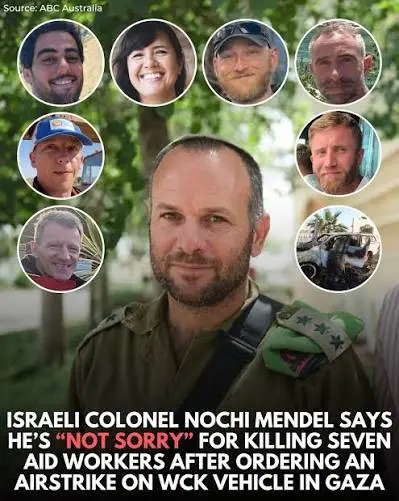
Nochi Mendel’s defence of the World Central Kitchen strikes exposes the lethal consequences of guilt by association in Gaza. After more than two years of withheld evidence and British promises, the case now demands scrutiny of individual criminal responsibility, state policy and the international courts established to confront both.
The Israeli settler colonel who ordered three successive strikes that killed seven World Central Kitchen aid workers in Gaza has dismissed their deaths as an “idiotic side event” and said he would act in exactly the same way again. His remarks come after Israel’s military prosecution decided that the attack, despite acknowledged failures and repeated breaches of military procedures, did not warrant a criminal investigation.
“I think it’s an idiotic side event,” reserve Colonel Nochi Mendel told the Guardian in an investigation published on 5 September 2026. “It really isn’t a serious event.” The seven people killed included three British military veterans, John Chapman, James Henderson and James Kirby, who had entered Gaza to protect a humanitarian food mission. Their families have spent more than two years demanding an independent examination of the circumstances in which their vehicles were tracked and destroyed. [1]
Mendel’s account supplies a disturbing new explanation for those deaths. He said the aid workers had become targets because they briefly associated with armed men whom his unit assumed to be Hamas. He continued to defend that assessment even though the international team was unarmed and the assumption identifying the guards as Hamas was, according to the Guardian’s investigation, groundless.
“They were not innocent because they were connected to Hamas,” he said. Asked whether the presence of armed men made the entire convoy a target, his answer was: “Certainly.” His description of the supposedly incriminating behaviour encompassed being “near them, talking, playing, hanging out and so on”. [1]
These statements do more than reveal contempt for the dead. They raise a question that Israel’s final public account has left unanswered: whether the seven workers were killed through an exceptional breakdown in an otherwise protective system, or through the application of a permissive targeting practice that made civilians vulnerable to attack because of proximity and association.
The danger of a trigger happy approach had already been exposed more than three months before the WCK killings, when Israeli troops shot dead three Israeli captives in Gaza City’s Shejaiya neighbourhood on 15 December 2023. Alon Shamriz, Yotam Haim and Samer Talalka approached the soldiers unarmed and shirtless, with one carrying a makeshift white flag. Two were killed immediately. Haim escaped into a building and called out in Hebrew, shouting for help and saying that soldiers were shooting at him. A commander ordered a ceasefire and called him forward, but two soldiers shot him dead as he emerged. The military inquiry said those soldiers had not heard the order amid the noise of a nearby tank. [32,33]
Herzi Halevi acknowledged on 16 December that the shooting breached the rules of engagement and that firing on someone raising a white flag and seeking to surrender was forbidden. The subsequent inquiry described the deaths as preventable but attributed the soldiers’ actions to mistaken threat assessments under combat pressure; reporting on its findings said they were not expected to face trial or dismissal. Even a white flag and Hebrew pleas for rescue had failed to secure the men’s survival. That episode had already exposed lethal failures to recognise protected people and enforce firing controls, making the question of what commanders learned before the WCK attack unavoidable. [32,33]
The implications extend beyond the officers who authorised the missiles. Mendel says his unit had previously been praised for similar operations against alleged attempts to take control of aid. Other Israeli officers interviewed by the Guardian described a process in which a person escaping one targeted vehicle could carry the same designation into another, exposing everyone inside the next car to death. An officer involved in the initial inquiry, however, said the second and third strikes violated orders. That disagreement concerns the operation of the system itself. [1]
The legal consequences could be grave. Deliberately attacking protected civilians or humanitarian personnel can constitute a war crime. Evidence that such attacks formed part of a broader policy could engage responsibility further up the military and political hierarchy. Evidence that relief operations were attacked to help impose destructive living conditions on Palestinians could also be relevant to the wider genocide allegations before the International Court of Justice. Each proposition requires evidence and its own legal test; none is resolved by an Israeli prosecutor announcing that the case is closed.
For Britain, the new disclosures reopen an uncomfortable record assembled across this publication’s reporting since November 2024. Ministers demanded answers from Israel, withheld potentially relevant British surveillance footage, received the Israeli military’s senior commander under special mission protection, continued significant elements of the defence relationship and reduced specialist capacity for monitoring possible violations. The final Israeli decision has exposed how little those repeated assurances delivered for the bereaved. [2–7]
The people dismissed as a side event
John Chapman was 57, a former Royal Marine from Poole and an experienced security professional. His family remembered a father, husband, son and brother who had gone to help people and died in what they described as an inhumane act. James “Jim” Henderson, 33, from Falmouth, had also served in the Royal Marines. His work after leaving the military included helping civilians in Ukraine learn first aid and respond to traumatic injuries.
James Kirby, 47, from Bristol, had served with the British Army in Bosnia and Afghanistan. Known as “Kirbs”, he was remembered for his courage, compassion and willingness to help people in danger. His cousin Louise described the devastating loss suffered by his mother, Jacqui, whose only son had been killed. In April 2026, his family sought Bristol City Council’s support for a permanent memorial, proposing a mural and marble surround to preserve his name and service. [2,6]
The three Britons were employed by Solace Global to provide close protection for the World Central Kitchen team. Their military backgrounds did not make them combatants in Gaza. They were supporting a civilian humanitarian mission, and the Australian review recorded that WCK and Solace took particular care to keep their international personnel unarmed because of the danger of misidentification.
Their four colleagues were Lalzawmi “Zomi” Frankcom, 43, the Australian humanitarian worker and team leader; Damian Soból, 35, from Poland; Jacob Flickinger, 33, a dual Canadian and American citizen who had served in the Canadian Armed Forces; and Saifeddin Issam Ayad Abutaha, 25, the Palestinian driver and translator. The international attention generated by the six foreign deaths must not erase the Palestinian member of the team or imply that nationality determines the value of a humanitarian worker’s life. [2,8]
The seven were helping to unload more than 100 tonnes of food delivered through a maritime aid operation. WCK, founded by chef José Andrés, was trying to reach civilians whose access to food had been devastated by Israel’s military campaign and restrictions on humanitarian access. The work was urgent in a way that the familiar phrase “aid delivery” can conceal: it was an attempt to prevent people from starving.
Two weeks before the attack, the Integrated Food Security Phase Classification had warned that famine was imminent in northern Gaza. Its March 2024 analysis placed the whole population of approximately 2.23 million people in acute food insecurity and projected catastrophic conditions for around 1.1 million. Four days before the strikes, the ICJ ordered Israel to enable urgently needed humanitarian assistance. The convoy’s destruction occurred against that specific warning and legal background. [2,9]
A humanitarian mission known in advance
Air Chief Marshal Mark Binskin, the former Australian defence chief appointed to examine Israel’s response, reconstructed the operation in a report released on 2 August 2024. The detail matters because it rules out the suggestion that the aid organisation simply appeared without warning in a military operating area.
WCK’s coordination requests identified the organisation, its task, the particular vehicles, the personnel and their photographs, and the planned route. Israel’s Coordination and Liaison Administration processed the information and distributed it within Southern Command. A senior Israeli commander and a representative of COGAT, the defence ministry body handling civilian coordination, were present at the jetty during the day. There was a dedicated military operations order, although important movement details were circulated separately in an annex. [2,8]
The operation involved approximately eight locally contracted trucks, WCK escort vehicles and a separate vehicle belonging to locally contracted security personnel. Loading at the jetty was completed around 8.30pm, but the convoy waited for Israeli permission to move. Communications difficulties and possibly another military operation delayed departure, pushing an operation that WCK preferred to conduct in daylight further into darkness.
Two Israeli drones subsequently monitored the convoy. At WCK’s Welcome Centre, local security personnel boarded the aid trucks. One man fired a weapon into the air. The brigade fire support commander interpreted what the drone operator saw as evidence of a Hamas seizure of the convoy.
That interpretation became the basis for further suspicion. Yet the food trucks continued to their intended warehouse in Deir al-Balah and unloaded the aid. The convoy’s successful arrival at its designated destination was a fact demanding consideration against the theory that it had been hijacked. It was not a substitute for investigating the armed men’s identities, but neither was it evidence that the humanitarian team had become a military target.
The presence of armed local security requires careful treatment. It was separate from the unarmed international protection team. Binskin could not determine conclusively how the arrangement arose and could not rule out links between the locally contracted security provider and Hamas. The September 2026 Guardian investigation goes further in describing the initial Hamas identification as groundless. Neither account establishes that the seven people killed were participating in hostilities. [1,8]
Outside the warehouse, roughly 15 to 20 people moved around the escort vehicles over about ten minutes, including men identified from the drone feed as carrying weapons. Higher command refused an initial request to strike vehicles near the warehouse because they were too close to the humanitarian convoy. Binskin also recorded a divisional direction that no further strikes should take place around humanitarian convoys that night.
The groups then separated. The vehicle containing the local security personnel and previously identified gunmen drove north. The three WCK vehicles travelled west towards the coast before turning south towards their accommodation in Rafah. One drone followed the armed men north for about three minutes and observed them enter another warehouse. The military abandoned that potential engagement because they were entering the building. The vehicles carrying the unarmed aid workers remained targets. [2,8]
Three strikes, with survivors pursued between them
The attacks took place between approximately 11.09pm and 11.13pm on 1 April 2024, according to Binskin’s reconstruction. The first missile struck an armoured WCK vehicle. Two survivors reached the second vehicle, which was hit around two minutes later. Two survivors from that attack moved to the third vehicle. The final missile left nobody alive.
Binskin assessed that one worker was probably killed in the first vehicle, two in the second and four in the last. He separated the initial mistaken identification and failure to follow the intent of senior command direction from the subsequent attacks, which he attributed to violations of Israeli rules of engagement and standard operating procedures. The required fresh identification had not been carried out before the second and third strikes. [2,8]
Describing the sequence as a “triple tap” conveys its repeated nature, but the precise chronology is more revealing than the label. There were three separate decisions to use lethal force. Between them, the operators could observe people surviving, leaving wreckage and entering another vehicle. The central question is what those observations meant to the people deciding whether to fire again.
There is no dispute that the vehicles were intentionally selected for attack. Israel’s contention is that its personnel believed they were attacking Hamas operatives and did not knowingly target the WCK team. WCK disputes that explanation, saying Israel had clear visual awareness of its marked humanitarian vehicles and advance knowledge of the team’s movements, identities and activities.
Binskin assessed, on the information available to him, that the attack was not knowingly directed against WCK. His report also recorded the Israeli finding that the roof markings were not visible to the drone operators at night. Those findings must be included alongside WCK’s rejection of the Israeli account. The organisation’s logos, Israel’s institutional knowledge of the mission and the actual information available to individual operators are connected evidentiary questions, but they are not interchangeable facts. [8,10]
An independent inquiry would need to reconcile those accounts against the original recordings and communications. That examination becomes more urgent when the colonel responsible offers a defence based on association with alleged militants, rather than merely repeating that his operators mistook a civilian object for a weapon.
How association became a death sentence
The Guardian investigation by Matan Cohen and Julian Borger identifies a practice known as haflala, translated as “incrimination”. In their account, it gives field commanders substantial discretion to designate someone a terrorist or military target, including through association. Its application can depend on local circumstances and instructions passed verbally down the command chain. [1]
Mendel’s explanation makes the danger explicit. The workers were near armed men, the armed men were assumed to be Hamas, and that contact was treated as sufficient to place the aid workers inside the same target category. Ordinary social proximity acquired the force of a lethal classification.
Reserve Brigadier General Oren Solomon, described as the battle manager of Gaza Division, supplied an explanation of how the designation travelled from one vehicle to the next. “If I incriminated this vehicle beforehand as Hamas — anyone who escapes from it and enters another vehicle: death comes,” he told the Guardian. “Together with him they will die. That meets the incrimination rules, no problem.” [1]
Under that reasoning, survival offered no protection. A person escaping a missile strike could be interpreted as a continuing enemy target, and the vehicle into which they climbed could inherit the same status. The possibility that the original identification was wrong, or that those around the survivor were civilians, risked disappearing beneath the initial assumption.
Another officer familiar with the incident estimated that most qualified officers, placed in the same circumstances under the standing procedures, would have ordered the strikes. His percentages were a personal estimate, not a statistical finding. Their significance lies in his assessment that Mendel’s conduct was foreseeable within the existing system.
A senior officer involved in the initial investigation disagreed. He said the first strike might have followed from misidentification, but the second and third were contrary to orders because the personnel could no longer establish whom they were attacking. He rejected the proposition that one armed person could incriminate a much larger group. [1]
That conflict within the Israeli accounts should itself be investigated. If the later strikes breached binding orders, who knowingly departed from them and why? If other senior officers regarded those same strikes as a normal application of targeting practice, what instructions had commanders actually received? How often had the practice produced civilian deaths before the WCK convoy was destroyed?
Mendel said his unit had received praise for earlier strikes on supposed attempts to commandeer aid. “They applauded us and were pleased with our action,” he said. He described the presence of foreign nationals among the WCK dead as the essential difference from those earlier operations, adding: “Not a substantive difference.” His account is evidence to be tested, rather than independent proof that every previous strike was unlawful. But it directs attention towards the operational history and superior officers who allegedly approved it. [1]
The political mission he invoked was to destroy Hamas’s ability to govern. That objective, as he described it, included preventing Hamas from exercising control through aid distribution. A broad campaign against an organisation’s governing influence had therefore become part of the explanation for attacking people associated with a food convoy.
The Guardian reported that the convoy was nowhere near Israeli troops and that officers familiar with the incident did not describe an imminent threat to Israeli lives. The absence of an immediate threat does not, by itself, make an attack on a genuine military target unlawful. Its relevance here is narrower and substantial: the strikes were not presented as a desperate response to incoming fire that left no time to question the identification. [1]
Mendel is also reported to have signed a letter, dated 20 January 2024 and supported by approximately 130 officers, calling for restrictions on aid entering Gaza. Binskin expressly raised that report with the head of Israel’s inquiry and said it was a matter for the Military Advocate General to address. The letter does not prove that Mendel ordered the WCK attack to obstruct relief. It is, however, relevant evidence about his stated position on aid and a question the final public decision leaves unresolved. [1,2,8]
Israel’s decision against a criminal investigation
On 19 August 2026, World Humanitarian Day, the Israeli military published a bulletin announcing prosecution decisions in five cases. It declined to open a criminal investigation into the WCK strikes, notwithstanding what it described as serious failures, because the commanders’ decisions supposedly did not create reasonable suspicion of criminal misconduct in the operational circumstances. [11]
The decision was made by the chief military prosecutor after the Military Advocate General withdrew because of a previous professional relationship with one of those involved. No further measures were ordered beyond the dismissals and reprimands already imposed.
The bulletin said armed security had accompanied the convoy without coordination, that people were mistakenly identified as armed before entering vehicles, that the vehicles deviated from the agreed route and that attempts to contact WCK failed. Its compressed account leaves out distinctions central to Binskin’s reconstruction, including the northward departure of the previously identified gunmen and the different directions taken by the humanitarian vehicles. [2,11]
The changed route is particularly problematic as an explanation. Binskin recorded that investigators discovered the deviation only afterwards. He also found that the decision to strike had been taken before the WCK vehicles turned south. A circumstance unknown to the decision makers could not have justified their decision at the time.
The communications claim also needs the original record. Binskin described an extended attempt to reach WCK through its headquarters in the United States, including WhatsApp contact with a staff member in Gaza. A message said the guards had fake guns, although the basis for that claim was unclear. The timings were difficult to establish and communications apparently continued after the vehicles had been struck. That account cannot simply be reduced to an assumption that a failure to reach the team established hostile identity. [2,8]
WCK condemned the decision on 19 August, accused the investigation of conflating different events and timelines, and renewed its demand for an independent commission. The Guardian reported that the Israeli military had not responded to its questions about the September investigation by publication. [1,10]
The same Israeli bulletin opened criminal investigations into the deaths of Hind Rajab, her relatives and the paramedics sent to rescue her, and into the March 2025 killing of 15 Palestinians, including medical personnel and a UN employee, at Tel al-Sultan. It declined investigations into two incidents involving Médecins Sans Frontières. Those decisions demonstrate that an initial military examination and a criminal investigation are different stages. The WCK case has been stopped before the latter stage begins. [11]
The limits of the process Australia examined
Israel’s initial fact finding inquiry began on 2 April 2024 and was completed on 4 April. Two officers were removed from their posts, including the brigade chief of staff, while three more senior commanders were reprimanded. These were command and administrative consequences, not criminal convictions.
The inquiry was led by retired Major General Yoav Har-Even, the former head of Israel’s Operations Directorate and the outgoing chief executive of Rafael Advanced Defense Systems. Rafael manufactures the Spike family of missiles, widely reported as the type used in the attack. The precise munition has not been established in the public Israeli findings. Har-Even’s industrial connections create a serious appearance problem for an investigation of an attack reportedly involving Rafael weaponry, but do not themselves prove falsification of evidence. [2]
Australia appointed Binskin on 8 April, seven days after the killings. He travelled to Israel in May, met senior officials and viewed approximately 90 minutes of unedited drone footage without audio. His mandate was to assess Israel’s investigation and response. He had no compulsory investigative powers and depended on voluntary cooperation, although he said he received the access he requested and was comfortable with the information collected. [8]
Binskin was often favourable towards Israel’s early response. He regarded the initial investigation and command measures as timely and broadly appropriate, with exceptions, and identified similarities with Australian military procedures.
Even this comparatively sympathetic assessment documented failed controls, mistaken identification, failures to circulate coordination information and breaches of internal procedures during the repeated strikes. It also called for public explanation of the eventual prosecution decision. That decision, initially expected within one or two months of the completed factual assessment, took more than two years to emerge. [2,8]
The publicly available record still lacks the complete factual assessment, drone audio, targeting authorisations, detailed operational communications, witness interviews and full legal reasoning. Diplomatic representatives initially saw an edited video of about five minutes that did not include the strikes. Binskin thought the poor quality of that clip was probably caused by editing and transmission, rather than deliberate degradation, and said the original feed was better. This is precisely why independent scrutiny should use original evidence rather than descriptions of edited extracts.
Britain’s evidence and the families’ unanswered questions
Britain has a separate evidentiary responsibility. Declassified UK reported on 22 July 2024 that the Ministry of Defence had confirmed holding video from an RAF Shadow R1 surveillance flight over Gaza on the day of the attack. The aircraft operated from RAF Akrotiri in Cyprus and spent approximately five hours over Gaza. The ministry refused public disclosure on security grounds. [12]
Flight tracking placed its landing in Cyprus at about 10.49pm, before the strikes at 11.09pm, 11.11pm and 11.13pm. The responsible conclusion is that Britain may hold imagery of the period leading up to the attack. It cannot be stated that the RAF certainly filmed the missiles, the survivors moving between cars or the complete targeting sequence.
The footage could nevertheless be relevant if it covers the convoy or events Israel relied upon to identify its occupants as Hamas. Its precise geographical coverage and recording times have not been disclosed. Neither relevance nor irrelevance can be inferred from the existence of the recording alone. An independent evidentiary assessment would answer a question that speculation cannot. [2,12]
Henderson’s father, Neil, demanded disclosure of evidence that could explain why his son was targeted. His family also sought an assurance that no British supplied weapon or component had been used and called for an end to British arms supplies to Israel. For them, the government’s position was not an abstract argument about intelligence practice. It concerned material held by the country their son had served, potentially relevant to his death at the hands of a military that country continued to support. [2]
The MoD told Declassified in July 2024 that its unarmed surveillance missions were solely intended to help locate captives and that it would consider formal ICC requests for information concerning war crimes investigations. That public position matters: it prevents a categorical claim that Britain has refused every form of cooperation with international investigators. There is, however, no public disclosure establishing that the WCK families have obtained the material or that an independent examination has resolved its relevance. [12]
There is also a difference between publication to the world and controlled disclosure to a court or investigator. The Rome Statute provides procedures for addressing national security information, including consultations and protective arrangements. Security concerns require careful handling; they do not make the evidentiary question disappear. [13]
Ministerial promises, an adjourned inquest and diplomatic condemnation
The parliamentary record traces the families’ search for an alternative to relying on Israel. Caroline Lucas asked in April 2024 about an independent commission. Alistair Carmichael raised a coronial inquest. Andrew Mitchell’s replies emphasised reviewing Israel’s findings, its initial disciplinary action and demands for a thorough Israeli investigation. The government did not establish an equivalent to Australia’s special adviser. [2,6]
During the Commons debate on military cooperation with Israel on 18 March 2025, MPs again raised the Shadow R1 footage and intelligence sharing. Armed forces minister Luke Pollard described the surveillance as restricted to locating and rescuing captives and said information would be shared only when the government was confident it would be used consistently with international humanitarian law. That answer did not disclose what the British recording contained. [2,3]
The December 2025 and April 2026 GreatReporter articles documented how the original demand for an urgent investigation had become a prolonged wait. At the independent Gaza Tribunal in September 2025, barrister Forz Khan, representing Henderson’s family, alleged failures of government support and said a coroner’s investigation could still be years away. Those statements were evidence presented to a civil society tribunal, not findings by a British court. [2,5,6]
The Guardian’s September 2026 investigation reports that a British inquest opened in 2024 had been adjourned pending the Israeli investigation. The pertinent question is what will now happen after the Israeli decision, what evidence the coroner can obtain and what support the families will receive. An inquest can establish facts about a death; it does not itself convict an individual of a criminal offence. [1]
On 7 July 2026, Middle East minister Hamish Falconer told the Foreign Affairs Committee that he had repeatedly raised the case at every available level. He said his initial confidence in Israel’s justice system had given way to concern that its accountability mechanisms were proving “woeful”. The admission brought the government close to the position the families had been expressing for years: repeated requests to the responsible military had not produced credible resolution. [14]
Australia reacted to the August closure by announcing that Israel’s ambassador would be called in and its own ambassador would deliver a protest directly. On 21 August, Britain joined Australia and Canada in a statement calling the Israeli decision “shameful”. The statement condemned the timing on World Humanitarian Day and promised to continue seeking answers. [15,16]
That language was stronger than silence, but the statement announced no independent British investigator, no evidentiary review of the RAF recording and no new mechanism capable of compelling testimony or establishing criminal responsibility. Poland separately demanded cooperation with its own investigation into Soból’s death. Britain’s challenge is now to translate its condemnation into an identifiable process, rather than another interval of waiting. [2]
Protection for commanders, access for weapons companies
While the families waited, Britain made formal arrangements to receive the head of the military responsible. The Foreign Office confirmed that Herzi Halevi and his delegation were granted special mission status for their visit on 24 and 25 November 2024. The visit included official discussions about Gaza and Lebanon and, according to subsequent reporting, a meeting with Attorney General Richard Hermer. [2,17]
Halevi was Israel’s chief of staff when the WCK vehicles were destroyed and approved the ensuing dismissals and reprimands. There is no public evidence establishing that he personally authorised the convoy strikes. Nor was he named in the ICC arrest warrants issued against Benjamin Netanyahu and Yoav Gallant days before his visit. His official position warrants scrutiny of the command chain, not an automatic conclusion of personal criminal guilt.
The political contrast nevertheless remains. Britain provided a protected official visit for Israel’s senior commander while the families struggled to obtain an independent account of the attack. The November 2024 GreatReporter article placed that visit within a longer history of frustrated attempts to test allegations against Israeli officials in British courts. [7]
In September 2005, retired Major General Doron Almog remained aboard an El Al aircraft at Heathrow after learning of an arrest warrant concerning the destruction of Palestinian homes in Gaza. The aircraft returned to Israel. Almog denied wrongdoing. Police documents later described concerns about a possible armed confrontation if officers boarded the plane; lawyers for Palestinian victims argued that the authorities should have acted. A further controversy over a warrant for Tzipi Livni preceded the 2011 requirement for the Director of Public Prosecutions’ consent to privately sought warrants for specified universal jurisdiction offences. [3,7]
Those episodes do not determine the WCK case. They explain why families and campaigners have grounds to ask how readily Britain enables scrutiny when the subject is an allied military official, and how diplomatic protection interacts with promises of accountability.
The same question reached the exhibition halls of Farnborough in July 2026. As GreatReporter reported on 22 July, journalists questioned Elbit Systems UK, Israel Aerospace Industries and Rafael about Gaza and the weapons reportedly connected to the WCK attack. Declassified’s filmed reporting described refusal to answer, removal from stands, photography of journalists and a threat of police involvement. [3]
At Elbit’s stand, representatives disputed the claim that an Elbit drone was involved and told reporters to leave. At IAI, a security representative followed journalists, sought their identities and threatened to report them to police, according to the recorded account. Rafael personnel barred access to their chalet, while journalist Iain Overton said staff filmed the reporters from inside. [3,18]
A Hermes 450 drone manufactured by Elbit and a Rafael Spike missile have been widely identified in reporting about the attack, but the full platform and weapons records have not been publicly released. Neither the manufacture of a weapon nor refusal of an interview proves participation in the decision to kill the aid workers. The legitimate public question concerns the systems used, the companies’ relationships with Israel’s military and the scrutiny expected when they seek business in Britain.
The July article also documented the wider scale of the relationship. Israel approved plans in May 2026 for another 25 F-35s and 25 F-15IA aircraft, potentially taking its eventual fleets to 100 F-35s and 50 F-15IAs if the agreements were completed. Elbit also obtained a reported $34 million contract to develop external fuel tanks for Israeli F-35s. The airshow took place within an expanding international procurement network, rather than a closed national defence industry. [3]
Britain’s September 2024 suspension of approximately 30 export licences was never a comprehensive arms embargo. It retained an exception for components entering the global F-35 programme, arguing that interrupting the pooled supply chain would affect allied fleets. The previous reporting also cited an Action on Armed Violence analysis finding that British imports in the category of Israeli arms, ammunition and related parts rose from $74,517 in 2023 to almost $8 million in 2025. That is a particular trade category, not a valuation of the entire bilateral defence relationship. [3]
The unanswered question of British components in the WCK attack is narrower. Parliament’s International Development Committee recorded evidence raising that possibility in June 2025. It was an allegation requiring investigation, not a finding that British components were used. Establishing the actual munition and its supply chain would answer a question the families have repeatedly asked. [2,19]
Reducing the machinery of scrutiny
The April 2026 GreatReporter investigation examined another British decision with consequences for accountability: the closure of the Foreign Office’s specialist international humanitarian law cell and the end of funding for the Centre for Information Resilience’s Conflict and Security Monitoring Project. [4]
The external project maintained a database of approximately 26,000 verified incidents across Israel, the occupied Palestinian territories and Lebanon. Its work used geolocation, imagery, video verification and comparison of sources, providing material relevant to diplomatic analysis and assessments of possible violations. Officials warned of the consequences of losing access to that resource. [2–4]
The government presented the change as restructuring under financial pressure and said another team would take over the cell’s work. That explanation should be recorded. There is no established evidence that the closure was designed to destroy WCK evidence or shield a particular suspect, and the existence of the database does not mean that every incident it documented was a proven crime.
The practical concern is the loss of specialist capacity and continuity. Testing whether a lethal targeting practice was exceptional or widespread requires a preserved record of comparable incidents, instructions, warnings and official responses. A government cannot make an evidence based assessment of an ally’s compliance while allowing the resources needed for that assessment to diminish without an adequate replacement.
The human stakes extend far beyond this convoy. The joint British, Australian and Canadian statement recorded 186 humanitarian workers killed in Gaza in 2025 and described the territory as the deadliest place to deliver aid. The September Guardian investigation reported more than 70,000 Palestinian deaths over the course of the war. The seven WCK workers became an internationally prominent case within a much wider devastation. [1,16]
What the targeting account means under international law
The starting point is civilian protection. The customary rules summarised by the International Committee of the Red Cross require distinction between civilians and lawful military targets, protection for humanitarian personnel and feasible precautions before and during attacks. Civilians lose protection from direct attack only for such time as they directly participate in hostilities. A person’s former military service, civilian employment or presence near an armed person does not, by itself, establish that participation. [20]
Applied to Mendel’s account, the problem is the asserted route from association to targetability. Talking to someone believed to belong to Hamas does not automatically turn an aid worker into a fighter. Nor does delivering food in territory administered by Hamas make the humanitarian mission part of its armed forces. A policy that treats those circumstances alone as permission to attack protected people conflicts with the obligation to distinguish them from lawful targets.
Armed security near an aid convoy can create operational complications, but it does not strip everybody nearby of civilian protection. Even if a genuine fighter had been present, the remaining civilians would still have required consideration under the rules on precautions and proportionality. The claimed military advantage of weakening Hamas’s political or administrative influence cannot replace the requirement to identify a lawful military objective.
The successive strikes raise a separate obligation to reassess. Feasible verification is required before attack, and an attack must be cancelled or suspended when it becomes apparent that the target is protected or that expected civilian harm would be excessive. An initial identification does not exempt subsequent decisions from scrutiny. The observation of unarmed survivors moving between vehicles should have generated renewed examination of what the operators actually knew. [20]
The strongest legal criticism therefore does not rest solely on the existence of WCK logos or on the number of missiles fired. It concerns a combination of prior coordination, observable separation from the armed guards, doubtful identification, opportunities to reassess and the decision to attack people because of association. Those facts, if established through the underlying evidence, could support an allegation of unlawful attacks on civilians and serious failures to take precautions.
Whether particular officers committed an ICC crime is a further question. Article 8 of the Rome Statute criminalises intentionally directing attacks against civilians and qualifying humanitarian assistance missions. Depending on the applicable conflict classification and the victims’ protected status, wilful killing or murder provisions may also be relevant. A prosecutor must establish the contextual and mental elements of the particular charge, not simply show that an internal procedure was broken. [21]
This is why Israel’s admission of a grave mistake does not settle the case in either direction. A genuine factual mistake can matter if it negates the intent or knowledge required for a crime. Conversely, believing that civilians may lawfully be killed because they associated with an alleged enemy is a different proposition from being mistaken about a concrete fact. Mendel’s description makes that distinction a central issue for investigation. [22]
His later dismissal of the deaths and statement that he would repeat his conduct are relevant to assessing his account and the policy he defended. They do not independently prove everything he knew on the night of 1 April 2024. A proper investigation would obtain the complete interview, original language, translation, operational records and testimony, and examine how the later explanation compares with statements made immediately after the strikes.
State policy does not erase personal responsibility
If an officer knowingly orders an unlawful attack, the fact that the order was delivered through an official chain of command is no defence in itself. The Rome Statute recognises liability for ordering crimes as well as committing them. It also excludes official position as an automatic exemption and tightly limits reliance on superior orders. A government cannot legalise a war crime simply by incorporating it into its mission. [22]
Command responsibility can reach beyond the person who authorised a particular missile. For military commanders, Article 28 addresses crimes resulting from a failure to exercise proper control over forces under their effective command or control. It requires knowledge, or circumstances in which they should have known of the crimes, and failure to take necessary and reasonable measures to prevent or repress them or submit the matter to competent authorities. The test for civilian superiors differs, including knowledge or conscious disregard of clearly indicating information. [22]
Applied here, investigators should examine who designed or approved the targeting criteria, what commanders knew about previous attacks on aid, who allegedly praised Mendel’s unit and whether warnings about civilian deaths produced effective changes. Senior rank alone does not establish guilt. But calling one officer a rogue operator cannot substitute for examining the instructions, incentives and supervision that shaped his decisions.
Where the evidence establishes a widespread or systematic attack against a civilian population pursuant to a state or organisational policy, particular killings may also qualify as crimes against humanity. Prosecutors would need to prove the individual act’s connection to that broader attack and the accused’s knowledge. A single convoy incident can form part of a larger campaign, but describing something as state sponsored is not a replacement for establishing those elements. [21]
For the state itself, the attribution question is more straightforward. The International Law Commission’s articles on state responsibility treat official military conduct as attributable to the state, including conduct that exceeds authority or disobeys instructions. A finding that an officer violated orders would therefore not automatically remove Israel’s international responsibility for his official actions. State responsibility and an individual’s criminal guilt are distinct legal questions. [23]
What the ICC could do, and why Israel’s closure is not decisive
The ICC already has an investigation into the situation in Palestine. Its 2021 territorial jurisdiction ruling encompassed Gaza and the West Bank, including East Jerusalem. Israel’s nonmembership does not by itself prevent the court from examining crimes committed on territory within that jurisdiction. A WCK case would still require decisions about evidence, admissibility, gravity and individual responsibility; there is no automatic prosecution whenever a national process ends. [24]
The principle of complementarity gives genuine national proceedings priority. Under Article 17, however, an unwilling or unable state cannot secure permanent immunity for suspects merely by announcing its own decision. Shielding a person from responsibility, unjustified delay and a lack of independence or impartiality are among the relevant considerations. A genuine decision against prosecution can carry legal weight; a protective façade does not have the same effect. [21]
For that reason, the delay, the scope of the Israeli examination, its treatment of disputed evidence and the new accounts of targeting practice could be relevant to an ICC assessment. The prosecutor would have to examine what Israel actually investigated concerning the same persons and conduct. Public dissatisfaction alone would not establish unwillingness, but the military’s conclusion is not binding on the ICC.
The warrants issued on 21 November 2024 against Benjamin Netanyahu and former defence minister Yoav Gallant concern alleged war crimes and crimes against humanity, including starvation as a method of warfare, murder, persecution and other inhumane acts. They are warrants based on reasonable grounds, not convictions. They are not genocide convictions or findings that either man personally ordered the WCK strikes. [25]
Their relevance is that senior Israeli political office has already failed to prevent the court from issuing criminal process over the conduct of the Gaza campaign. The WCK killings occurred within that campaign, but responsibility for them would require an evidentiary link to each person charged. A case against a colonel, a superior commander or a political leader must be proved on its own facts, rather than inferred from another person’s wanted status.
The punishment a proven offender could face
Someone proved to have knowingly ordered the unlawful killing of protected humanitarian workers could face a substantial prison sentence after a fair criminal trial. The ICC’s sentencing framework allows a fixed term of up to 30 years, or life imprisonment when the extreme gravity of the crime and the convicted person’s circumstances justify it. The ICC has no death penalty. [26]
There is no automatic sentence of life imprisonment for a state official, no fixed tariff of years per victim and no lawful presumption of guilt because a suspect speaks callously. Judges assess the crimes proved, the person’s role, gravity and individual circumstances. Where several crimes result in conviction, the court imposes individual sentences and an overall joint sentence within its statutory framework.
Official power can aggravate the punishment rather than excuse the conduct. The ICC’s sentencing rules identify abuse of power or official capacity, particularly defenceless victims, particular cruelty and multiple victims among the factors judges may consider. If proved, knowingly ordering repeated attacks on unarmed people attempting to survive could engage several of those considerations. Their application would depend on the trial findings. [31]
The court may also order fines, forfeiture of assets derived from the crimes and reparations for victims. Reparations can include compensation and rehabilitation, with awards sometimes implemented through the Trust Fund for Victims. For bereaved families, those remedies can recognise material loss and lasting harm, although they cannot restore the lives taken. [13,26]
An ICC sentence is served in a state designated under the court’s enforcement arrangements. Review after two thirds of a fixed sentence, or after 25 years of a life sentence, does not guarantee release. The court decides whether reduction is justified. The possibility of prosecution also does not expire under the Rome Statute’s limitation rules simply because a suspect remains protected at home for many years. [22,27]
The practical obstacle is obtaining custody. The ICC depends on state cooperation to execute arrest warrants and ordinarily requires the accused to be present for trial. It does not have an international police force able to enter Israel and seize a suspect. A warrant can create continuing arrest exposure and restrict international travel, but it cannot guarantee that governments will act. The distance between a legal obligation and political enforcement is part of the very problem this case exposes. [13,24]
The ICJ genocide case and the destruction of humanitarian protection
The International Court of Justice has a different function. South Africa’s case concerns Israel’s responsibility under the Genocide Convention. The ICJ cannot sentence Mendel, Netanyahu or Gallant to prison. Nor does that particular case give it a general criminal jurisdiction over every allegation of murder or war crimes in Gaza. It examines the state’s obligations within the dispute before it.
The proceedings remain ongoing. Israel filed its counter memorial in March 2026. According to the South African presidency’s account of the ICJ’s order of 21 May 2026, South Africa’s next written reply is due on 22 November 2027 and Israel’s rejoinder on 22 May 2029. Those are procedural deadlines, not a scheduled verdict, and they do not suspend the binding provisional measures already ordered. [28]
The March 2024 order is especially relevant to WCK. It required Israel to ensure urgently needed humanitarian assistance and basic services could reach Palestinians and that its military did not obstruct delivery through conduct violating protected rights. Four days later, Israeli missiles destroyed a team helping to deliver food. Establishing how that happened, and whether the conduct formed part of a broader obstruction of relief, is directly relevant to scrutiny of compliance. [9]
Genocide requires more than showing that an attack was unlawful or that many civilians died. It requires the specific intent to destroy a protected national, ethnic, racial or religious group, in whole or in part, through prohibited acts. Attacks on relief operations may become evidence of deliberately imposing conditions of life calculated to destroy a population when considered with the broader policy, pattern and intent. [21]
The murder of foreign humanitarian workers would not become genocide merely because the victims were aid workers or because the attack happened in Gaza. The potential connection is to the population deprived of assistance, as well as to the Palestinian member of the team. A deliberate effort to disable relief as a means of destroying Palestinians would raise a different and wider question from the unlawful killing of the seven alone.
Mendel’s reported support for restricting aid, his invocation of the mission to crush Hamas’s governing capacity and his account of earlier praised strikes are therefore matters investigators should examine together. They are not a complete proof of genocidal intent. They may help illuminate how policy was translated into action and whether humanitarian survival was being subordinated to an unlawful objective.
A UN Independent International Commission of Inquiry concluded on 16 September 2025 that Israel had committed genocide in Gaza. Israel rejects that finding. The commission’s conclusion is an important investigative assessment, but it is separate from the ICJ proceedings and does not turn the court’s provisional measures into a final merits judgment. The final judicial determination in South Africa’s case has not yet been delivered. [29]
If the ICJ ultimately finds Israel responsible for breaches within its jurisdiction, consequences can include a binding declaration of responsibility and appropriate remedies. Depending on the breach and proven injury, those can encompass cessation, guarantees against repetition and reparation. Such state remedies are legally different from an ICC prison sentence. The two routes can coexist; one does not have to wait for the other to decide individual guilt. [23]
Enforcement remains a political weakness. ICJ judgments bind the parties, but the court has no police or military arm. The UN Charter allows recourse to the Security Council over failure to comply with a judgment, where political alignment and vetoes can obstruct action. That weakness does not make the legal duties optional; it makes the conduct of other governments central to whether they are honoured. [30]
What meaningful accountability now requires
The immediate task is to preserve and independently examine evidence. That means the original drone recordings and audio, operational logs, coordination documents, targeting permissions, communications with WCK and the orders that governed engagement that night. It also means examining Mendel’s reported account of previous operations, the commanders who allegedly approved them and the instructions that allowed association to become a targeting criterion.
Britain should establish what its own recording contains and ensure that relevant material is preserved and made available through a lawful independent process. The families need a clear account of the coronial timetable, the evidence being sought and the practical support available to them. Neither intelligence secrecy nor diplomatic reliance on Israel provides an answer to the factual questions.
Parliament has already identified another avenue. Its International Development Committee noted in June 2025 that Britain funds and supports the International Humanitarian Fact Finding Commission but was not believed to have used its services. Poland had sought the commission’s involvement in the WCK case. Such a body would not itself prosecute suspects, and its work depends on the applicable mandate and cooperation, but it offers a route for independent factual examination that Britain should actively pursue. [19]
The international criminal route requires evidence capable of proving who did what and with what knowledge. It also requires governments willing to assist investigators and carry out lawful arrest requests. The state responsibility route requires sustained scrutiny of relief restrictions, the protection of civilians and compliance with binding orders. Neither can be replaced by an apology or a military dismissal.
The evidence concerning arms supplies and intelligence assistance also requires precise examination. A continuing commercial or diplomatic relationship is not, by itself, proof of criminal complicity. Equally, an allied government cannot assume that its support is legally insulated from the circumstances in which it is used. The relevant questions concern the assistance actually provided, its contribution to unlawful conduct, what officials knew and the legal duties engaged.
For the WCK families, the demand is ultimately straightforward: an independent process in which the available evidence is tested, responsibility is determined and any crimes proved are punished. That demand is entirely compatible with due process. It is Israel’s refusal to open a criminal investigation that has prevented its own system from supplying such a determination.
Mendel told the Guardian he had come to defeat Hamas and would do exactly the same thing again. If his account is accurate, the danger extends beyond retrospective accountability. A commander is defending a method by which civilians can be condemned through proximity, while the military justice system has decided that the deaths produced by its application do not warrant a criminal inquiry. [1]
John Chapman, Jim Henderson, James Kirby, Zomi Frankcom, Damian Soból, Jacob Flickinger and Saifeddin Abutaha had names, families and a humanitarian purpose. Their last movements were efforts to survive attacks while returning from a food mission. The surviving occupants of the first car reached the second; the surviving occupants of the second reached the third. Each time, another missile followed.
The question now is whether the governments and institutions that promise to defend international law will obtain the evidence and pursue the responsibility those deaths demand. An officer may dismiss seven human beings as a side event. A functioning system of justice must be capable of examining the orders he gave, the policy he says he followed and the lives his decisions ended.
Sources and reporting notes
This feature combines my previous reporting with official statements, parliamentary records and international legal texts. Quotations and reported interviews are attributed to their original sources; no new interview or request for comment is represented as having been conducted for this synthesis. Legal analysis distinguishes allegations, investigative findings and judicial decisions.
[1] Matan Cohen and Julian Borger, The Guardian. ‘Guilt by association’: why seven international aid workers were killed in Israeli airstrike. 5 September 2026; full text supplied for this article.
[2] R. Powell, GreatReporter. Israel issues final insult to families of British aid workers killed in Gaza. 20 August 2026.
[3] R. Powell, GreatReporter. Israeli arms firms linked to killing of British aid workers in Gaza threaten journalists at Farnborough Airshow. 22 July 2026.
[4] R. Powell, GreatReporter. Britain’s Gaza blind spot: Foreign Office closure seen by critics as a gift of impunity to Israel. 24 April 2026.
[5] R. Powell, GreatReporter. Massacre of UK aid workers: two years on, Britain still withholds the truth. 2 April 2026.
[6] R. Powell, GreatReporter. Heroes in life and death: a year and a half after three British veterans were killed in Gaza, the UK still has no answers. 10 December 2025.
[7] R. Powell, GreatReporter. Israel army chief who oversaw deadly attack on British aid workers in secretive UK visit. 27 November 2024.
[8] Australian Department of Foreign Affairs and Trade. Special Adviser’s Public Report on the Government of Israel’s Response to the IDF Attack on World Central Kitchen Aid Workers in Gaza on Monday 1 April 2024. Air Chief Marshal Mark Binskin; released 2 August 2024.
[9] International Court of Justice, via United Nations. Additional provisional measures: South Africa v. Israel. Order of 28 March 2024.
[10] World Central Kitchen. World Central Kitchen condemns Israeli account of April 1, 2024. 19 August 2026.
[11] Israel Defense Forces, Military Advocate General’s Corps. Criminal investigation decisions regarding five incidents examined by the General Staff Fact Finding and Assessment Mechanism. 19 August 2026.
[12] Phil Miller, Declassified UK. UK covers up Gaza spy footage from day of aid worker massacre. 22 July 2024.
[13] United Nations, Rome Statute. Part 6: The Trial. Statute adopted 17 July 1998; Articles 63, 66, 72 and 75.
[14] UK Parliament, Foreign Affairs Committee. Oral evidence: Israel and Palestine, including evidence from Hamish Falconer. 7 July 2026.
[15] Penny Wong, Australian Minister for Foreign Affairs. Statement on Israel closing the investigation into strikes against World Central Kitchen. 20 August 2026.
[16] Governments of the United Kingdom, Australia and Canada. Joint statement: Israel closing the investigation into strikes on World Central Kitchen convoy. 21 August 2026.
[17] UK Parliament. Written question 18276: Herzi Halevi. Question tabled 5 December; answered 11 December 2024.
[18] Declassified UK. Israeli arms firms threaten journalists at UK airshow. 22 July 2026.
[19] UK Parliament, International Development Committee. Protection not permission: the UK’s role in upholding international humanitarian law and supporting the safe delivery of humanitarian aid. June 2025; report and linked evidence.
[20] International Committee of the Red Cross. Customary International Humanitarian Law: rules on distinction, civilian protection, precautions and humanitarian personnel. Customary IHL study, 2005; Rules 1, 6, 14–21, 31 and 32.
[21] United Nations, Rome Statute. Part 2: Jurisdiction, Admissibility and Applicable Law. Statute adopted 17 July 1998; Articles 6–8, 12 and 17.
[22] United Nations, Rome Statute. Part 3: General Principles of Criminal Law. Statute adopted 17 July 1998; Articles 25, 27–30, 32 and 33.
[23] United Nations, International Law Commission. Articles on Responsibility of States for Internationally Wrongful Acts. 2001; especially Articles 4, 7, 16, 30, 31 and 34–37.
[24] International Criminal Court. Pretrial Chamber I decision on territorial jurisdiction in Palestine. 5 February 2021; Palestine investigation opened 3 March 2021.
[25] International Criminal Court. Situation in the State of Palestine: jurisdiction challenges and arrest warrants for Benjamin Netanyahu and Yoav Gallant. 21 November 2024; public defendant records checked 5 September 2026.
[26] United Nations, Rome Statute. Part 7: Penalties. Statute adopted 17 July 1998; Articles 77–79.
[27] United Nations, Rome Statute. Part 10: Enforcement. Statute adopted 17 July 1998; Articles 103 and 110.
[28] The Presidency, Republic of South Africa. Presidency notes ICJ order of 21 May 2026 in the matter between South Africa and Israel. 2 June 2026.
[29] United Nations Human Rights Office. Israel has committed genocide in the Gaza Strip, UN Commission finds. 16 September 2025.
[30] United Nations Office of Legal Affairs. Charter of the United Nations, Article 94. Charter signed 26 June 1945.
[31] International Criminal Court. Rules of Procedure and Evidence. Rule 145: determination of sentence, including aggravating circumstances.
[32] Israel Defense Forces. Chief of the General Staff’s statement regarding the killing of Yotam Haim, Alon Shamriz and Samer Talalka. 16 December 2023.
[33] Emanuel Fabian, The Times of Israel. Reporting on the military inquiry into the killing of the three Israeli captives. 28 December 2023.