
Demands for a full arms embargo and wider economic restrictions deepen pressure on Andy Burnham, as Israel’s ban on British MPs sharpens calls for an inquiry into Britain’s involvement in Gaza.
More than 130 legal experts have warned Andy Burnham that Britain’s new sanctions against Israeli settlements “fall far short” of the country’s obligations under international law, calling for a full arms embargo and wider action against the economic structures sustaining the occupation of Palestinian territory.
The intervention, in a letter sent to the prime minister on 15 September, adds a detailed legal challenge to the political pressure surrounding the government’s measures. Signatories include 18 king’s counsel, among them Michael Mansfield KC and Imran Khan KC, alongside former lord justice of appeal Sir Alan Moses and legal academics.
They describe the sanctions as “a necessary corrective” but say they are “improperly narrow”. Their central argument is that accepting the occupation is unlawful requires Britain to address the support that sustains it across its relationship with Israel.
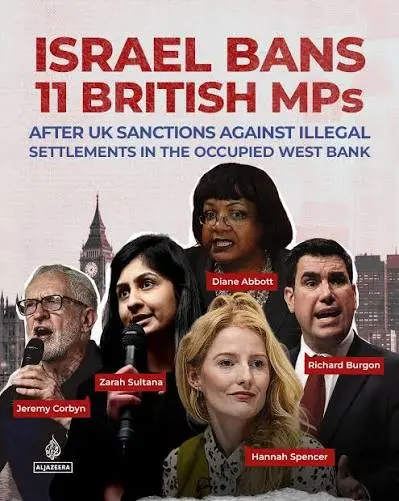
The warning comes a week after the government’s announcement triggered Israeli retaliation, including entry bans on 11 British MPs. Those exclusions have intensified demands for a public inquiry into British intelligence sharing, surveillance flights, arms sales and diplomatic support during Israel’s assault on Gaza.
‘The elephant in the room’
The lawyers’ case rests on the International Court of Justice’s July 2024 advisory opinion, which concluded that Israel’s continued presence in the occupied Palestinian territory was unlawful and must end “as rapidly as possible”. It also identified obligations on other states not to recognise that situation as lawful or provide aid or assistance in maintaining it. The opinion was advisory rather than a binding judgment between parties, but it addressed obligations arising under international law.
The signatories say those findings have “not had an impact on Israel’s apartheid practice”. They question why Britain’s response is confined so closely to settlements when the state that establishes and sustains them remains largely insulated from wider economic pressure.
Ralph Wilde, a professor of international law at University College London and one of the letter’s drafters, welcomed Britain’s recognition of the occupation’s unlawfulness as an “important shift”. But he said the measures failed to follow that recognition through.
“The elephant in the room is the illegality of the occupation itself,” said Wilde, who acted as senior counsel and legal adviser to the Arab League in the ICJ proceedings. “It’s not just simply the settlements and the abuse of treatment and the genocide, which of course are also wrong, it’s Israel’s very presence.”
He added: “There’s a mismatch between saying Israel’s very presence there is illegal, but then only focusing on the question of the settlers and the settlements. If the problem is with the settlements themselves, then the problem is with the state that establishes them.”
The letter contrasts Britain’s approach with its sanctions against Russia, which extend beyond economic activity inside occupied Ukrainian territory to the wider economic structures supporting unlawful conduct.
“We ask it to commit to further and more rigorous measures to ensure that no part of the UK’s economic relationship with Israel continues to sustain the illegal occupation itself, and the settlements and other serious violations of fundamental rules of international law perpetrated through its conduct, and to build on this to adopt robust coercive measures to seek to bring all these serious violations of international law, and the practices they sustain, including, fundamentally, the occupation itself, to an end,” the signatories write.
Their proposed measures include extending sanctions to insurance, accountancy services and digital infrastructure, alongside public confirmation that no UK public body, pension scheme or sovereign fund holds settlement investments.
The breadth of those demands sets a wider test for the government than its settlement restrictions. The lawyers want ministers to examine the structures through which British money, services and military exports help sustain the occupation.
Banned MPs demand an inquiry
Israel’s decision to bar Jeremy Corbyn and Zarah Sultana had already intensified the argument over how far Britain was prepared to change its relationship with Israel.
The two Your Party MPs were among 11 parliamentarians banned from entering Israel following the government’s announcement on 8 September 2026. The others were Diane Abbott, Naz Shah, John McDonnell, Richard Burgon, Hannah Spencer, Carla Denyer, Siân Berry, Ellie Chowns and Adrian Ramsay.
Sultana called the ban a “badge of honour” and vowed to keep speaking out. “If anything, this ban only strengthens my resolve to keep speaking out,” she said. Corbyn similarly promised to “keep speaking up for peace, freedom and justice for the Palestinian people”.
Your Party presented the exclusions as evidence that campaigning for Palestinian rights was having an effect. In a message to members that evening, it accused Israel of blaming the Palestine solidarity movement for ending its “veto over British foreign policy”, while urging ministers to go considerably further.
“This would not have happened without the pro-Palestine movement refusing to let Palestine fall off the agenda,” the party said of the government’s new measures. It demanded recognition of genocide in Gaza and a public inquiry into British intelligence sharing, surveillance flights, arms sales and diplomatic support.
The ban formed part of a wider Israeli response. Foreign Minister Gideon Sa’ar announced the closure of Britain’s consulate in East Jerusalem, the exclusion of British representatives from a Gaza coordination mission led by the United States, and the termination of British training for Palestinian Authority security forces. He condemned the sanctions as “morally distorted” and accused Britain of interfering in Israel’s affairs and electoral process. Sa’ar also accused Miliband of “outrageous lies” and said the British government was “systematically working against the state of Israel”.
A sanctions programme with limits
For the government, the measures were a response to settlement expansion and the forced displacement of Palestinians. For its critics, the confrontation raised a harder question: why were trade and security relationships with Israel being protected while Britain acknowledged the unlawfulness of the occupation those relationships could help sustain?
Foreign Secretary Ed Miliband described the situation in Palestine as a “moral emergency” and said the British government accepted that Palestinians were being subjected to “ethnic cleansing” in parts of the West Bank. His announcement included a proposed import ban on settlement goods, sanctions against those financing or facilitating settlement expansion, and a prohibition on advertising settlement property in Britain.
The measures followed escalating attacks by Israeli settlers on Palestinian villages and an Israeli tender for 1,200 homes in the E1 settlement area east of Jerusalem. The development threatens to sever the territorial connection between the northern and southern West Bank, further undermining the viability of a future Palestinian state.
The government also adopted the position that Israel’s occupation was unlawful. Miliband’s programme targets commercial activities supporting settlements, including construction, infrastructure, finance and property services. The legal experts’ objection is that the consequences of recognising an unlawful occupation extend beyond those restrictions.
The main legislation is expected within six to nine months, leaving a gap between the announcement and its implementation. Further sanctions against extremist settlers were announced for immediate action. Existing suspensions covering more than 30 arms licences remain, and Britain will refuse applications for arms and other exports that materially contribute to the occupation.
France and Canada announced plans for national restrictions on settlement goods alongside Britain. A joint statement also included Denmark, Finland, Iceland, Ireland, Norway, Poland, Portugal, Spain and Sweden, with commitments ranging from introducing restrictions to supporting or considering further measures. It welcomed action already taken by Ireland, Spain, the Netherlands, Norway and Belgium. The countries have not all adopted identical sanctions or timetables.
Their declared objective is to preserve a viable Palestinian state alongside Israel. That approach explicitly distinguishes settlement activity from trade with Israel within the Green Line, the armistice boundary preceding the 1967 occupation. Miliband made clear that wider trade should continue and rejected the boycott, divestment and sanctions movement.
Responding to the lawyers’ criticism, a government spokesperson defended the measures as a substantial change in policy.
“This is the biggest reset in the UK’s approach to protecting and securing the two-state solution in a generation. We have shown our commitment to international law and our refusal to be bystanders to further suffering,” the spokesperson said.
“We have taken concrete action, supported accountability, pledged to galvanise the international community and acted with our partners across the globe.”
Humanitarian organisations welcomed the announcement while questioning the delay. William Bell, Christian Aid’s head of Middle East policy, said the issue concerned the displacement of Palestinians rather than simply the origins of supermarket produce. “Given the urgency, the ban must be immediate,” he said, urging rapid restrictions on services that sustain settlements.
Yachad, a British Jewish organisation supporting a negotiated political settlement, also welcomed the measures. Its position illustrated the range of views within Britain’s Jewish community, where support for sanctions coexisted with strong opposition from the Chief Rabbi and other communal leaders.
A change in policy or a change in presentation?
A much sharper critique came from writer and campaigner Ali Abunimah during a livestream discussion with Nora Barrows-Friedman. He argued that the government was responding to pressure while preserving the central features of its relationship with Israel. His assessment challenged both the official presentation of a major policy change and any suggestion that the announcement should satisfy Palestine solidarity campaigners.
“He’s not breaking with a state that is perpetrating genocide,” Abunimah said. “Rather, he’s trying to save Britain’s relationship with Israel while still trying to appease its lobby.”
He identified Miliband’s opening remarks as revealing. The Commons speech began with the foreign secretary’s identity as a British Jew, his grandmother’s refuge in Israel after the Holocaust, and childhood memories of visiting Tel Aviv and picking oranges on a kibbutz. Abunimah criticised the absence from that account of the Nakba, the mass displacement of Palestinians during Israel’s creation, and Britain’s responsibility as the former mandatory power.
He also questioned why Miliband had invoked the assessments of former Israeli officials when describing ethnic cleansing. Palestinian testimony, he argued, should not have required validation by an Israeli politician before a British government took it seriously. His objection was to whose evidence was accorded authority, and to the continued marginalisation of Palestinians in a debate ostensibly about their future.
The dispute over the sanctions quickly became a dispute about the safety of British Jews. Chief Rabbi Sir Ephraim Mirvis called the announcement “a dark day for British Jews” and warned that the measures would strengthen extremism. The Board of Deputies expressed regret and warned that deteriorating relations could damage security, economic ties and community relations.
Former Labour minister Margaret Hodge also warned of a “spike in antisemitism”. Abunimah compared the reaction with the political attacks that had surrounded Corbyn’s Labour leadership, arguing that allegations concerning antisemitism were again being used to push a politician onto the defensive over criticism of Israel.
Miliband rejected the suggestion that holding the Israeli government accountable made British Jews responsible for its actions. “I don’t think anyone should be conflating these two sets of questions,” he said. He also emphasised that Jewish organisations held different views about the sanctions and that the government had to make its own decisions about legality and policy.
At the same time, he offered a clear assurance about the relationship he intended to preserve: “I want a strong and flourishing relationship with Israel.” For Abunimah, that reassurance demonstrated how narrowly the government had defined the change it was prepared to make.
The foreign secretary’s Commons statement also defended continuing cooperation with Israel against threats from Iran and announced further measures against Iran and Hezbollah’s financing arm. Abunimah argued that pairing limited restrictions on settlements with additional action against Israel’s regional adversaries weakened claims of a fundamental change in policy. He disputed Miliband’s presentation of Iran principally as a threat to Israel, pointing instead to Israeli and American attacks on Iran.
The demand for a full arms embargo
One of the most consequential limitations concerns weapons. Britain’s new announcement does not establish a comprehensive arms embargo, a demand now reinforced by the legal experts’ letter.
The signatories argue that Miliband’s acknowledgement of ethnic cleansing in the West Bank has consequences for Britain’s arms transfers. They invoke Article 6(3) of the Arms Trade Treaty, which prohibits authorising transfers of covered arms and related items when the exporting state knows, at the time of authorisation, that they would be used to commit genocide, crimes against humanity or the war crimes specified by the treaty.
Their call for a full embargo is an argument about applying that prohibition to Israel’s conduct. The treaty provision does not expressly list “ethnic cleansing” as a separate offence; acts committed in such a campaign can constitute crimes covered by the prohibition.
The exception allowing British components to enter the global F-35 supply pool used by Israel remains in place. Miliband defended that arrangement on the grounds that interrupting the shared programme would affect Britain’s allies as well as Israel.
For campaigners, the distinction between direct exports to Israel and components supplied through an international programme does not resolve the question of British responsibility. Abunimah called for an end to military and intelligence assistance that enables Israeli operations, arguing that sanctions against individual settlers leave untouched the state institutions that organise and sustain the occupation.
What did Britain know, and what did it share?
Surveillance flights are another focus of the inquiry demand. Hundreds of RAF flights over Gaza took place under the Sunak and Starmer governments from Britain’s base in Cyprus. Ministers described their purpose as locating people held captive in Gaza. The intelligence gathered, the circumstances in which it was shared, and the extent to which footage might document attacks on civilians remain central questions for those seeking disclosure.
Abunimah alleged that surveillance activity was continuing under Burnham and criticised the absence of a clear break in intelligence cooperation. Establishing what was collected, who received it and which ministers authorised its use would be a central task for an inquiry into the allegations of British complicity.
He also criticised the lack of a new pledge in the announcement to pursue Israeli officials and soldiers, including a clear commitment concerning the arrest of Benjamin Netanyahu and Yoav Gallant under the International Criminal Court warrants. He contrasted that approach with Britain’s efforts to gather evidence of war crimes in Ukraine, arguing that accountability should be applied consistently.
Your Party’s central demand is for that British role to be exposed. “Britain has not merely turned a blind eye to this genocide,” its message said, “it is complicit in it, through intelligence sharing, surveillance flights, arms sales and diplomatic cover.” The party urged supporters to sign its petition for a public inquiry, describing disclosure as the first step towards accountability.
The duty to prevent genocide
The argument over genocide also runs through the disagreement about sanctions. Your Party said that, on 8 September, Burnham had been prime minister for 50 days without recognising Israel’s actions in Gaza as genocide. “This is not just a matter of semantics,” it said, arguing that Britain had obligations to prevent and punish the crime.
Miliband maintained the government’s policy of awaiting a determination by a competent court before reaching a formal conclusion on genocide. Abunimah called that position “a cowardly and depraved political evasion dressed up as respect for law”, arguing that it confused a final judgment with the immediate duty to prevent the crime.
“Governments undertake to prevent genocide, not merely to condemn it after the extermination has occurred and it is too late,” he said. In his view, continuing assistance while waiting for a final ruling defeated the purpose of the Genocide Convention.
The legal distinction is significant. The duty to prevent genocide arises when a state knows, or should know, of a serious risk that it will be committed. States must use means reasonably available to them, with the extent of the obligation depending on their capacity to influence those responsible. That preventive obligation does not begin only after a final judgment.
The ICJ’s January 2024 provisional measures required Israel to take steps to prevent prohibited acts, punish direct and public incitement, facilitate humanitarian assistance and preserve evidence. Those orders were not a final finding that genocide had occurred. The British government also disputes the argument that the orders automatically established the separate serious risk threshold, while maintaining that it assesses genocide risk when making decisions such as arms licensing.
A UN commission of inquiry subsequently concluded in September 2025 that Israel had committed genocide in Gaza, drawing on the pattern of conduct and statements by senior officials. Israel rejected its findings. The commission’s conclusion added to the evidence campaigners cite when demanding preventive action and an end to British assistance.
Abunimah argued that the government could not credibly address those concerns through restrictions on settlement goods alone. His demands extended to weapons transfers, intelligence support and cooperation enabling Israeli operations. He also contrasted the limited action against Israel with the arrest and prosecution of people in Britain protesting against its conduct, describing that treatment of campaigners as part of the same failure of accountability.
Retaliation and pressure from Washington
The international backlash supplied further evidence of the pressure surrounding even limited sanctions. US ambassador to Israel Mike Huckabee characterised the British measures as “discrimination against the Jewish people” and warned of retaliation affecting British businesses. In an earlier social media attack on the government, he wrote: “The Brits have lost it. The Jew hate of their government knows no boundaries and knows no facts.”
Republican congressman Randy Fine invoked Florida’s anti-boycott legislation and claimed that British companies could lose access to state and local government business, at a cost of billions of dollars. “Any company or nation that boycotts Israel is boycotted in Florida,” he declared.
The White House response was less confrontational. Trump did not oppose the initiative, and the White House said Huckabee’s remarks had not been coordinated with it or the State Department. Marco Rubio also declined to condemn the British measures. The threats therefore did not amount to a single, agreed administration response.
Democratic politicians offered support. Senator Chris Van Hollen described the settlement restrictions as a “modest but important step”, while Representative Greg Casar welcomed them as progress towards ending the occupation. Those reactions reflected a disagreement in Washington over whether allied governments should face punishment for restricting trade with settlements.
Abunimah also drew attention to the nature of Israel’s retaliation. Closing the East Jerusalem consulate, removing Britain from the Gaza coordination mechanism and ending its training of Palestinian Authority forces principally restricted British engagement with Palestinians. He argued that those choices put pressure on Britain’s Palestinian relationships while leaving the wider relationship with Israel available to continue.
Pressure to confront the occupation itself
Behind the immediate diplomatic argument lies a deeper disagreement about what the proposed Palestinian state would mean. Miliband’s stated goal is a sovereign, viable Palestinian state alongside a secure Israel. Abunimah contends that the version of partition sustained by Western policy would leave Palestinians in disconnected territories under lasting Israeli military, economic and political control.
He framed the dispute around the division between the roughly 78 per cent of historic Palestine within Israel’s pre-1967 boundaries and the remaining 22 per cent comprising the West Bank and Gaza. In his analysis, Western governments defend the first arrangement while objecting to Israel’s extension of control over the remainder, without confronting Palestinian displacement in 1948 or the right of refugees to return.
He compared the fragmented territories he feared would result with apartheid South Africa’s Bantustans and rejected the treatment of settlements as an isolated departure from an otherwise acceptable system.
He linked the announcement to domestic politics, arguing that Burnham’s government wanted Labour to appear less supportive of Israel without making a substantial change in practice. “It’s simply 90% rebranding,” he said. Barrows-Friedman shared his scepticism about whether the confrontation would produce a lasting change, warning that assurances to Israel could ultimately outweigh the new restrictions.
Yet both speakers emphasised that public pressure mattered. “They are responding to pressure,” Abunimah said, before urging campaigners to persist. “Keep up the pressure because they are feeling it.” His argument was that the limitations of the announcement made continued campaigning necessary, while the government’s need to respond demonstrated that such campaigning could have an effect.
The legal experts’ intervention brings a separate challenge to the government’s position. Their letter asks ministers to ensure that Britain’s economic relationship with Israel no longer sustains the unlawful occupation and to use wider measures to help bring it to an end.
Your Party is seeking to translate public pressure into both an inquiry and further demonstrations. Its message called for attendance outside Labour’s conference in Liverpool on Saturday 26 September, assembling at noon at St George’s Plateau, and at a national demonstration in London on Saturday 10 October, assembling at noon on Victoria Embankment.
The party also linked the MPs’ exclusion to restrictions on journalists, humanitarian organisations and solidarity activists, accusing Israel of trying to prevent scrutiny of its treatment of Palestinians. It ended with a pledge that neither the entry bans nor the government’s limited concessions would conclude the campaign: “We won’t let up the pressure.”
Sources
International Committee of the Red Cross. Arms Trade Treaty, Article 6 and 2013 Arms Trade Treaty: explanatory material.
Your Party. Corbyn and Sultana banned from Israel. 8 September 2026. Email to members supplied for this article.
The Electronic Intifada. Livestream discussion between Nora Barrows-Friedman and Ali Abunimah. Transcript supplied 14 September 2026. Discussion of Abunimah’s article “Don’t be fooled by Britain’s fake support for Palestine”. Undated recording transcript; obvious transcription errors in names and spelling have been corrected.
Anadolu. UK lawmaker banned from entering Israel calls it a badge of honor. 8 September 2026.
The Times. Israel closes UK consulate over sanctions row. 8 September 2026.
Reuters. Israel to close British consulate in East Jerusalem after UK, France and Canada ban imports from settlements. 8 September 2026.
Foreign, Commonwealth and Development Office. Foreign Secretary Oral Statement on Israel and Palestine. 8 September 2026.
Foreign, Commonwealth and Development Office. Joint Foreign Ministers’ Statement on the Two State Solution. 8 September 2026.
Christian Aid. UK to ban goods from Israeli settlements. 8 September 2026.
Religion Media Centre. Religion news 9 September 2026. 9 September 2026.
Jewish News. Miliband explains why he rejected UK Jewish leaders’ pleas over Israel sanctions. 8 September 2026.
Declassified UK. Do Andy Burnham’s sanctions on Israel go far enough. 8 September 2026.
House of Commons Library. The obligation to prevent genocide. 3 February 2026.
Just Security. The Obligation to Prevent in a Future Crimes Against Humanity Convention. 27 September 2024.
Amnesty International. Israel must comply with key ICJ ruling ordering it do all in its power to prevent genocide against Palestinians in Gaza. 26 January 2024.
The Guardian. The UN commission of inquiry’s report on Israel’s actions in Gaza. 16 September 2025.
Axios. Trump did not oppose UK sanctions on Israeli settlements. 9 September 2026.
Haroon Siddique and Geneva Abdul, The Guardian. UK sanctions on Israel ‘fall far short’ of its obligations, legal experts say. 15 September 2026. Report supplied for this update, including quotations from the legal experts’ letter, Ralph Wilde and the government response.