


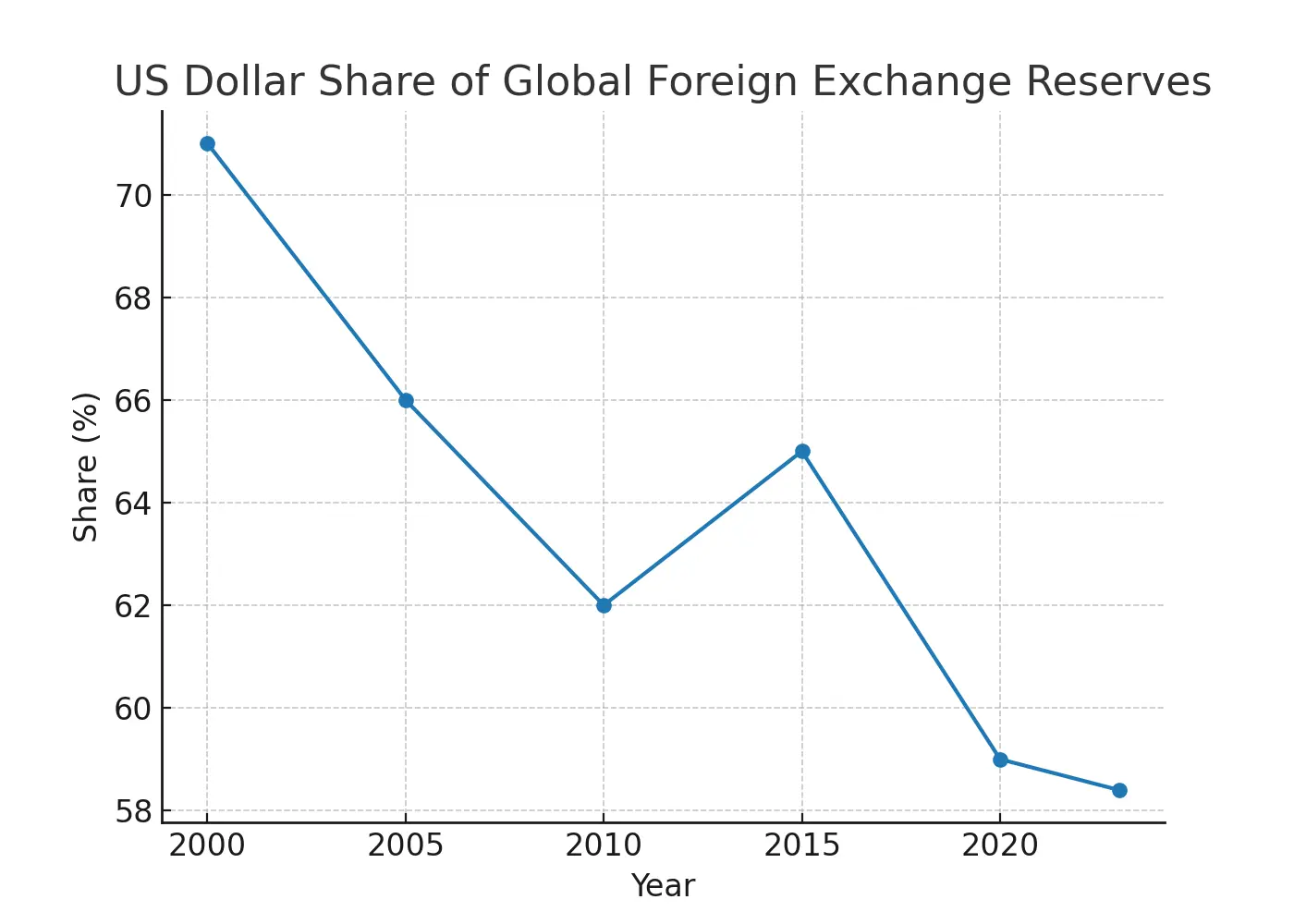
In a development that could reshape the architecture of the global economy, China has chosen Africa as the launchpad for its most ambitious financial experiment yet — a coordinated push to internationalize the yuan, challenge the dominance of the US dollar, and rewire the rules of global trade.
The plan, revealed in Beijing’s latest Africa strategy, goes far beyond infrastructure projects and bilateral trade deals. It aims to replace the Western-controlled payment infrastructure with China’s own Cross-Border Interbank Payment System (CIPS), allowing African nations to trade, invest, and settle debts in yuan without touching the US dollar.
The move comes on the heels of a sweeping trade framework signed last month in which 53 of Africa’s 54 nations secured 100% tariff-free access to the Chinese market. The deal marks the first time in modern history that a rising power has secured the coordinated economic partnership of an entire continent in such a comprehensive fashion.
Africa’s Shift: From Dollar Dependency to Yuan-Based Trade
The change is already visible on the ground. In Cairo, the central banks of China and Egypt recently signed a series of agreements to facilitate trade and investment exclusively in yuan. Egypt joins a growing list of African economies — including South Africa, Nigeria, and Angola — that have established yuan-based trade arrangements.
Nigeria, Africa’s largest economy, has gone further still, entering into a currency swap agreement with China worth the equivalent of 15 billion yuan. The deal allows both countries to exchange goods directly without the costly process of converting first into US dollars.
For many African nations, the shift is about more than efficiency. Under the current Western-dominated system, an African exporter selling goods to Europe cannot use its local currency. It must first convert into US dollars and then into euros, doubling transaction fees, increasing delays, and placing the process under the oversight of foreign banks.


SWIFT, Sanctions, and the Erosion of Trust
At the heart of the dollar’s dominance is the SWIFT payment network, controlled by Western institutions. Ostensibly designed to facilitate faster, more secure international payments, SWIFT also functions as a geopolitical lever.
The risks became clear in 2022 when, after Russia’s invasion of Ukraine, Western nations froze $300 billion in Russian foreign currency reserves. For much of the Global South, this was a wake-up call. If Washington and Brussels could seize Russia’s assets overnight, what was to stop them from doing the same to any other state that defied Western foreign policy?
As economist Richard Wolff notes, this moment “accelerated the decline of the dollar beyond what it might otherwise have been,” as nations realized the political risks of dollar dependence.
CIPS: China’s Answer to the Dollar System
China’s Cross-Border Interbank Payment System offers an escape route. Already used by over 4,900 financial institutions in 187 countries, CIPS is steadily gaining traction across Africa.
In June, South Africa’s Standard Bank became the first African bank to enable direct interbank yuan payments with China, bypassing the US dollar entirely. South Africa and Egypt — Africa’s two largest economies — are now leading the continent’s de-dollarization drive, with other major economies like Nigeria and Algeria invited to join BRICS.
If accepted, BRICS would encompass Africa’s top four economies, giving the bloc immense leverage in commodity markets — and further eroding the dollar’s dominance in energy trade.
The Decline of an Empire
Wolff frames the dollar’s weakening as part of a larger, predictable pattern: the decline of an empire past its peak. He draws a parallel with Britain’s post–World War II loss of currency dominance, noting that US leaders refuse to acknowledge the reality of relative decline.
The dollar’s position was secured in 1944 at Bretton Woods, when Washington outproduced and outarmed the rest of the world, controlling half of global trade. That dominance was already under pressure by the 1960s, when foreign governments began redeeming dollars for gold. Nixon’s 1971 decision to close the “gold window” bought the US time, but the underlying imbalance persisted.
Compounding the problem, US corporations themselves offshored production to Asia in pursuit of cheap labor — building the industrial base of rising competitors like China. In Wolff’s words, “sooner or later, that meant the US dollar wasn’t necessary.”
Angola as a Case Study: Agriculture Over Oil
A recent $350 million Chinese investment in Angola’s agricultural sector illustrates the new model. Long dependent on oil for 50% of GDP and over 70% of government revenue, Angola is now partnering with Chinese firms to develop vast soybean and corn farms, alongside a seed research center.
For Angola, the move promises food security and diversification. For China, it deepens a trade relationship conducted increasingly in yuan, bypassing the US-led system.
The US Response: Tariffs, Isolation, and Strategic Missteps
Rather than coordinate industrial policy with allies, Washington has increasingly relied on tariffs as a blunt instrument. Under both Trump and Biden, tariffs on Chinese electric vehicles rose to 100%, effectively shutting them out of the US market. Wolff argues this protects a few domestic auto jobs at the expense of broader competitiveness, forcing US businesses to buy “inferior vehicles at higher prices” compared to their global rivals.
The approach is alienating not just adversaries but allies, with tariffs and sanctions targeting India, Japan, South Korea, and Brazil — pushing even historically US-aligned states to seek alternative trade arrangements.

Internal Fractures and the Risk of Crisis
Domestically, the US faces what Wolff calls “pre-revolutionary indicators” — deep polarization, declining trust in institutions, widening inequality, and a political elite unwilling to admit the country’s diminished position. These internal pressures intersect with economic warning signs: in 2024 the dollar had its worst year since 1973, China sold off over $300 billion in US Treasury bonds, and capital has begun flowing out of US markets.
Wolff warns that the consequences of “declaring economic war on the whole world” have yet to fully hit. By late 2025, he predicts, the US could see a combination of recession and inflation — a politically volatile mix that could accelerate both economic and geopolitical decline.
A Multipolar Future
For decades, African nations operated within a financial order designed in Washington. Now, through yuan-based trade, infrastructure investment, and systems like CIPS, China is offering a credible alternative.
Wolff cautions that the dollar will not disappear overnight — “it will be important as long as the United States is a major player” — but its role will steadily diminish. With BRICS expansion, accelerated South–South trade, and growing distrust of the US-led system, the shift toward a multipolar currency order appears irreversible.
For the United States, the warning signs are flashing. The question is no longer whether the dollar will face serious competition, but whether Washington can adapt to a world in which it no longer writes the rules — or whether it will cling to a fading dominance until the costs become catastrophic.