


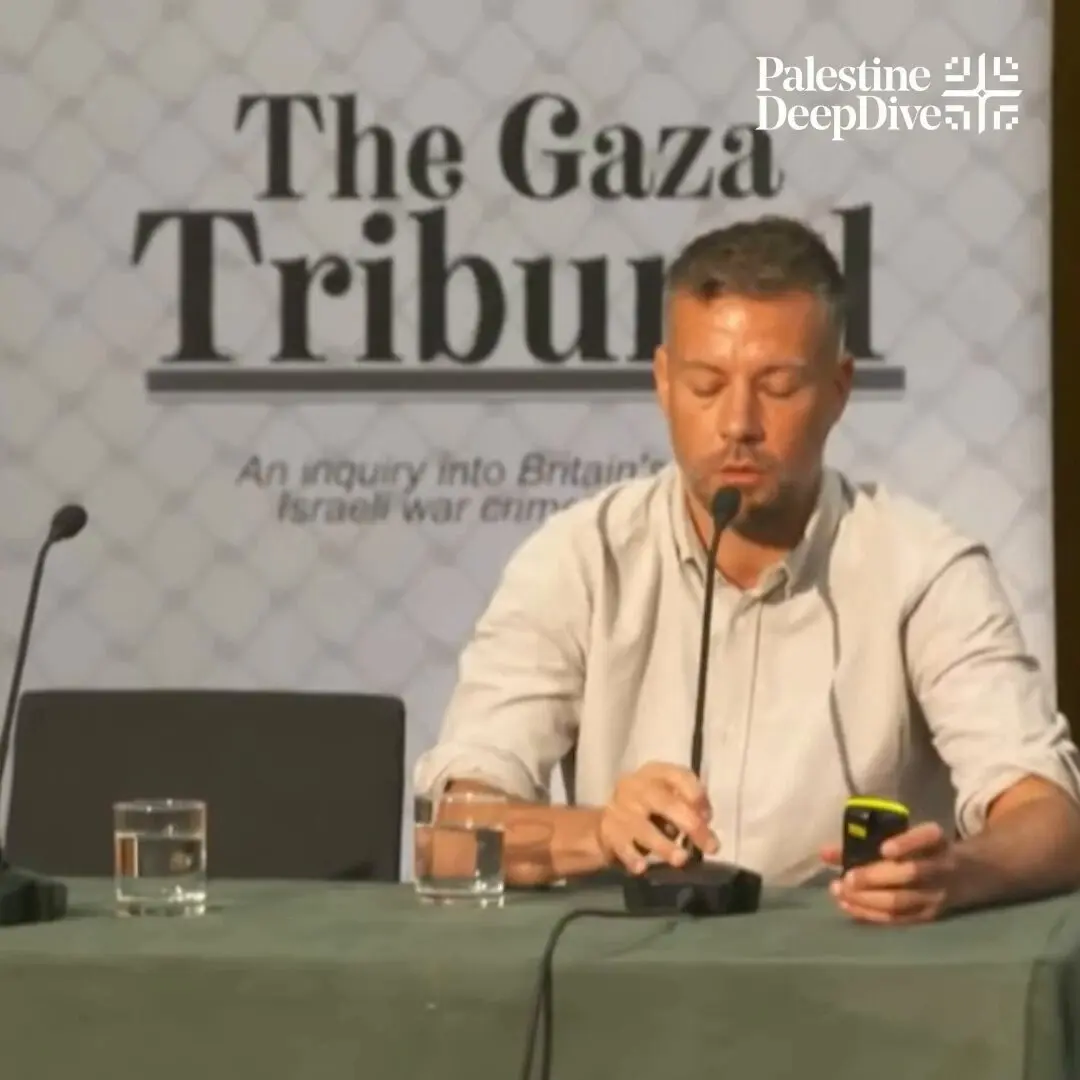
A people’s tribunal in London heard explosive testimony this week accusing the British government of actively enabling Israel’s devastating military operations in Gaza. Over two days of evidence, witnesses – including an investigative journalist, a senior barrister, a whistleblower civil servant, a union leader, and expert analysts – painted a stark picture of UK complicity.
They detailed British surveillance flights, weapons transfers, and even special forces activity supporting Israel’s assault, as well as alleged legal breaches and cover-ups that could expose UK officials to war crimes charges. “This is not complicity, it’s participation,” one witness contended, encapsulating the tribunal’s gravest claim: that Britain has crossed the line from observer to partner in the Gaza campaign. The emotionally charged testimony, ranging from personal accounts to forensic data, underscored the tribunal’s central question – has Britain enabled alleged atrocities in Gaza, and if so, will it be held accountable?
UK Military and Intelligence Support: “Not Complicity but Participation”
Investigative journalist Matt Kennard opened the proceedings with evidence of extensive British military and intelligence support to Israel’s war in Gaza. Kennard revealed that RAF Akrotiri, a sprawling UK airbase in Cyprus, “became the central international site for supporting and supplying Israel’s genocide in Gaza”. From that base, near-daily Royal Air Force transport flights ferried unknown cargo to Israel – 48 RAF flights in the first four months of the war alone. Kennard noted that these heavy transport planes could carry tanks, helicopters or other weaponry, and the UK government has refused to disclose what was on board.
He further testified that UK special forces (SAS) were deployed to the region days after the conflict began in October 2023, after which British authorities issued a rare “D-notice” censorship order barring media from reporting on UK military operations in Israel. This gag order has meant “zero information” on what British troops have done on the ground in Israel or Gaza since then, Kennard said, calling it a major red flag. Meanwhile, British spy planes have been conducting surveillance flights over Gaza on an almost daily basis, ostensibly for hostage rescue – but Kennard’s investigations suggest a more troubling role.
He showed flight data indicating these RAF Shadow R1 reconnaissance aircraft circling over active combat zones in Gaza, not hostage locations, and pointed to a leaked source confirming that the UK was feeding real-time surveillance intelligence to Israeli forces. According to Kennard, Britain ultimately flew nearly half of all reconnaissance missions over Gaza – “47% of them, more than double Israel itself” – providing targeting information used in Israeli operations. “This to me looks like participation. This is not complicity. This is participation,” he argued, describing the UK as an essential player in the assault.
Kennard’s evidence extended to logistical and diplomatic support. He noted that UK and US military cargo flights turned Cyprus into a munitions relay hub, and he highlighted a New York Times report that British intelligence teams were on the ground in Israel “providing…intelligence we [Israel] cannot collect on our own,” according to an Israeli official. He also accused London of deceiving the public about arms exports: after initially announcing a suspension of some arms licenses to Israel, the UK continued shipping thousands of munitions to Israel in late 2024 – including parts for F-35 fighter jets heavily used in Gaza – as revealed by customs data.
Even Israeli Air Force planes involved in the Gaza airstrikes were allowed to land at UK airbases for refueling stops: Kennard tracked unregistered Israeli military flights at RAF Brize Norton, including a refueling tanker that serviced an airstrike killing 73 people in Gaza and then touched down in Britain days later. The British government repeatedly stonewalled questions about these landings. Such actions, Kennard warned, make the UK not just a bystander but a direct accomplice in the conduct of the war. “They know that this is participation in war crimes,” he said of British officials, “and that’s why there’s so much secrecy around it”.
Legal Breaches and Liability: Barrister Warns of War Crimes Charges
A veteran British barrister with over 30 years in criminal law testified that the UK’s support for Israel’s operations in Gaza isn’t just unethical – it’s illegal. In a detailed legal analysis, he outlined how British officials could be criminally liable under both domestic and international law. The barrister pointed to Britain’s obligations as a signatory of the Genocide Convention and as a High Contracting Party to the Geneva Conventions, which impose a duty to prevent genocide and punish those complicit.
He noted that the UK has incorporated international crimes into domestic law through the International Criminal Court Act 2001, which explicitly criminalizes genocide, crimes against humanity, and war crimes – as well as aiding and abetting such crimes – even if committed abroad. Under that law, individuals can face life imprisonment for genocide or assisting in genocide, he said.
Based on the evidence from Gaza, the barrister did not mince words about potential culpability in London. “It is highly likely that the Prime Minister of this country is guilty of genocide,” he stated, adding that the Defence Secretary and others who provided support “will be found guilty should they be tried”. The UK government, he argued, has “totally and utterly breached international criminal and UK criminal law” through its actions, and “assisted genocide” by aiding Israel’s campaign. In his view, Britain has manifestly failed to meet its legal obligations to prevent atrocities.
However, the barrister also explained why, despite this apparent prima facie case, no prosecutions have occurred – highlighting a gap between the law and political reality. Any effort to charge UK officials with war crimes or genocide would require the Attorney General’s approval, a step he called “highly improbable” under the current government. “Genocide is a highly politicized crime,” he noted, and British authorities have little appetite to prosecute themselves.
The witness described a “two-limb test” for prosecution – evidence of a crime, and the public interest – and argued that “the first limb can overwhelmingly be fulfilled” given abundant independent evidence of war crimes in Gaza. “I see no greater public interest than [ensuring] war criminals…are punished,” he added. Yet the only reason no case has moved forward, he suggested, is political interference.
“Why…is there no prosecution taking place? The sole answer is political power,” the barrister said, accusing the establishment of protecting itself from accountability. He even drew parallels to the post-World War II Nuremberg trials, arguing that if lower-level perpetrators could be tried then, high-ranking officials today should not be immune. The chilling conclusion of his testimony was that if Britain’s leaders were ever hauled into court for Gaza, they could face lengthy prison sentences – on the order of 30 years – but political cover is shielding them despite the strength of the case.
Whistleblower Reveals Arms Export Cover‑Ups
Adding an inside perspective from Whitehall, former civil servant Mark Smith gave evidence of systematic cover-ups within the UK government regarding arms exports to Israel. Smith served as the lead official drafting the UK’s arms export licensing report – the crucial internal review meant to ensure British arms sales comply with the law, especially when the receiving country is at war. What he witnessed in that role, he said, “was profoundly concerning.” In his testimony, Smith described how his superiors repeatedly pressured him to manipulate and sanitize the report’s findings to downplay evidence that British weapons might be contributing to atrocities in Gaza. “I was routinely asked to change the report,” he recounted – not to fix errors, but to omit or alter key information so that it “sounded less bad.”
Entire paragraphs about Palestinian civilian casualties and indiscriminate Israeli strikes were excised or shoved to the back, on orders from senior officials who explicitly told him to “make the situation look less bad.” Meanwhile, sections highlighting nominal British “efforts” to improve the situation – for example, claims of trying to encourage restraint – were expanded and moved to the front. This aggressive editing, Smith said, “was absolutely counter to what we are trained to do as civil servants” and something he had never experienced before in his career.
Perhaps most alarmingly, Smith revealed that his department deliberately kept discussions off the record to avoid scrutiny. Managers insisted that the most sensitive conversations about UK arms to Israel happen only in person, never by email or text, specifically so that no paper trail could later be obtained by courts or investigators. “There have been hundreds if not thousands of conversations…which will never be seen by the public, which will never be put into a court,” Smith said of this secretive culture.
He also described a tactic of delaying reports during intense bombing episodes: if Israeli forces committed a particularly egregious strike causing mass civilian deaths, Smith’s team was told to hold off submitting the compliance report until they could find “something more positive to add.” For instance, they might wait for Israel to announce an “investigation” into an incident, and then prominently cite that in the report to dilute the negative facts. These practices, he suggested, aimed to maintain the appearance that Britain was upholding the law on arms exports – while in reality, uncomfortable evidence was being buried or spun.
Smith’s ethical concerns eventually turned into open dissent. He raised objections internally “multiple times,” and he noted that he was not alone – “some other colleagues” in the Foreign Office shared his alarm. But the response from leadership was hostile. After witnessing Israel’s all-out assault on Gaza in late 2023, Smith – by then posted abroad – questioned how his former team could justify continuing arms exports. In return, he received “a barrage of angry emails by legal advisers” telling him to stop asking questions and even scolding him for putting any of his concerns in writing, he testified. Realizing that the same cover-up he had experienced was still in full effect, Smith decided to blow the whistle. He went to his line managers, the ambassador, and finally the Foreign Office’s internal whistleblowing unit with grave reports about “serious illegal activity” – only to be ignored at every level.
He even wrote directly to the highest officials (the Permanent Under-Secretary and the Foreign Secretary, at that time crossing between outgoing and incoming ministers) with “evidence of serious illegal activity…in the subject line,” pleading for an investigation. Both ignored him. After months of stonewalling, Smith’s only choice was to resign in protest in 2024.
“The system is completely unfit for purpose,” he concluded, describing a total lack of independent oversight over ministers’ decisions on arms to Israel. All the safeguards, he said, were “left up to civil servants under immense pressure from ministers” – pressure to keep the arms flowing and the truth hidden. In his parting message, Smith urged ordinary citizens to take action since official channels had failed: much like the anti-apartheid movement of the 1980s, he suggested a “civilian boycott” and public outcry may be the only ways to force a change in the UK’s stance.
Civil Servants “Forced to Assist in War Crimes”: Union Leader’s Alarm
The tribunal also heard from Fran Heathcote, president of the Public and Commercial Services Union (PCS), which represents tens of thousands of UK civil servants – including those working in departments like the Foreign Office, Ministry of Defence and Department for Business and Trade. Heathcote voiced deep concern that British civil servants are being made unwitting participants in potential war crimes through their everyday jobs linked to Israel. “We don’t believe it is in the interests of our members to be placed in situations where they are potentially being asked to act in breach of the law,” she said, explaining that many PCS members fear their roles – for example, processing arms export licenses or arranging trade visits – could implicate them in the commission of atrocities in Gaza.
Heathcote pointed to the same January 2024 International Court of Justice ruling noted by others, which found a “plausible case” that Israel was committing genocide in Gaza. In PCS’s view, that ruling triggered the UK’s legal obligation to prevent genocide, meaning “the UK government has an obligation to do all that it can to prevent acts of genocide” – including stopping all work within the civil service which in any way potentially enables those acts, Heathcote said. Yet the union found that Britain not only continued business-as-usual (approving arms exports, pursuing a UK-Israel free trade agreement, etc.), but also failed to even seek legal advice on whether these activities were lawful. “We are not satisfied that the employer has obtained or even sought legal advice” on the legality of its actions, Heathcote said, referring to the Cabinet Office and departments in charge. For civil servants on the ground, this official silence has been devastating.
Heathcote recounted how PCS raised urgent concerns on behalf of members – from multiple departments – only to receive dismissive responses. In one instance, after dozens of Foreign Office staff wrote to the Foreign Secretary in May 2024 warning that UK-Israel cooperation could make them complicit in genocide, the only response from the government was to offer the staff “conversations with HR and counsellors.”
Officials suggested that if employees felt uncomfortable, they could simply resign, an answer Heathcote called “nothing short of a disgrace”. “That is simply reprehensible. It is a dereliction of duty,” she said, describing the government’s attitude as essentially “ignore the law, and if you don’t like it, leave.”
Such replies, Heathcote argued, show a “startling ignorance” of the Civil Service Code – the rules that bind UK officials to act lawfully, objectively and with integrity. Civil servants are sworn to uphold both the policies of the elected government and domestic and international law. The current situation, she warned, puts them in an impossible bind: “There is currently no reasonable path for civil servants to ensure they are not found complicit in genocide except giving up their livelihoods,” one tribunal panelist observed, to which Heathcote agreed.
She noted that with each passing day, the evidence of war crimes in Gaza mounts – “more and more evidence that what is happening could put [civil servants] in conflict with the law,” yet the government’s stance has been to “simply deny that genocide is occurring” and press on. In response, PCS has taken an unprecedented stand.
Heathcote testified that the union’s annual conference in May 2024 passed a resolution making clear that “no member should be put at risk of being liable for aiding or assisting genocide” as a result of their official duties. The union vowed to “fully back any member” who refuses work on, for example, an arms export license to Israel – even if that means fighting any disciplinary action against that employee.
In closing, Heathcote stressed that the UK government’s current approach – forcing civil servants to “undertake interactions with a government engaged in a genocide, …ignoring the provisions of its own civil service code, and ignoring a whole range of domestic and international legal obligations” – is both morally and legally untenable. The implication was that not only are Palestinians suffering the consequences, but British officials themselves could one day be in the dock for following orders. The tribunal panel pressed Heathcote on what recourse civil servants have.
She admitted it was extremely difficult for individual staff to refuse or challenge orders, given the personal risk, but argued this made the union’s collective stance – and public exposure like the tribunal – all the more important. “Civil servants must be able to clearly understand what the government’s position is…if they’re going to fulfill their obligations,” she said; right now, that clarity is sorely missing.
Structural Complicity and Genocide Denial: Expert Testimony
Two expert witnesses – a Palestinian-British policy advisor and a renowned forensic architect – placed Britain’s actions in a broader historical and structural context, accusing the UK of entrenching a pattern of complicity while denying the reality of genocide. Dr. Sarah Husini, director of the British Palestine Policy Centre, traced the roots of the Gaza crisis back over a century and positioned Britain as a consistent, if often hidden, collaborator. The current “unprecedented national emergency” facing Palestinians, she said, “cannot be seen as an aberration.”
Rather, “the past two years of mass murder, starvation, and forced displacement…are the culmination of a process more than a century old.” Husini noted that since the very creation of Israel – which involved the mass expulsion of Palestinians in 1948 – Israeli leaders have pursued a twin goal: maximize control over all the land, while ensuring the fewest Palestinians remain on it. This strategy, she argued, has always relied on the backing of powerful states. And chief among those enablers has been Britain.
“Britain, often historically miscast as an innocent bystander…has in fact been remarkably consistent in aiding and abetting Palestinian dispossession,” Husini testified. She gave striking historical examples: Britain’s first Labour Prime Minister, Ramsay MacDonald, gave the colonial Balfour Declaration “his full backing” in 1917, and in 1944 the British Labour Party officially endorsed the idea of transferring (forcibly removing) Palestine’s population. That legacy, she said, continues today in Britain’s unwavering diplomatic cover for Israel.
Husini listed ways in which contemporary UK policy sustains the oppression of Palestinians – “justifications for atrocities” in political rhetoric, the “demonization of international solidarity” such as smearing protest movements, efforts to shield Israel from accountability in international forums, and, most egregiously, “active military assistance” to Israel as it conducts “ethnic cleansing and forced displacement” in Gaza on a scale not seen since 1948. She noted that while a growing number of countries (including allies like Belgium, Spain and Norway) have taken steps to censure Israel or pursue war-crimes investigations, the UK has pointedly refused.
“A growing number of states…have taken positive action to address the unfolding genocide. The UK remains a glaring outlier – increasingly politically isolated and morally adrift,” Husini said, criticizing London’s refusal to support measures like the International Criminal Court probe into Gaza.
In her assessment, the British government has failed to uphold even minimal commitments to Palestinian rights. For instance, it has not formally recognized Israeli policies as apartheid despite clear evidence, and it has continued arms trade and economic engagement that other nations halted. Domestically, Husini added, the UK’s stance abroad has been accompanied by entrenchment of “structural racism” against Palestinians at home.
Successive British governments have tolerated or enacted policies that suppress Palestinian narratives and punish pro-Palestine advocacy – from policing tactics that target protesters, to the proposed banning of certain Palestinian activist groups. This hostile climate has left Palestinians in Britain feeling “demonized and victimized” for speaking about their own suffering. Even as their families in Gaza endure bombardment, Palestinians in the UK face surveillance, intimidation, and dismissal from jobs for trying to voice their reality, Husini noted. The thread connecting these phenomena, she suggested, is Britain’s unwillingness to reckon with its role in Palestine – past and present.
Professor Eyal Weizman, founder of Forensic Architecture, took the floor to delve into what he termed the “architecture of genocide denial.” Weizman, whose research group has been documenting the destruction in Gaza, argued that attempts to cover up or normalize the obliteration of Palestinian life are not just after-the-fact spin – they are part and parcel of the genocidal process itself. “There is no genocide without genocide denial,” he observed. “Genocide denial is not a rhetorical act… it’s operating on the ground. It’s operating as the targeting and murdering of journalists and human rights defenders… Genocide denial is what enables genocide.”
In other words, silencing witnesses and erasing evidence – whether by bombing media offices, criminalizing human rights groups, or controlling the narrative – is a strategic component of the violence. Weizman noted that Israeli forces have deliberately targeted Palestinian journalists and NGOs (including the prominent rights groups Al-Haq and others, which Israel has outlawed and the US recently sanctioned) in an effort to quash documentation of war crimes. This creates an information black hole around Gaza, allowing atrocities to continue unchecked – a dynamic in which, he implied, Western governments are complicit when they echo Israeli talking points or punish those who speak out.
Weizman also presented a grim analysis of post-war plans for Gaza’s “reconstruction” – warning that some international rebuilding proposals might actually cement the outcome of the destruction and thus continue the crime under a new guise. He highlighted a controversial Gaza reconstruction masterplan that was put forward at a March 2025 summit of Arab states (spearheaded by Egypt) and has “won the endorsement of Britain” and other Western countries. On paper, the plan aims to rebuild Gaza City and other devastated areas.
But Weizman’s forensic team overlaid the plan’s maps with the pattern of Israeli bombardment – and the alignment was deeply disturbing. The design features a large “green zone” of parks or empty land around northern Gaza and along strategic corridors – which corresponds exactly to the buffer zones and corridors Israeli forces created by leveling entire neighborhoods. During its onslaught, Israel carved Gaza into strips – for example, bulldozing a wide corridor from north to south (along Salahedin/Netzarim road) and depopulating areas along the Egyptian border (the Philadelphi corridor).
Weizman showed that the international plan effectively adopts these corridors of destruction as the sites for new infrastructure or open space, rather than restoring the Palestinian homes and communities that were there.
In doing so, it “builds the Israeli buffer zone into its logic,” he said. Weizman characterized such top-down planning – devised without Palestinian input, and literally rebuilding on Palestinians’ mass graves – as a continuation of the atrocity. Designing Gaza’s future in this way “uses architecture as the continuation of genocide by other means,” he warned. By “erasing” the original urban fabric and superimposing a new one that accommodates the recent ethnic cleansing, the plan risks validating the forced removal of residents as a fait accompli.
The forensic architect argued that reconstruction should never be an instrument to reward or lock-in the results of war crimes. He noted that alternative Palestinian-led reconstruction visions (such as a grassroots “Phoenix Gaza” initiative by Palestinian planners) exist, emphasizing the right of Gaza’s people to define how and where they rebuild. Any rebuilding imposed by outside powers against the will of survivors, he suggested, could amount to “designing over the heads of Palestinians” and finalizing their dispossession.
To underscore the point, Weizman described the literal landscape of Gaza after a year of bombardment: entire districts “ungrounded” – reduced not just to ruins, but to dust and sand where even the street grid and property lines are obliterated. In some cases, rubble (with bodies still unrecovered beneath) has been bulldozed into earthworks that the Israeli military is using for bases and fortifications. Gaza, he said, has been turned into both a “demolition zone” and a construction site for the occupiers’ plans – a tabula rasa on which Israel and its allies appear intent to redraw the map.
Any British endorsement of such a scenario came under his scathing critique. If the UK supports rebuilding schemes that ignore Palestinian rights and mirror the occupier’s designs, “we are seeing an image of reconstruction that is genocidal in its nature,” Weizman said bluntly.
Tribunal Background and Next Steps
The UK Gaza Tribunal was convened in response to mounting public outcry and legal questions about Britain’s role in the 2023–2024 Israel–Gaza war. Organized by former Labour Party leader Jeremy Corbyn’s Peace and Justice Project, the two-day hearing (held in London and livestreamed online) aimed to scrutinize British government conduct that Parliament and courts have so far avoided fully addressing.
The event brought together a panel of international lawyers and public figures to hear testimony from experts, eyewitnesses and impacted individuals. According to organizers, over 20,000 people followed the proceedings live – a sign of the widespread interest and concern within the UK and abroad. The tribunal’s formal title, “Inquiry into British Complicity in Israel’s Actions in Gaza,” underscores its focus: examining whether UK officials and institutions have been complicit in violations of international law, including potential genocide and war crimes, during Israel’s military operations in Gaza.
While the tribunal has no official power to sanction the government, its purpose is to compile evidence and present findings that can pressure authorities to act. A final report will be produced, incorporating the witness statements and documentation from the two days of hearings, along with recommendations for the UK government.
Organizers indicated these recommendations could range from halting arms exports to Israel and ending security cooperation, to pursuing accountability for British officials found to have broken the law. “We will be putting together a report of the whole two days … with the proposals that we make at the end of all this,” the tribunal chair (former Labour leader Jeremy Corbyn) said in his opening remarks. The ultimate goal, he and others noted, is to galvanize both public awareness and political action.
This UK people’s tribunal is part of a broader international effort to seek justice for Gaza. Human rights lawyers reminded the audience that a coalition of countries – sometimes dubbed the “Group of Hague” – is working through the International Court of Justice and International Criminal Court to investigate the Gaza conflict. In that context, the evidence uncovered by the UK tribunal could feed into global legal mechanisms. Sir Geoffrey Bindman KC, one of the tribunal’s jurors, emphasized that holding a major Western state accountable for complicity could set a powerful precedent and help end the cycle of impunity. Observers from foreign tribunals (such as a forthcoming Gaza People’s Tribunal in Istanbul) also praised the UK inquiry for “placing, for the first time, proper emphasis on the complicity of a major liberal state” in the Gaza crisis.
As the tribunal concluded, panellists issued a sober reminder that the testimony heard – however harrowing – is only a sample of a much larger body of evidence. “What has been presented…is just a little bit of the mountain of evidence for genocide in Gaza,” one expert said, noting that hundreds of genocide scholars and legal analysts worldwide now concur that the label “genocide” is warranted.
The British public, tribunal members urged, must reckon with this reality. In a poignant closing statement, Dr. Husini addressed both the officials in Whitehall and ordinary citizens: “We are witnessing one of the most heinous crimes in modern history…. [Britain] has the legal, moral, historic obligation and the power to prevent the extermination of the Palestinian people…. Ending all forms of military, diplomatic, and economic support for Israel’s genocide must be the absolute priority…. Anything short of this amounts not only to complicity but participation.”
The tribunal’s findings, expected to be published in the coming weeks, will seek to drive that message home – that without immediate change in policy, the UK will be remembered not as a passive observer but as a willing participant in Gaza’s darkest chapter.