


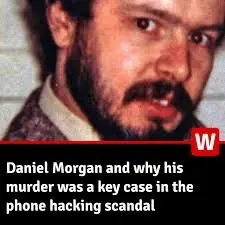
When private investigator Daniel Morgan was found murdered in a south London pub car park in 1987, an axe buried in his head, it looked at first like a brutal underworld hit. Nearly four decades and five failed police investigations later, no one has ever been convicted of his killing.
But the reason for that failure lies not only in the dark corners of London’s policing world — it runs through Fleet Street itself.
The same web of corruption that shielded Morgan’s killers was later exposed in the News of the World phone hacking scandal. That scandal, which rocked Rupert Murdoch’s media empire in the 2000s, revealed how corrupt police officers, private investigators, and journalists had built an industrial-scale criminal enterprise of surveillance, bribery, and cover-ups — one that fatally compromised the Morgan murder inquiry.
A Murder in South London
On 10 March 1987, Daniel Morgan was found dead outside the Golden Lion pub in Sydenham. The killing bore the marks of a professional hit. Morgan’s business partner, Jonathan Rees, soon fell under suspicion — he had been arguing with Morgan over alleged police corruption and planned to expose it.
But when detectives began probing Rees’s connections, they ran into an invisible wall. Several officers involved in the investigation were already in Rees’s pocket. Files were “lost.” Leads were ignored. Witnesses were intimidated. From the start, the murder investigation was sabotaged from within the Metropolitan Police.
From Murder Suspect to Murdoch Contractor
After emerging unscathed from early investigations, Jonathan Rees reinvented himself as one of Britain’s most connected private investigators. Through his company, Southern Investigations, Rees began working for Britain’s biggest newspapers — including the News of the World, the Mirror Group, and the Mail on Sunday.
He and his team — many of them former police officers dismissed for corruption — sold illegally obtained information: financial records, phone data, criminal files, and private addresses. It was the same network of illegal activity that would later explode into public view as the News of the World phone hacking scandal.
At one point, Rees was reportedly earning up to £150,000 a year from the News of the World alone.
The Murdoch Connection: Brooks, Coulson, and the “Dark Arts”
Rees’s work was highly valued by the tabloid’s editors, including Rebekah Brooks and Andy Coulson, both of whom would later face criminal charges in the phone hacking trials.
Under their leadership, News of the World built an intelligence-gathering machine that relied on illegal phone intercepts, blagging, and police bribes — precisely the “dark arts” Rees specialised in.
His contacts inside the Metropolitan Police provided confidential information that routinely appeared in tabloid exclusives. Some of those officers were the same individuals who had once investigated Daniel Morgan’s murder.
When the phone hacking scandal broke publicly in 2011, it revealed that Rees’s corrupt networks had extended into the highest levels of British journalism and law enforcement. What had begun as a single unsolved murder had grown into a national crisis of institutional corruption.
How the Hacking Scandal Collapsed the Murder Trial
By the late 2000s, the Metropolitan Police had mounted its fifth attempt to bring Daniel Morgan’s killers to justice. The Crown Prosecution Service (CPS) charged Rees and several others with murder.
But as the News of the World scandal erupted — leading to criminal investigations into Brooks, Coulson, and Murdoch’s senior executives — the prosecution’s case began to disintegrate.
1. Corruption and Conflicts of Interest
Key witnesses and detectives involved in the Morgan investigation were themselves under investigation for corruption and illegal dealings with Rees. Their credibility was destroyed, making it impossible to rely on their testimony in court.
2. Disclosure Failures
The CPS was legally obliged to disclose all material that could be relevant to the defence — including documents linking Rees to journalists and corrupt officers. But that evidence overlapped with ongoing phone hacking prosecutions, and disclosing it risked compromising other criminal cases. The result was legal gridlock.
3. A Web Too Tangled to Untangle
The same people who should have been testifying for justice were now defendants or suspects in related scandals. The entire system of accountability collapsed under the weight of its own corruption.
In March 2011, prosecutors formally abandoned the case, citing “disclosure failures and police corruption.” Months later, News of the World was shut down by Murdoch in disgrace.
The 2021 Independent Panel: “Institutional Corruption”
After decades of delay, the Daniel Morgan Independent Panel finally published its report in June 2021. Its findings were damning.
“The Metropolitan Police had placed the protection of its own reputation above the need for accountability and justice,” the report said.
“There were clear links between police corruption, private investigators, and journalists at the News of the World.”
The Panel concluded that the Met was “institutionally corrupt.” It found that crucial lines of inquiry had been blocked, evidence destroyed, and whistleblowers silenced. The close relationship between senior officers and Murdoch’s tabloid executives created what the report called “a culture of concealment.”
The Human Cost of Corruption
For Daniel Morgan’s family, the revelations were devastating but not surprising. His brother, Alastair Morgan, had spent more than 30 years campaigning for the truth.
“We always knew corruption was at the heart of this,” he said after the report’s release. “But the fact it reached into the media and politics — it’s worse than we could have imagined.”
The phone hacking scandal, in the end, didn’t just expose Fleet Street’s moral decay. It revealed how journalism, police power, and political influence had fused into a single web of self-protection — one that allowed a man’s murder to go unpunished.
Legacy: Britain’s Untouchable Networks
The collapse of the Morgan case remains one of the most powerful examples of how corruption across institutions can nullify justice entirely.
The News of the World is gone, but the questions it raised — about the relationship between press, police, and power — are not. Rebekah Brooks returned to run Murdoch’s UK operations. Andy Coulson served a prison sentence but later resurfaced in business. Jonathan Rees walked free.
Daniel Morgan remains dead, his killers unpunished.
The final verdict on the case came not from a courtroom, but from the inquiry itself:
“The Metropolitan Police’s first duty is to the truth and to the public,” the Panel wrote. “In the case of Daniel Morgan, it failed on both counts.”
Timeline: The Daniel Morgan Case
| Year | Event |
|---|---|
| 1987 | Daniel Morgan is murdered with an axe in a Sydenham car park. |
| 1988–1999 | A series of failed police investigations follow; corruption suspected at every level. |
| 2000 | Jonathan Rees is jailed for unrelated conspiracy to pervert the course of justice. |
| 2002–2006 | Rees resumes work for News of the World after his release. |
| 2008 | Fifth investigation into Morgan’s murder launched. |
| 2011 (March) | Murder trial collapses due to disclosure failures and police corruption. |
| 2011 (July) | News of the World closes amid the phone hacking scandal. |
| 2013–2014 | Andy Coulson jailed; Rebekah Brooks acquitted in hacking trials. |
| 2021 | Independent Panel finds the Met “institutionally corrupt” in its handling of the case. |
Key Figures
| Name | Role | Connection |
|---|---|---|
| Daniel Morgan | Private Investigator | Murdered in 1987 after allegedly planning to expose police corruption. |
| Jonathan Rees | Morgan’s business partner, PI | Suspect in murder; later worked for News of the World as an illegal information broker. |
| Rebekah Brooks | News of the World Editor, later CEO of News UK | Oversaw editorial period when Rees’s services were used; acquitted in hacking trial. |
| Andy Coulson | News of the World Editor; later PM David Cameron’s aide | Convicted in 2014 for conspiracy to hack phones. |
| Alastair Morgan | Daniel’s brother | Long-time campaigner for justice, key advocate for the 2021 inquiry. |
| Metropolitan Police | Law enforcement | Found by the inquiry to be “institutionally corrupt” in the handling of the case. |
In the End
The phone hacking scandal didn’t just kill News of the World — it killed the last chance for justice in one of Britain’s most infamous murders.
By exposing the same network of journalists, detectives, and police officers that had sabotaged the Morgan investigation for decades, the scandal revealed the truth — but at a price.
It made prosecution impossible, and it ensured that Daniel Morgan’s murder would remain, in the words of the official inquiry, “the most investigated — and most corrupted — case in British criminal history.”