


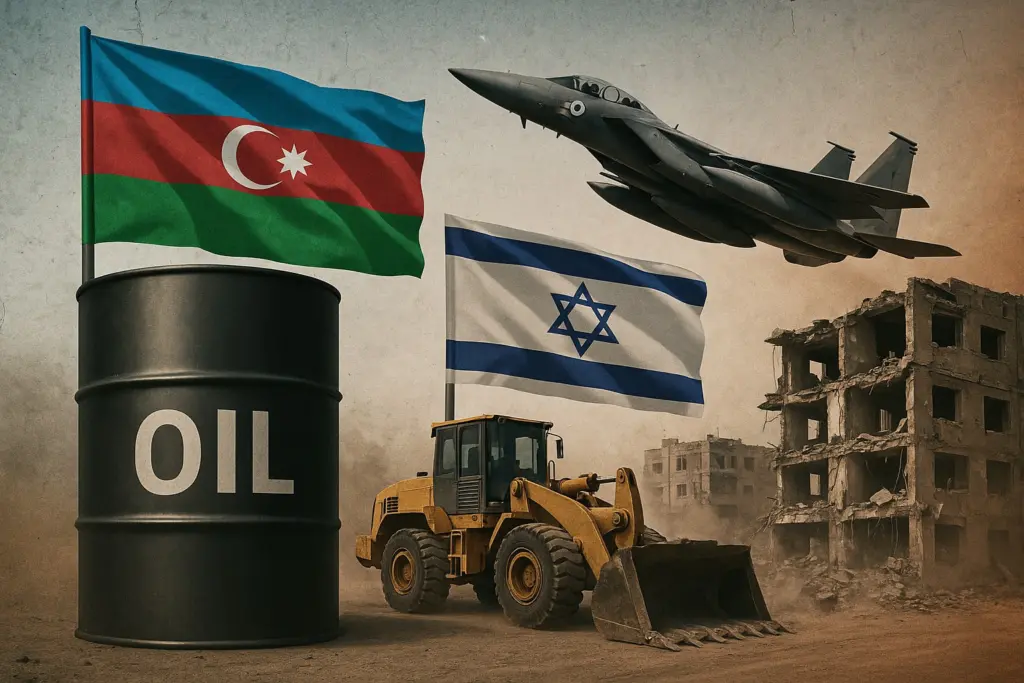
As Gaza’s ruined landscape smoulders and the West Bank lies under the dark shadow of military bulldozers, nearly 70,000 Palestinians—mostly women and children—have been killed by rogue state Israel’s genocide, according to the latest casualty figures compiled by humanitarian monitors.
Yet even as global outrage grows, one Muslim-majority country has emerged as a silent but crucial enabler of this lawless war machine tearing through Palestinian lives: Azerbaijan.
Behind closed doors, Azerbaijan is among Israel’s most vital suppliers of oil, providing the fuel that powers its fighter jets, tanks, and bulldozers.
In public, however, Baku insists it “supports the Palestinian people” and calls for “an independent Palestinian state with East Jerusalem as its capital.” The contrast between word and deed reveals one of the most striking hypocrisies of the modern Middle East.
Fueling the Fire: The Oil Pipeline Behind the War
Azerbaijan’s oil exports to Israel are the lifeblood of the Israeli military economy.
Multiple independent sources confirm that over 60 percent of Israel’s oil is supplied by Azerbaijan. In 2024 alone, more than one million tons of crude were shipped to Israel — a 28 percent increase over the previous year, even as Gaza’s death toll mounted.
The Baku–Tbilisi–Ceyhan pipeline, running from the Caspian Sea to the Mediterranean, serves as the conduit through which Azerbaijan’s state oil company SOCAR indirectly fuels Israel’s military. From the Turkish port of Ceyhan, tankers deliver crude to Israeli refineries, producing the jet fuel used in the air raids over Gaza and the diesel that powers bulldozers flattening Palestinian homes.
When Gaza war victims filed legal action against BP in December 2024 for supplying oil that reached Israel’s refineries, attention briefly turned to Azerbaijan’s role in the chain. Human rights advocates argued that such flows of fuel “enable the commission of war crimes” and must be examined under international law.
Strategic Allies: Oil for Arms
The relationship between Azerbaijan and Israel goes far beyond energy. It is a mutual pact of profit and power.
In exchange for oil, Azerbaijan has received billions of dollars’ worth of Israeli weapons—drones, radar systems, and missile technology—used in its regional conflicts, notably against Armenia.
Between 2016 and 2020, Israel accounted for nearly 70 percent of Azerbaijan’s major arms imports.
Analysts describe it as an “unholy trinity of oil, arms, and intelligence.” Israel gains secure energy from a Muslim state bordering Iran, while Azerbaijan benefits from Israeli weapons and lobbying power in Washington. The two countries are so intertwined that one regional expert said, “Azerbaijan functions as Israel’s Muslim shield in the Caucasus.”
Silence at Home, Complicity Abroad
Despite its Islamic identity—nearly 90 percent of Azerbaijan’s population is Muslim—the country has shown no public outrage over Israel’s destruction of Gaza.
There have been no major protests, no boycotts, no official condemnation.
Government control over the media and public assembly has kept dissent muted, while polling suggests many Azerbaijanis even view Israel as a “reliable partner.”
When the Organisation of Islamic Cooperation convened to denounce the war, Azerbaijan’s foreign minister issued a carefully crafted statement supporting “the inalienable rights of the Palestinian people,” but stopped short of naming Israel or calling for sanctions.
Even as its president welcomed the new Palestinian ambassador to Baku in 2025 and pledged humanitarian aid, the oil tankers kept sailing to Israel’s ports.
This duplicity—professing solidarity with Palestinians while materially enabling their oppressor—has not gone unnoticed among observers in the Muslim world.
Analysts have called Azerbaijan’s silence “unsurprising,” citing a foreign policy driven by money and strategic calculation rather than religious or moral conviction.
Moral Cost of Realpolitik
For a government that prides itself on being part of the Islamic world, Azerbaijan’s unwavering energy partnership with Israel amid the Gaza genocide is seen by many as an act of betrayal.
While other Muslim-majority nations at least downgraded or criticized relations with Israel, Azerbaijan deepened them — even as death and starvation spread across Gaza.
The moral question is stark: what does it mean for a Muslim nation to fuel the bombs that kill fellow Muslims?
In Gaza, where mothers bury their children under rubble, the answer is written in blood and dust.
Critics argue that Azerbaijan has sold its conscience for contracts. Its leadership prioritizes oil revenues, Israeli drones, and Western influence over solidarity with Palestine.
“Realpolitik,” one academic noted, “has replaced faith and fraternity.”
Pattern of Hypocrisy
The Azerbaijani government’s official website still proclaims its “support for Palestine’s independence.” But that support remains entirely rhetorical.
There is no evidence of significant humanitarian aid being delivered to Gaza by Azerbaijan, no diplomatic efforts to halt the bombing, and no move to cut off oil shipments.
Instead, the country continues to profit from Israel’s demand for energy, while its own people remain largely shielded from images of Gaza’s destruction. Independent journalists in Baku who attempt to question the government’s stance face censorship and intimidation.
Meanwhile, Israel rewards Azerbaijan with favourable trade deals, energy investments, and a steady flow of advanced weaponry.
In March 2025, Israel even awarded exploration licences to SOCAR for new gas fields—cementing their alliance while Gaza’s ruins still smouldered.
A Muslim Nation’s Moral Collapse
Azerbaijan’s actions lay bare a fundamental contradiction: it claims to stand with the oppressed while supplying the oppressor.
As tens of thousands of Palestinians lie dead—families obliterated, homes erased—the oil that fuels Israel’s warplanes continues to flow from Baku’s wells.
In the eyes of the Muslim world, this double standard is more than geopolitical cynicism. It is a moral collapse — a betrayal of faith, solidarity, and humanity itself.
If Azerbaijan truly believes in the right of Palestinians to live free, then it must stop powering their destruction.
Until that day, its words about peace will remain as empty as the shells falling on Gaza.