


For nearly a decade, Benjamin Netanyahu has governed Israel not only as its longest-serving prime minister but as a defendant fighting for his political survival. The corruption cases against him – involving bribery, media manipulation, and alleged abuse of national-security authority – have never been peripheral. They sit at the centre of Israel’s political crisis, its constitutional breakdown, and its accelerating drift toward authoritarian rule.
Those cases, which include allegations that Netanyahu traded regulatory favours for positive media coverage and received illicit benefits from foreign businessmen, have shadowed every major decision of his final years in office. When he returned to power in late 2022, his first priority was not security or the economy but the judiciary. Within weeks, his coalition launched a sweeping overhaul designed to neuter Israel’s courts, strip the Supreme Court of its power to block government actions, and give politicians direct control over judicial appointments.
That move ignited the largest protest movement in Israel’s history. Hundreds of thousands marched weekly, warning that Netanyahu was attempting to abolish the separation of powers in order to save himself from criminal conviction.
Then came the Gaza war.
As Israel plunged into an open-ended military campaign, Netanyahu’s trial was repeatedly delayed. Hearings were postponed. Schedules were altered. Legal pressure eased as the country entered a permanent emergency. Critics inside Israel accused Netanyahu of deliberately prolonging the war to freeze his prosecution – a charge that grew louder as the conflict expanded into multiple regional fronts.
Behind the scenes, Netanyahu also sought something even more extraordinary: a presidential rescue.
According to Israeli and US reporting, Donald Trump personally urged Israel’s president, Isaac Herzog, to grant Netanyahu a pardon or sweeping amnesty. The effort was sold publicly as a statesmanlike gesture – freeing Netanyahu from prosecution so he could focus on diplomacy and peace deals. Netanyahu himself released a video asserting that the Israeli people wanted him granted amnesty because his trial was supposedly a “national threat.”
The message was unmistakable: the law should yield to his leadership.
Yet the pardon never came. Herzog did not move. Despite the war, despite US pressure, and despite Netanyahu’s public campaign, the corruption cases remained alive.
Then, on 4 January 2026, a shock hit Israel’s legal system.
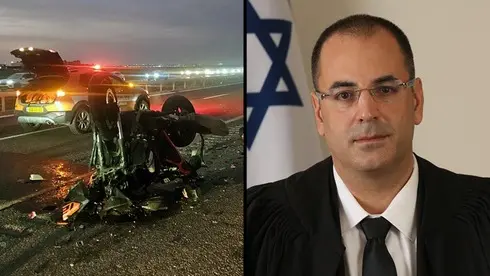
That evening, Judge Benny Sagi – President of the Be’er Sheva District Court and one of the senior figures in Israel’s judiciary – was killed while riding his motorcycle on Highway 6 in southern Israel. He was 54 years old.
According to police and emergency services, a vehicle that had been driving off-road entered the highway and struck Sagi’s motorcycle. Paramedics from Magen David Adom arrived to find him with catastrophic injuries and no signs of life, and he was pronounced dead at the scene. A formal traffic-accident investigation was opened.
The reaction from Israel’s political and legal establishment was immediate and effusive. The Judicial Authority called his death “a devastating loss” and praised his professionalism and leadership. President Herzog described him as “one of the finest sons and leaders of the judiciary,” lauding his integrity and humanity. Justice Minister Yariv Levin called him a “brilliant jurist” who elevated public trust in the courts. Knesset Speaker Amir Ohana and other senior figures issued similar tributes.
Sagi was not a marginal figure. He had served for nearly two decades as a prosecutor and judge, including in Tel Aviv’s magistrate and district courts, before becoming acting president of the Be’er Sheva District Court in 2024 and formally assuming the role in April 2025. He was widely respected for his productivity, leadership, and ability to manage complex cases. Colleagues jokingly called him the “biker president” because he routinely commuted by motorcycle. He left behind a wife and three children.
Officially, his death was a tragic traffic accident.
But politically, its timing and implications were explosive.
Sagi was part of the judicial layer handling cases that Netanyahu desperately wants erased. His death removed a senior, experienced judicial figure from a system already under relentless political attack. Israeli media coverage largely avoided highlighting this connection, focusing instead on road safety and personal tragedy.
At the same time, Netanyahu’s government is actively trying to seize control of the very system now tasked with investigating the crash. The police fall under the authority of Itamar Ben-Gvir, Netanyahu’s closest political ally – a man who has openly advocated crushing dissent and reshaping law enforcement along ideological lines.
Whether or not foul play is ever proven, the institutional meaning of Sagi’s death is inescapable.
Netanyahu has spent years building a parallel power structure inside Israel’s security and law-enforcement apparatus. Israeli reporting has revealed loyalists inside the military and intelligence services feeding him information directly, bypassing normal chains of command. His political survival has depended on dominating not only parliament, but the police, the media, and the courts.
Now, one of the senior judges standing between Netanyahu and a legal reckoning is gone.
Even if the crash was purely accidental, its effect is real. It weakens a trial Netanyahu wants buried. It chills a judiciary already under siege. And it underscores how dangerously politicised Israel’s institutions have become.
At the heart of this crisis is a simple truth: Netanyahu is not fighting for Israel’s future. He is fighting for his own.
The judicial coup, the endless war, the pressure for a presidential pardon, and the removal – by accident or otherwise – of key legal obstacles all orbit the same centre: a prime minister determined to avoid the dock at any cost.
Israel was already an apartheid state in its treatment of Palestinians. Under Netanyahu’s war on the courts, it is becoming something else as well: a state where the law bends around one man, and where even the judiciary now operates under a growing shadow of fear.