


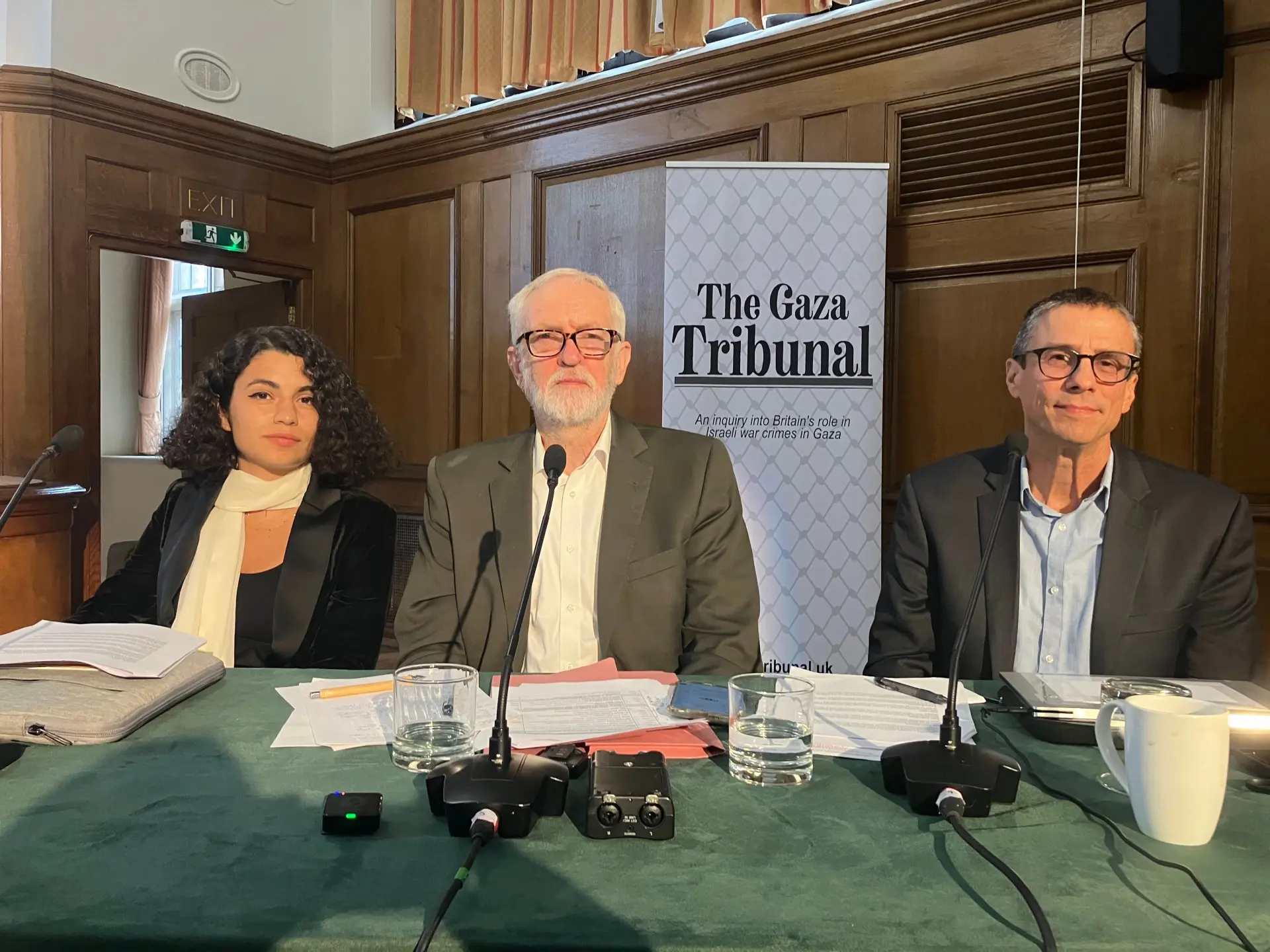
A sweeping independent inquiry into Britain’s role in Israel’s war on Gaza has concluded that successive British governments have failed in their legal duty to prevent genocide and may have materially contributed to war crimes and crimes against humanity through arms exports, military cooperation, and political protection of Israel’s actions.
The findings are laid out in a comprehensive report published in March 2026 following the Gaza Tribunal, a two-day hearing held in September 2025 at Church House in Westminster. The Tribunal was convened to examine what the organisers described as Britain’s “profound legal and moral failure” in relation to Israel’s military campaign in Gaza, and it brought together legal experts, humanitarian workers, journalists, doctors, academics and survivors to provide evidence.
The hearings were overseen by former Labour Party leader Jeremy Corbyn alongside international law expert Dr Shahd Hammouri and political sociologist Professor Neve Gordon. Their investigation sought to answer four central questions: what has happened in Gaza, what are Britain’s legal obligations under international law, what role Britain has played in the conflict, and whether the United Kingdom has fulfilled those obligations.
The report’s conclusions are uncompromising. Based on testimony from witnesses and documentary evidence presented during the hearings, the Tribunal argues that “the British government, both Conservative and Labour, has systematically failed to meet a range of legal obligations, most notably the obligation to prevent genocide,” and that evidence presented to the panel “reveals that the British government has been complicit in war crimes, crimes against humanity and genocide committed by Israel.”
The inquiry further warns that in some instances Britain may have moved beyond passive complicity to direct involvement in unlawful acts through arms transfers, intelligence cooperation and continued economic ties with Israel during the war.
The Scale of Destruction in Gaza
The Tribunal’s investigation begins with a detailed account of the destruction wrought by Israel’s military campaign in Gaza following the events of October 7, 2023.
By the time the report was written, the official death toll had exceeded 73,000 Palestinians, of whom at least 20,000 were children. However, the report emphasises that these numbers likely represent a significant undercount because thousands of victims remain buried under rubble and many deaths caused indirectly by starvation, disease and the collapse of healthcare are not included in official figures.
A study published in early 2026 estimated that the real number of deaths attributable to the conflict could be far higher. According to that research, more than 75,000 people had already been killed more than a year earlier, suggesting that the true toll could approach 186,000 once indirect mortality is taken into account.
The physical destruction of Gaza is equally staggering. According to the Tribunal’s findings, more than eighty percent of the buildings in Gaza have been either damaged or destroyed. Housing has been particularly affected, with over ninety percent of homes damaged or flattened.
The territory’s public infrastructure has also been devastated. Ninety-seven percent of schools have been damaged or destroyed. Thirty-three of Gaza’s thirty-six hospitals have been destroyed or rendered inoperable. Every university in the territory has been damaged or destroyed.
Agriculture, the backbone of Gaza’s food supply, has been almost entirely wiped out. More than ninety-five percent of agricultural land has been rendered unusable due to bombing, bulldozing and contamination.
At least 1.9 million people—around ninety percent of the population—have been displaced, often repeatedly. The report describes how many Palestinians have been forced to move ten times or more during the war as Israeli military operations advanced across the enclave.
The result is that vast numbers of people now live in makeshift camps or overcrowded shelters without electricity, clean water or functioning sanitation systems.
Gaza, the Tribunal notes, is now home to the largest population of child amputees in the world.
A Tribunal Born of Political Obstruction
The Gaza Tribunal itself emerged after repeated attempts to secure a formal inquiry from the British government were rejected.
Jeremy Corbyn explained in the report’s foreword that he introduced a Private Member’s Bill in Parliament in June 2025 calling for an independent public inquiry into Britain’s involvement in the Gaza war.
He wanted answers to a series of basic questions: what weapons had Britain supplied to Israel, whether those weapons had been used in Gaza, what role British military facilities such as RAF Akrotiri had played in the war, and what legal advice the government had received regarding its obligations under the Genocide Convention.
The proposal was supported by more than fifty Members of Parliament as well as numerous human rights organisations.
The government blocked the initiative.
Officials wrote to Corbyn stating that “there is no need for an inquiry” and that such an investigation would be unnecessary because there was “no confusion about UK military operations in Gaza.”
For Corbyn, the refusal only reinforced suspicions that the government was seeking to avoid scrutiny.
“To most people, however, it is quite simple,” he wrote. “If the government had nothing to hide, it wouldn’t need to block our efforts to expose the truth.”
In response, civil society groups organised the Gaza Tribunal to examine the evidence independently.
The Destruction of the Healthcare System
Some of the most disturbing testimony presented to the Tribunal concerned the systematic destruction of Gaza’s healthcare system.
Witnesses described a campaign of attacks on hospitals, clinics and medical staff that effectively dismantled the territory’s ability to provide medical care.
Since the beginning of the war, Israel has carried out more than 750 attacks on healthcare facilities and staff.
These attacks have killed thousands of civilians and injured many more, including doctors, nurses, medics and ambulance drivers.
More than two-thirds of Gaza’s hospitals are no longer operational. Those that remain open operate with severely limited capacity due to shortages of fuel, medicine, medical equipment and food.
Dialysis patients, cancer patients and pregnant women frequently have nowhere to receive treatment.
Many deaths now occur from causes that would normally be medically preventable.
Dr Victoria Rose, an NHS plastic surgeon who worked in Gaza during the war, described the catastrophic injuries she treated daily.
“Anything around them when the bomb went off is then whipped up and ejected at very high velocity and hits them,” she told the Tribunal. “So we were seeing children with bits of their body blown off.”
She described one day in which she operated on six children in succession.
“We started with an eighteen-month-old child with a fifteen percent burn. We then went on to a three-year-old boy with a thirty-five percent burn. I then operated on a five-year-old girl who had had her arm blown off. She was down for an amputation but we managed to salvage half of her hand and most of her forearm and shoulder.”
She then treated the girl’s sister, who had lost part of her cheek and shoulder, followed by a seven-year-old girl whose knee had been destroyed by an explosion, and finally a thirteen-year-old boy whose ankle had been blown off.
These operations were often performed under extremely primitive conditions.
“When we were there, we ran out of analgesia,” Rose told the Tribunal. “Unlike in the UK when we amputate your leg and give you anaesthesia and local anaesthetic into the stump so that you don’t wake up in pain, we were not able to do that.”
She described how children would wake from surgery screaming.
“The screaming in the recovery room would not stop until about three in the afternoon and we had no analgesia to give those children.”
Doctors also ran out of antibiotics and disinfectants and were forced to water down cleaning solutions or re-sterilise surgical blades.
Malnutrition, caused by Israel’s blockade of food and humanitarian aid, further weakened patients and medical staff alike.
“I didn’t see any fresh fruit or vegetables,” Rose said. “I only ate the food that I took in with me.”
Hospitals Under Military Attack
Other witnesses described Israeli raids on hospitals themselves.
British surgeon Dr Nick Maynard told the Tribunal that Israeli forces entered hospitals and destroyed critical equipment.
“They dismantled the whole infrastructure of the hospital,” he said. “They destroyed the scanning machines. They cut the cables to all the ultrasound machines. They destroyed all the dialysis machines.”
He described how Israeli forces bombed an intensive care unit while he was performing surgery in the adjacent operating theatre.
Healthcare workers themselves were frequently targeted.
More than 1,600 healthcare workers have been killed since the start of the war, while hundreds have been detained or abducted.
Dr Natalie Roberts of Doctors Without Borders testified that several of her colleagues had been killed during Israeli attacks.
One physiotherapist was killed together with her parents and siblings when their home was bombed. Another nurse was shot in the head while travelling in a clearly marked humanitarian convoy.
Hospitals were also raided, with staff arrested and detained.
The Tribunal concluded that these attacks formed part of a deliberate strategy to dismantle Gaza’s healthcare system.
The report describes this process as “medicide”—the systematic destruction of healthcare infrastructure to undermine the population’s ability to survive.
The Destruction of Education and Civil Society
The Tribunal also heard evidence regarding the destruction of Gaza’s education system.
Schools and universities have been repeatedly targeted. Hundreds of teachers and professors have been killed.
As a result, entire academic disciplines may disappear in Gaza for years.
The loss of universities is particularly devastating because it prevents the training of professionals needed to rebuild society, including doctors, engineers, social workers and teachers.
The war has also devastated Gaza’s media community.
More than 250 journalists have been killed, transforming Gaza into what the report calls “journalism’s graveyard.”
Witnesses described how journalists were placed on target lists and killed because of their role in documenting the conflict.
The result, the Tribunal argues, has been both the loss of life and the suppression of evidence about atrocities.
Starvation and the Weaponisation of Aid
The Tribunal also examined how Israel’s blockade of Gaza has produced famine conditions.
Food, water and fuel have been deliberately restricted. Agricultural land, irrigation systems and fishing vessels have been destroyed.
These policies have deprived the population of what international law calls “objects indispensable to survival.”
Witnesses described how humanitarian aid deliveries were severely restricted while the Gaza Humanitarian Foundation was used as what the report calls a militarised “humanitarian camouflage” that lured civilians to distribution points where they were exposed to violence.
Britain’s Role
The final sections of the report focus on Britain’s actions during the war.
The Tribunal argues that Britain has played a vital role in Israel’s military operations through several mechanisms.
These include the sale and transfer of weapons, including components for F-35 fighter jets.
Approximately fifteen percent of every F-35 aircraft is manufactured in the United Kingdom, with key components produced across several British facilities.
The report also cites surveillance flights conducted by the Royal Air Force over Gaza and the use of British military bases to facilitate the transport and refuelling of military equipment.
In addition, the report criticises Britain’s diplomatic support for Israel.
British political leaders repeatedly justified Israeli actions by invoking Israel’s right to self-defence while opposing attempts to hold Israeli officials accountable in international courts.
The Tribunal’s Conclusion
After examining all of the evidence, the Tribunal concluded that Britain has failed to meet its legal obligations under international law.
“The British government has failed in every single legal obligation outlined above,” the report states.
Its failure to act, the Tribunal argues, has contributed to the mass killing of civilians, the destruction of infrastructure and the erosion of international law itself.
In some cases, the report suggests, Britain may have moved beyond passive complicity to active participation in the crimes.
A Call for Accountability
The report calls for sweeping changes in British policy.
It recommends ending all military cooperation with Israel, including arms exports, intelligence sharing and joint operations.
It also calls for sanctions against Israeli officials, restoration of funding to humanitarian agencies, and support for international legal proceedings investigating the war.
Most importantly, the Tribunal calls for a full independent public inquiry into Britain’s role in the conflict.
For Jeremy Corbyn, the stakes extend far beyond British politics.
“Today schoolchildren are taught about history’s worst crimes against humanity,” he wrote. “In the near future our history books will shame those in our government who could have stopped the genocide in Gaza but facilitated it instead.”
The Gaza Tribunal, he argues, is only the beginning.
“This Tribunal is not a substitute for an independent inquiry,” he wrote. “Far from it. This Tribunal means the case for an independent inquiry is stronger than ever before.”