


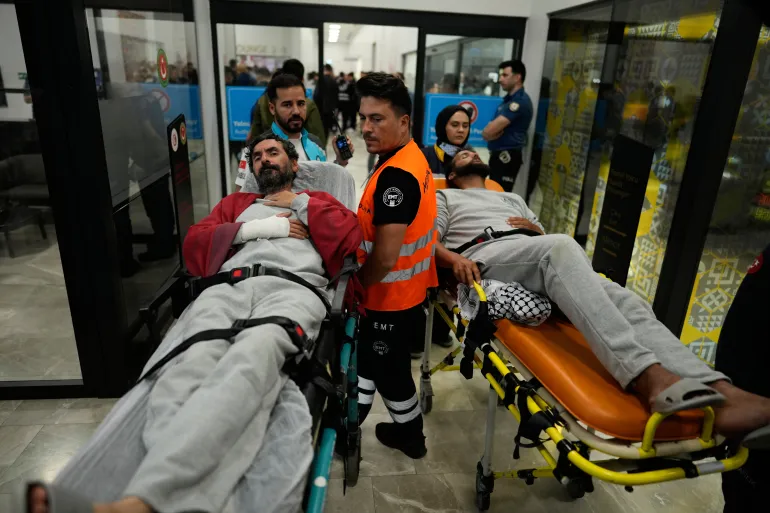
Malaysia says it is preparing legal action against Israel at the International Court of Justice after former detainees from the Global Sumud Flotilla accused Israeli forces and prison authorities of rape, sexual assault, torture, severe beatings and humiliation following the interception of Gaza-bound aid boats in international waters.
The allegations, emerging from activists across Europe, Australia and Asia, are rapidly escalating into one of the most serious international scandals surrounding Israel’s treatment of foreign detainees during the Gaza war.
Former captives from Australia, Italy, France, Spain, Canada and Malaysia have described what they say were systematic abuses carried out aboard Israeli military vessels converted into makeshift prison ships and later inside Israeli detention facilities.
The accusations include:
- rape
- sexual assault
- beatings with rifle butts
- tasering
- forced strip searches
- humiliation
- denial of medication
- threats with firearms
- sleep deprivation
- denial of legal access
- forced kneeling for hours
- confinement in containers
- internal injuries and fractures
Israel has denied the allegations, calling them “false and entirely without factual basis,” but the growing volume of testimony, visible injuries documented after detainees were released, and diplomatic outrage over video footage released by Israeli National Security Minister Itamar Ben-Gvir have dramatically intensified international pressure for independent investigations.
Malaysia vows legal action
The Malaysian government publicly signalled this week that it intends to pursue international legal proceedings against Israel.
Selangor Chief Minister Amirudin Shari made the announcement while welcoming released Malaysian flotilla activists home at Kuala Lumpur International Airport.
“They were kidnapped more than once, they were tortured,” Amirudin said.
He confirmed that legal teams were already gathering evidence and documentation relating to alleged violations of international law.
“We will not remain silent, we will not stop,” he added.
Malaysia’s foreign ministry confirmed that 29 Malaysian citizens detained by Israel had returned home on 21 May after being held in Israeli custody following the flotilla interception.
Some Malaysian and international reports indicate the case could be brought before the ICJ, while others refer to possible proceedings at the International Criminal Court.
The distinction is significant.
The ICJ handles disputes between states, meaning Malaysia would seek to hold Israel responsible under international law. An ICC proceeding, by contrast, would involve attempts to establish criminal liability against individual officials or military personnel.
Legal experts say a potential ICJ case could centre on:
- interception of civilian vessels in international waters
- unlawful detention
- torture and sexual violence
- violations of maritime law
- breaches of the Geneva Conventions
- violations of the UN Convention Against Torture
Flotilla intercepted in international waters
The Global Sumud Flotilla consisted of approximately 50 boats carrying around 430 activists from roughly 40 countries.
The flotilla was attempting to deliver humanitarian aid to Gaza, where famine warnings, disease outbreaks and humanitarian collapse continue to deepen after months of siege and military operations.
Organisers say Israeli naval forces intercepted the vessels in international waters before transferring detainees onto military landing craft later used as floating detention centres.
Released activists say the abuse began almost immediately.
Global Sumud Flotilla organisers said they have documented at least 15 allegations of sexual assault or rape.
According to organisers, some detainees described one converted military vessel as the scene of the worst abuse, including:
- sexual taunting
- groping
- strip searches
- pulling of genitals
- anal rape
- forced penetration with a handgun
The rape allegations have not been tested in court and the identities of several alleged victims remain undisclosed publicly.
However, multiple named activists from different countries have now publicly accused Israeli personnel of sexual assault, torture or violent abuse.
“Four days of absolute hell”
Australian documentary filmmaker Juliet Lamont gave one of the most detailed public testimonies after returning home.
“That was just the beginning of four days of absolute hell,” she said.
Lamont alleged she was restrained, sexually assaulted and repeatedly beaten aboard what she described as a “torture chamber” on one of the military vessels.
“We were tortured,” she said. “I was sexually assaulted in this kind of torture chamber.”
She further alleged that “five men were bashing me and smashing my face.”
Another Australian activist, Violet Coco, also accused Israeli personnel of sexual assault and severe physical abuse.
According to Australian media reports, Coco said detainees were beaten, tortured and sexually assaulted, while some suffered fractures and head injuries and others were denied vital medication.
Australian activist Sam Woripa Watson said he sustained a fractured rib, cuts and bruising and witnessed detainees being Tasered, shot with rubber bullets and attacked with stun grenades.
Italian activists describe prison ships and beatings
Several Italian detainees also gave graphic descriptions of their treatment.
Italian economist Luca Poggi said detainees were stripped, kicked and repeatedly assaulted.
“We were stripped, thrown to the ground, kicked,” Poggi said.
“Many of us were Tasered, some were sexually assaulted, and some were denied access to a lawyer.”
Italian activist Ilaria Mancosu described detainees being transferred onto what she called “prison ships” where some activists were locked inside shipping containers and beaten by soldiers.
She alleged that detainees suffered:
- broken ribs
- broken arms
- eye injuries
- ear injuries caused by Tasers
Mancosu said detainees were denied running water, stripped of clothing and later forced to kneel for extended periods.
Another Italian activist, Martina Comparelli, alleged she too was beaten and sexually assaulted.
“The guards who beat, assaulted and humiliated us are self-convinced,” she said, describing what she viewed as ideological zeal among some Israeli personnel involved in the detentions.
Italian prosecutors are now reportedly examining possible criminal offences including:
- kidnapping
- torture
- sexual assault
French and Spanish detainees speak out
French activist Adrien Berthel described being taken through darkened shipping containers where detainees were slapped, kicked and struck with rifle butts.
He said one soldier appeared partially undressed and that he feared sexual assault during the ordeal.
Spanish activist Mi Hoa Lee described detainees being “intercepted, boarded, tortured, held captive, humiliated and deported.”
“There was sexual violence,” she said.
Sabrina Charik, who helped coordinate the return of French citizens, said at least five French participants required hospital treatment in Turkey after release.
Some reportedly suffered broken ribs or fractured vertebrae.
She said several detainees had made detailed accusations of rape and sexual violence.
Ben-Gvir footage sparks diplomatic crisis
The controversy escalated further after Itamar Ben-Gvir released video footage from inside the detention facility showing restrained detainees kneeling while guards surrounded them.
Ben-Gvir appeared to taunt the detainees during the filmed visit.
The footage triggered outrage internationally and intensified calls for investigations.
Canada’s Prime Minister Mark Carney reportedly described the treatment of flotilla detainees as “appalling” and called for an independent inquiry.
France later banned Ben-Gvir from entering the country, while Italy and France reportedly discussed wider European sanctions responses.
The footage itself may now become important evidence in potential legal proceedings because it appears to show detainees restrained and publicly humiliated.
Critics say the publication of the video by an Israeli cabinet minister contributed to perceptions of impunity surrounding the detainees’ treatment.
Israel denies wrongdoing
Israel’s prison service has categorically rejected the allegations.
Officials insist detainees were held in accordance with Israeli law and that medical care was provided where necessary.
Israeli authorities argue the flotilla was attempting to breach a lawful naval blockade imposed on Gaza for security reasons.
Israel has long defended maritime interceptions of Gaza-bound vessels as legal under the laws of armed conflict.
Critics dispute that interpretation and argue that intercepting civilian humanitarian vessels in international waters may constitute unlawful seizure.
Human rights lawyers say the alleged abuse of detainees, if substantiated, could potentially violate:
- the Geneva Conventions
- international maritime law
- prohibitions on torture
- international human rights law
Gaza crisis driving flotilla movement
The flotilla interception occurred against the backdrop of worsening humanitarian collapse in Gaza.
The United Nations Relief and Works Agency for Palestine Refugees in the Near East, known as UNRWA, has warned of rapidly spreading disease and deteriorating sanitary conditions among displaced Palestinians.
UNRWA says its medical teams are witnessing rising cases of:
- scabies
- rodent bites
- chickenpox
- acute watery diarrhoea
particularly among children.
Aid agencies continue warning of hunger, medical collapse and severe shortages of medicine and clean water as restrictions on humanitarian access persist.
The flotilla movement has therefore become both a humanitarian initiative and a political challenge to Israel’s blockade of Gaza.
International pressure growing
The scandal surrounding the flotilla detentions now threatens to widen international legal and diplomatic pressure on Israel at a time when the country is already facing multiple international proceedings linked to the Gaza war.
South Africa’s genocide case against Israel remains active at the ICJ, while the ICC has separately pursued cases connected to the conflict.
The flotilla allegations could add a new and highly sensitive dimension to that scrutiny because they involve foreign nationals from allied Western democracies rather than Palestinians inside Gaza itself.
At present, the allegations remain unproven in court.
However, the consistency of accounts emerging from detainees across multiple countries, combined with visible injuries observed after their release and official video evidence showing detainees restrained and humiliated, has transformed the flotilla interceptions into a rapidly expanding international controversy.
Malaysia’s decision to explore legal action at the world’s highest international court now threatens to turn those allegations into a major diplomatic and legal confrontation over Israel’s conduct during the Gaza war.