


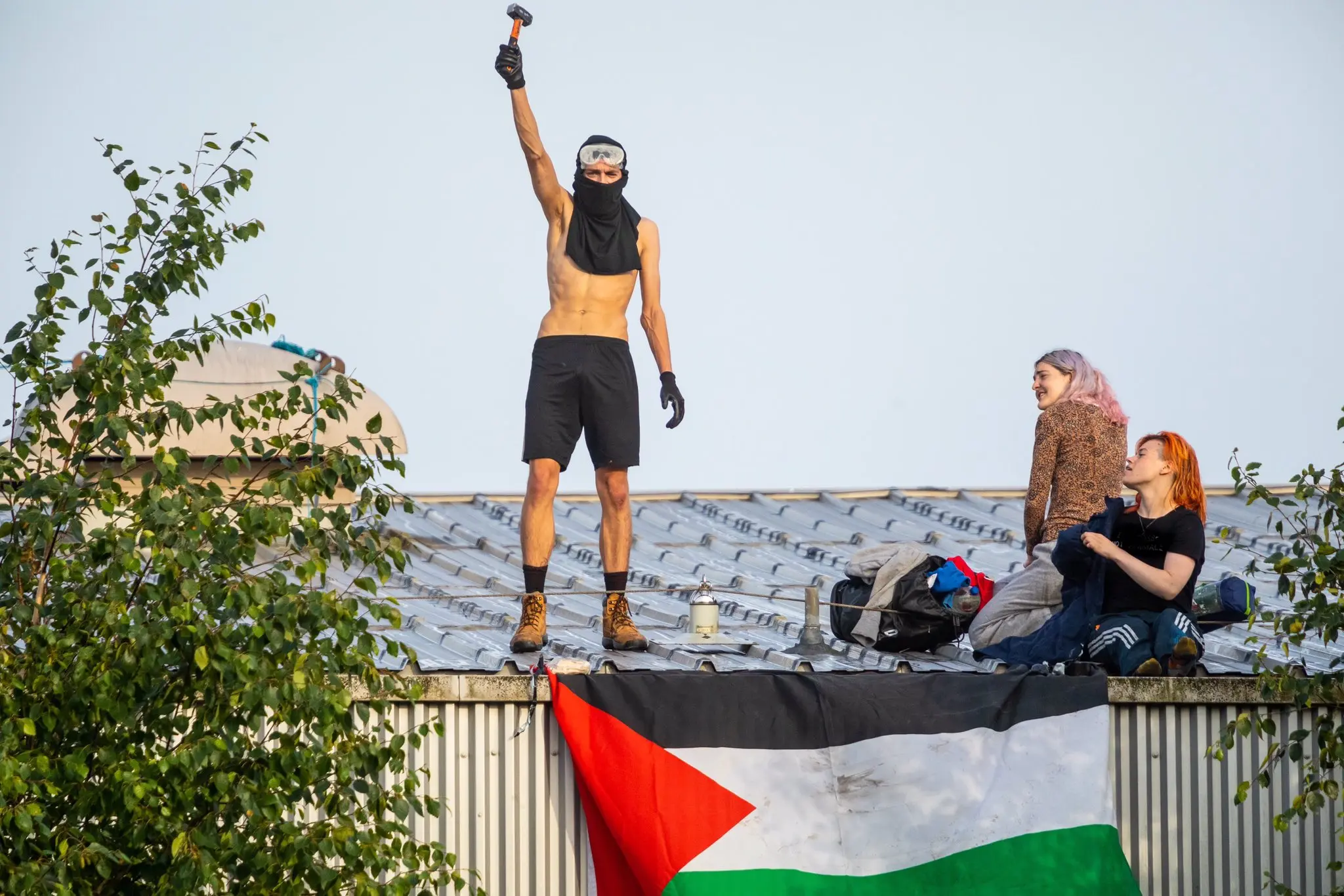
The case of four pro-Palestine activists, collectively sentenced to more than 22 years for criminal damage after a judge secretly ruled their protest had a “terrorist connection,” has ignited a fierce legal debate—as a separate jury in Birmingham has refused to convict four other activists who occupied a Wolverhampton arms factory.
In a blistering opinion piece published in The Key magazine, human rights lawyer Geoffrey Robertson KC argues that while the public may not sympathise with the methods of the “Elbit four,” their treatment under the law should be a cause for universal outrage. Robertson contends that the case represents a dangerous subversion of foundational English legal principles, including the right to a jury trial and the prohibition on convicting someone of an uncharged offence.
The twin cases have exposed what legal experts call an inconsistent approach to protest justice in Britain, with the Gaza conflict serving as the backdrop for both actions.
The Elbit Four: A Case of Criminal Damage or Terrorism?
Last week, Leona Kamio, 30, a nursery teacher; Samuel Corner, 23, and Fatema Rajwani, 21, both students; and Charlotte Head, 30, a domestic abuse caseworker, were sentenced for their roles in an August 2024 break-in at a factory in Filton, near Bristol, owned by Elbit Systems, an Israeli defence company that manufactures drones—the very drones that have been used extensively in Israel’s military operations in Gaza.
The group, among more than two dozen defendants in the “Filton 25” cases, caused over £1 million in damage. Corner, who injured a female police officer with a sledgehammer during the incident, received a sentence of seven years and eight months, while the others received sentences ranging from four years and eight months to five years.
However, the case has a far more complex procedural history. The Elbit four underwent not one, but two trials.
Two Trials and a Contempt Citation
At their first trial, they faced several charges, the gravest being aggravated burglary. Their leading counsel, Rajiv Menon KC, took to the floor to remind the jury of their historical right to acquit, and invited them to weigh the use to which the drones were being put. The judge, Mr Justice Johnson, referred Menon to the High Court to be tried for the crime of contempt of court for breaching his order not to mention the jury’s right to acquit.
The first jury, however, went on to acquit the defendants of aggravated burglary. But they could not come to a majority decision on any of the remaining charges. The prosecution decided that the defendants must face a retrial. This proceeded with the same Mr Justice Johnson presiding on the charges the first jury could not resolve: criminal damage, an offence ordinarily met with a fine or a sentence of 18 months or so.
At this point, the four had already spent more than 18 months in pretrial detention. The second jury convicted the Elbit four of criminal damage.
The court of appeal later struck down the judge’s decision to have Menon tried by the High Court for contempt, ruling that Johnson’s decision was wrong. The better view, Robertson notes, is that contempt citations should be referred to the attorney general to decide whether the public interest justifies a prosecution. The judge apologised, but that did not stop him sentencing Menon’s clients when they were convicted at the second trial.
The Secret Ruling: Protest as ‘Terrorism’
While the convictions were for criminal damage, the severity of the sentences was driven by a ruling from Mr Justice Johnson that the protest had a “terrorist connection.” This ruling, made at a secret hearing during the first trial, was unprecedented in the history of direct-action protests—and was kept secret from both the jury and the public. The UK press was barred from reporting on it.
Robertson KC, the founding head of Doughty Street Chambers, highlights the profound injustice: the judge’s reasoning was that the defendants’ purpose was to “influence” the British government—a central aim of almost every political protest ever mounted.
Robertson notes that there was “no terrorism in any ordinary sense: no violence meant to kill or maim, only a determination to expose British complicity in the killing of Palestinians.” Yet the judge applied the broad definition of “terrorism” established by the Sentencing Act of 2020, passed by the then-Conservative government, to impose a sentence far heavier than the crime would normally warrant.
“The Elbit four will be labelled as ‘terrorists’ because they were convicted, in substance, of a quasi-terrorist offence that was never charged, never put to the jury, and never proven by the prosecution,” Robertson writes. “The jurors who found them guilty of criminal damage had no idea their verdict would be treated as a verdict on terrorism.”
As “terrorists,” they will serve longer times in prison before they are up for parole and 15 years on a list that makes them police suspects for real terrorism crimes.
A Breach of Foundational Principles
Robertson argues that this breaches another foundational principle of English law: that no one should be convicted of an offence that has not been charged and proved. “In this case, the principle was suspended. The secrecy compounds the injury.”
He invokes the words of Jeremy Bentham: “Publicity is the very soul of justice; it keeps the judge, while trying, under trial.” The open-justice principle, Robertson notes, exists precisely for this reason.
The Wolverhampton Moog Case: A Contrast in Outcomes
In a striking contrast, a jury at Birmingham Crown Court has failed to reach a verdict over whether four other pro-Palestine activists committed criminal damage at a factory owned by Moog, a US aerospace firm, in Wolverhampton.
After more than 17 hours of deliberation, the jury in the case of Iain Evans, Hana-Yun Stevens, Frank Sherman, and Hisham Alkhamezi could not agree on a verdict. The four were each accused of criminal damage at the factory, which is said to produce “military aircraft parts for Israel.”
The trial saw footage from helicopters and CCTV cameras showing the defendants crashing through the site’s front gate and damaging solar panels on its roof. Prosecution lawyers presented this as an open-and-shut case, given the defendants admitted in court to occupying the roof in order to shut down the factory’s production line. They told the court the trial “is not about Israel, it’s not about Palestine… It’s simply about whether they unlawfully damaged property.”
But the jury was also shown a social media post demonstrating that the activists’ goal was to disrupt the supply of UK-made fighter jet components to Israel. In that post, the four defendants were wearing T-shirts bearing the names of Palestinians who had been killed by Israeli airstrikes, including the author Refaat Alareer.
Defence counsel Mira Hammad told the court last week that there was “no mystery about why the [four defendants] were there.” It was “on their T-shirts. It’s right there in… the tweet [discussing] military aircraft parts to Israel.”
‘The Longer We Stayed, the More Lives We Would Save’
The jury heard directly from the defendants during the trial. Alkhamezi, 23, told the court that the “main intention” of the action was “to occupy the roof” because the “factory can’t operate while we’re on the roof.”
Evans, who previously worked in the aerospace sector, told the court: “We believed the longer we stayed up there, the more lives we would save. The idea was that the longer we stay on the roof, the longer the factory would be shut down.”
Yun-Stevens described the concept of direct action and noted in court how a full arms embargo has still not been imposed on Israel. Sherman, who dismissed their own legal representation to offer their own closing statement, declared: “I will always in my heart know that using care and intention to disarm the factory is not criminal.”
They added: “As Iain told you, the longer we stayed up there, the more lives we could save; as Hisham told you, we intended to disrupt shipments, disrupt production; and as Hana told you, we disrupted only what we deemed to be criminal.”
Shortly after the hung jury verdict was delivered, Yun-Stevens and Sherman addressed some 20 supporters who had gathered outside the courthouse. Yun-Stevens led chants of “Free Palestine” while Sherman thanked those who had offered encouragement throughout the trial. Evans, wearing a keffiyeh, told Declassified he felt “relieved” by the verdict. A one-minute silence was also held outside the courthouse for Palestinians killed in Gaza.
All four activists were immediately released on bail. The Crown Prosecution Service is expected to decide on whether it seeks a retrial within the coming weeks.
A Return to the Principles of Bushell’s Case
Robertson, drawing on his 50 years of practice, reminds readers of the 1670 case of Edward Bushell, whose jury refused to convict the Quaker William Penn. The subsequent legal ruling established that a jury could not be punished for their refusal to convict and is a cornerstone of jury independence. A plaque honours Bushell at the Old Bailey, so jurors on their way inside may contemplate the man who secured their right to acquit.
The legal principle has held for three and a half centuries, and Robertson writes that he has witnessed many juries bring back “sympathy verdicts”—acquittals because they think a defendant has been oppressively or unfairly prosecuted. But barristers are not usually reminded of their right to do so “because of the profession’s concern that they should not be urging juries to lay aside the oath they took to decide according to the evidence.”
Robertson illustrates the power of juries to temper law with mercy with the story of the great advocate Edward Marshall Hall, who, years ago, defended a woman who had killed a man for beating her every day of their life together. He closed with the words: “Just look at her, gentlemen of the jury. God never gave her a chance. Won’t you?” They did.
Robertson argues it would be far more transparent to bring the power into the open—to let the judge, where the defence claims it, remind the jury of the right, and let the prosecution argue against its exercise. Instead, the only lawful way to appeal to a jury’s conscience is to tell them to look at a plaque in the Old Bailey lobby.
Conclusion: Punishment for a Crime Never Charged
While acknowledging that the Elbit four knowingly broke the law, Robertson concludes that what no defendant should have to face is punishment for a crime that was never charged.
“Bentham held that a citizen may disobey a law they believe to be unjust, provided they are willing to accept the punishment,” he writes. “On that view, the protesters who knew very well they were breaking the law against criminal damage should have pleaded guilty. While on trial, they openly acknowledged participating in the factory break-in and damaging the drones.”
“What no defendant should have to face is punishment for a crime of terrorism that was never charged.”