


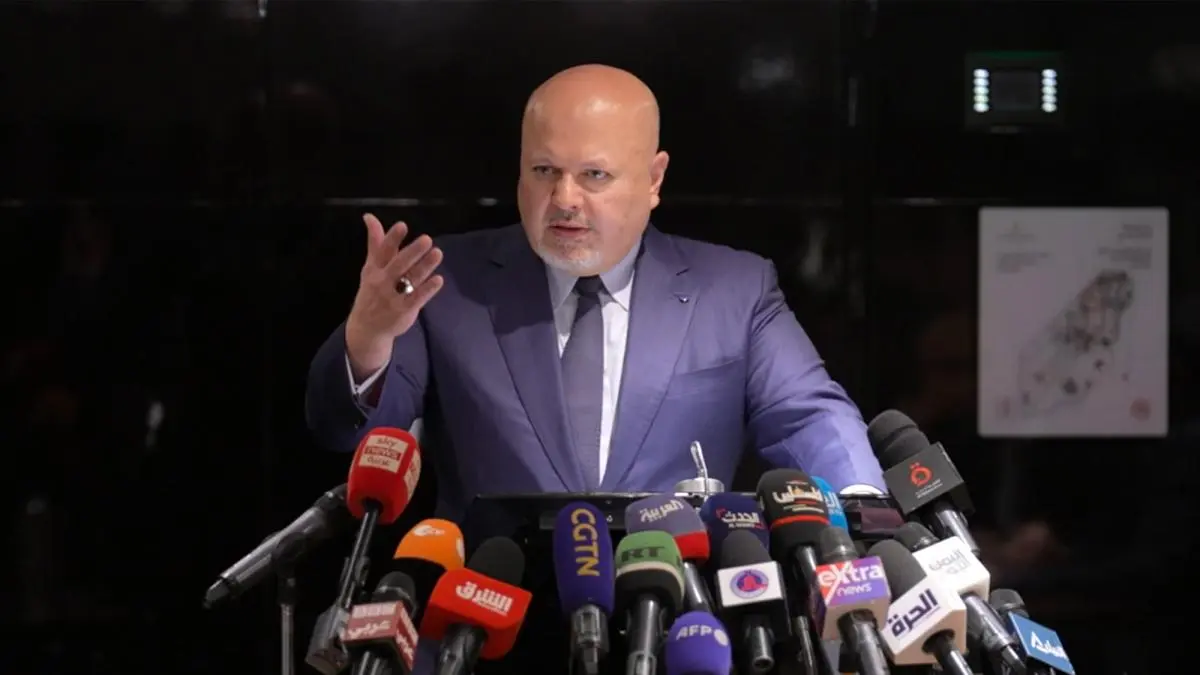
The prosecutor who took on Netanyahu over Gaza now fights for his survival. Evidence from a Zionist gathering in Israel reveals his case is part of a wider war against any UN official who pursues accountability for the Gaza genocide—and the UK is deeply complicit.
The video clip, played from a conference stage in the heart of Israel, is striking not for its substance—the facts have long been documented—but for its tone. There is no remorse, no defensiveness, no attempt to disguise the strategy. There is only pride.

Hil Neuer, speaking at the annual conference of the Jewish News Syndicate, a Zionist media organization dedicated to defending the Israeli state and whitewashing its actions, stood before an audience and did something remarkable: he boasted about destroying the life of a United Nations official.
“Francesca Albanese, the UN rapporteur on Palestine,” Neuer began, before accusing her of stating what is widely understood as fact—that the United States is influenced by a powerful pro-Israel lobby. Then he pivoted to the result of his organization’s campaign against her.
“We are fighting back. We are fighting back. We have exposed her,” Neuer declared. He listed the countries his group had mobilized to condemn her: France, Germany, Canada, the Netherlands, the United Kingdom, Argentina, Hungary, Latvia, Estonia, and the United States. Then came the achievement he was most eager to share.
“We led a campaign. We got 120,000 people, including many here, who signed our petition asking Secretary Rubio to take action. Secretary Rubio announced for the first time in history the US would sanction a UN official. For the first time in history, UN rapporteur Francesca Albanese was sanctioned by the United States.”
And then, the detail that exposed the cruelty as the point: “She cannot use a bank card. She cannot use a debit card. She cannot receive a payment. And in her words, the sanctions are devastating.”
The audience’s response: “Very good. Very good.”
The Same Playbook, The Same Target
Karim Khan KC, speaking to Al Arabiya English on 26 June 2026 from a location he cannot leave due to his own US sanctions, listened to the account of what happened to Francesca Albanese with the weary recognition of a man who has lived the same ordeal. The ICC prosecutor who filed arrest warrant applications against Israeli Prime Minister Benjamin Netanyahu and former Defense Minister Yoav Gallant in November 2024 has been methodically dismantled by the same machinery, using the same methods, producing the same results.
The warrants, relating to the conduct of the war in Gaza—a campaign that has seen the bombing of hospitals, markets, incubators, schools, water wells, and refugee tents, that has amputated infants and burned children alive—placed Khan at the center of the geopolitical firestorm that inevitably engulfs anyone who pursues legal accountability for the Israeli state.
The message from Washington was delivered before the warrants were even issued. Twelve United States senators wrote to the British prosecutor with a threat of exceptional clarity: “If you target Israel, we will target you and your family. You have been warned.”
“That’s almost a verbatim quotation,” Khan told Al Arabiya. “And so, one can say in this area at least, they are truthful and they’ve made good on their promises.”
They made good. Within months, Khan became the first ICC official sanctioned by the United States under President Trump in February 2025. His bank accounts were frozen. He cannot hold a credit card in his own name. He cannot receive a payment. His ability to travel has been so severely curtailed that he will be physically barred from New York on 24 July 2026, when the 125 member states of the Assembly of State Parties convene to decide whether to terminate his career. Later, the sanctions expanded: six ICC judges and two other officials were added to the list.
The parallels with Albanese’s case are not coincidental. They are the blueprint. Target the individual. Freeze their finances. Ban their travel. Mobilize allied governments to issue condemnations. Create a media firestorm. Make their life unlivable. Then, as Neuer demonstrated from the conference podium, boast about it publicly as a deterrent to others.
“To cause pain,” Khan said, “is not an unanticipated consequence. It’s the desired outcome.”
The UK Connection: Lawyers for Israel and the Bar Standards Board
If the United States has been the hammer of the campaign against Khan, the United Kingdom has been the scalpel—quietly, surgically removing his ability to practice the profession to which he has dedicated his life.
On 19 June 2026, just one week before his interview with Al Arabiya, the Bar Standards Board (BSB) of England and Wales issued an interim suspension order, stripping Karim Khan KC of his right to practice as a barrister. The timing, coming weeks before the critical ASP vote on his future, was devastating. But the backstory, Khan revealed, goes back years—and leads directly to a group called UK Lawyers for Israel.
“There have been previous attempts by UK Lawyers for Israel, twice in fact, to make complaints against me on the basis of the applications that we filed—that I filed—in the Palestine situation,” Khan disclosed. “That was dismissed. They appealed it. That was dismissed as well.”
The complaints, based on Khan’s decision to pursue arrest warrants for Israeli leaders over the conduct of the war in Gaza, were thrown out. But UK Lawyers for Israel, a Zionist legal advocacy group that mobilizes British lawyers to shield the Israeli state from accountability, did not stop. When the political Bureau of the ICC voted to suspend Khan on 8 June 2026, the group saw a new opening.
“This interim suspension, you’re quite right, it was very painful. It hurt,” Khan said. “It’s not based upon their own evaluation of evidence. It’s not based upon anything really except the fact that the political bureau of the ICC, this group of 21 countries, by majority, by qualified majority, decided to suspend me.”
He continued: “And of course, what can raise one’s own questions. These allegations have been known for more than a year. I took a voluntary leave from May. What the need was for that suspension is questionable, but certainly led to somebody giving this information to the Bar Standards Board and then the Bar Standards Board issuing an interim suspension.”
The chain of events is clear: a political vote at the ICC, driven by a Bureau dominated by Western states including the UK, triggered a professional suspension in Britain—without the BSB conducting its own independent evaluation of the underlying evidence. The evidence that had already been reviewed by three independent judges, who found no misconduct.
Khan’s chambers’ website had long made clear that he was not practicing domestically, dedicating himself full-time to the ICC. The suspension was not about protecting clients or the public. It was punitive. It was symbolic. It was, as Khan described it, “emotionally painful.”
“I’m sure some would quite like that,” he said of the possibility that the suspension could end his career permanently.
The Campaign Within
The external assault—the sanctions, the financial strangulation, the travel bans, the professional suspensions—tells only half the story. The more insidious threat to Khan’s position has been manufactured from within the institution he leads, and the timing of its escalation is impossible to separate from the Gaza warrants.
A 5,000-page report by the United Nations Office of Internal Oversight Services (OIOS), compiled over a full year of investigation, examined allegations of sexual misconduct against the prosecutor. The ICC Bureau appointed three independent judges—two men and a woman—to review the full body of evidence. They delivered 137 findings. On 21 March 2026, they issued a unanimous advisory opinion: there was no evidence whatsoever of inappropriate conduct, misconduct, or abuse of authority by Karim Khan.
“I thought that would be the end of it,” Khan said. “Why appoint judges if you’re going to reject their findings and their advice?”
It was not the end. It was barely the beginning of the political phase.
On 8 June 2026, the Bureau—a body disproportionately composed of Western European and allied states, Khan noted—voted to suspend him as prosecutor until the full ASP membership could vote in secret ballot. The vote marked a radical departure from the court’s history. “In the 20 years of the International Criminal Court until my matter, experts have written that not one decision of the Bureau was decided by a vote. It was all by consensus—until Karim Khan’s matter was before the Bureau.”
The political mechanics now facing Khan are designed for conviction. To find him guilty of sexual misconduct requires a two-thirds majority of 125 member states: 83 votes. If that threshold is met, a subsequent motion to remove him can pass by simple majority—just 63 states. Yet Khan says he has been given no formal guidance on the procedure, no clarity on whether he will be permitted to address the Assembly, no indication of what standard of proof applies. His lawyers have formally asked the Bureau Secretariat which members have actually read the 5,000-page report. They have received no answer.
“I’m in the dark,” Khan said. “I find out things from the media, from speculation. They have not told me what the procedure is.”
He suspects—and has reason to believe—that many of the ambassadors who will cast their votes have not read the evidence that exonerated him. “The fact that they have evidence available is not the same thing as reading it.”
The Pattern of Coercion
What the Jerusalem conference clip makes explicit is what Khan has been living: a coordinated, multi-front campaign designed not merely to defeat individuals but to send an unmistakable message to anyone who might consider holding the Israeli state accountable under international law.
Albanese spoke about Palestine. She was banned from receiving payments. She cannot use a debit card. She cannot receive a salary. She was condemned by a roll-call of Western governments mobilized by organized campaigns. She was banned from American universities—Harvard, Princeton, Georgetown, Columbia. Her sanctions are, in her own words, “devastating.”
Neuer’s boast reveals the contradiction at the heart of the Zionist victimhood narrative. He began his attack on Albanese by accusing her of claiming the Jewish lobby controls American policy—a charge he treated as a blood libel. Then he proceeded to prove her point in granular detail, listing the countries his organization had successfully pressured, the sanctions it had secured, the financial suffocation it had achieved, the careers it had destroyed.
“We are fighting back,” he said, and the “we” encompasses a network that stretches across Western capitals, through compliant media organizations, through groups like UK Lawyers for Israel, into the machinery of professional regulatory bodies, and into the very governing structures of the United Nations itself.
The UK is not a bystander. It is an active participant. A British prosecutor is facing professional death by a British regulator, triggered by a political process in which the British government wields influence, after years of legal harassment by a British Zionist organization that seeks to shield a foreign state from accountability for genocide.
Who Reads the Evidence?
The gap between the judicial process that cleared Khan and the political process now moving to destroy him is vast and revealing.
Three independent judges, handpicked by the Bureau, reviewed 5,000 pages of evidence. They delivered 137 findings. They unanimously concluded: no misconduct. No abuse of authority. Nothing that meets any standard of prohibited conduct.
“The biggest group of countries is the Africa group,” Khan noted. “There are 33 countries from the Africa group. And no country from the whole of this vast continent of Africa supported the finding of misconduct. They were really of the view that you have judges, you should stick with the judges.”
But the Bureau—dominated by WEOG, the Western European and Others Group, and Eastern European states—chose to override the judges. They voted to suspend. They referred the matter to the full Assembly. They are, Khan believes, preparing to bypass the two-thirds majority required for a misconduct finding and move directly to a simple-majority vote to fire him.
Asked if he fears this procedural maneuver will succeed, Khan’s answer was the answer of a lawyer, not a politician. “I won the legal case. I have the decision of three independent judges. I’m a simple person. I know a little bit about the law. I won in that forum. Where I’m a bit out of my depth is amongst big powerful states that have the full apparatus of ambassadors all over the world, and some of them are very vociferous and organized in their lobbying for a particular outcome.”
The states that sanctioned Albanese—France, Germany, the UK, the US—are the same states that hold disproportionate influence over the ICC Bureau. The same UK that allowed its Bar Standards Board to strip Khan of his license. The pattern is complete.
The Court on Trial
The ICC is now running the most active docket in its 23-year history. Khan’s office is pursuing cases in Palestine, Afghanistan, Myanmar, and other situations. But the institution is engulfed by a legitimacy crisis unlike any it has faced. American sanctions target its judges and its prosecutor. Internal political processes, seemingly coordinated with external pressure campaigns, threaten to decapitate its leadership. The message to the developing world—the African states that supported Khan, the states that see the court as a shield against impunity—is that the rules change when powerful interests are at stake.
“Is the ICC going to emerge from this stronger,” Khan was asked, “or will we be witnessing the beginning of the end?”
He did not reach for comfort. “I think the jury’s out. I don’t believe this simple adage that what doesn’t kill you makes you stronger. If you’re beaten up, you’re not stronger in the short term—you’re bruised or your bones are broken. So time will tell.”
But he returned, repeatedly, to the reason the court exists in the first place. The victims of Gaza. The children who survived the bombing of incubators. The families incinerated in refugee tents. The hospitals reduced to rubble. “They’re suffering a million times worse. They have much more insecurity, much more pain, and they deserve better from us—from me, but from the institutions as well. Focusing on them, that’s a battle worth fighting because their rights should never be surrendered.”
The Jerusalem conference revealed the strategy in the words of its architects: expose, condemn, sanction, freeze, ban, destroy. Make an example. Ensure no one follows. UK Lawyers for Israel filed the complaints. The Bar Standards Board delivered the suspension. The British state, through its role in the ICC Bureau, helped create the political conditions that made it possible.
The question now is whether the Assembly of State Parties, when it gathers in New York on 24 July 2026, will ratify that strategy or reject it. The man who pursued the warrants against Netanyahu will not be in the room. He has no bank card. No credit card. No ability to travel. No license to practice the law he has served his entire career.
“Some sanity and fairness can prevail,” he said, at the end. “But that’s not under my control.”
The vote is less than four weeks away. In Jerusalem, they already celebrated the last one. In London, the regulator has done its part. The machinery grinds on.