
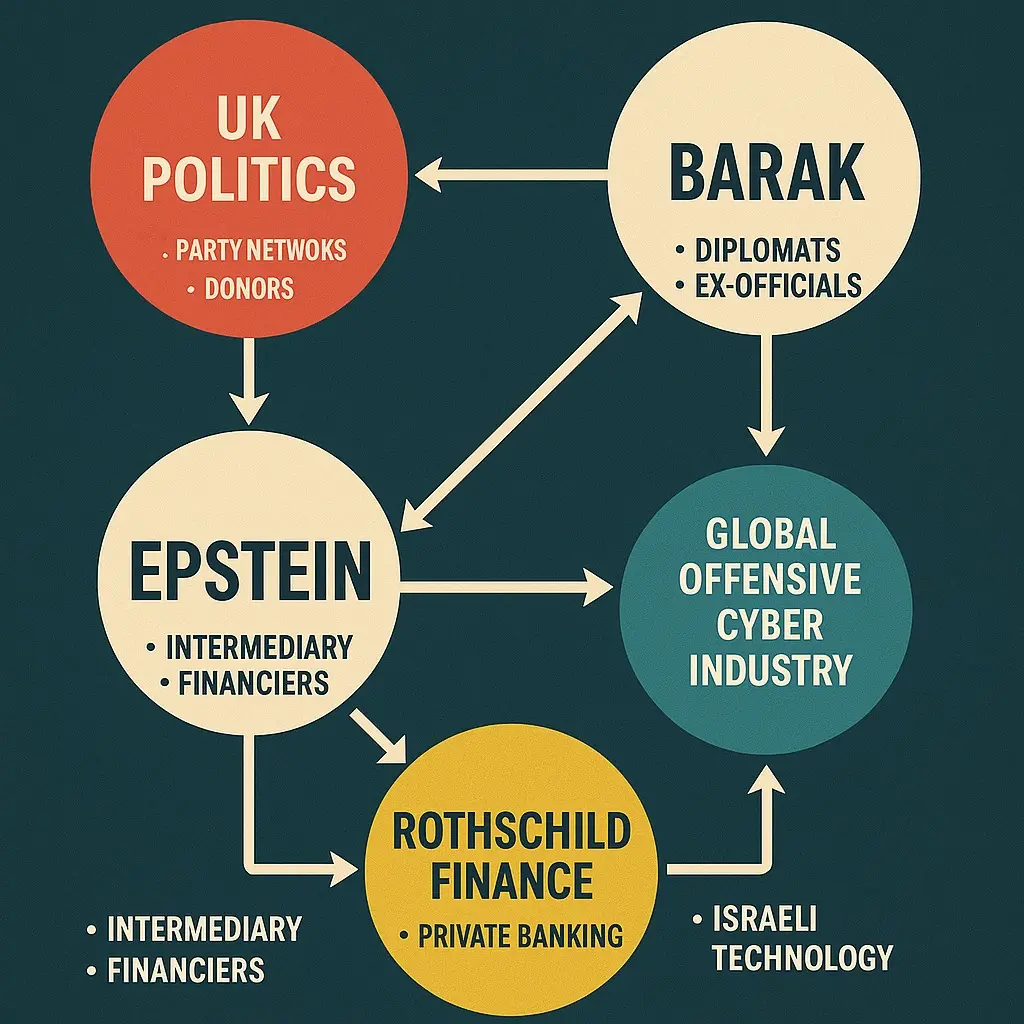

For years, anyone who suggested that British politicians, Israeli diplomats, US power-brokers and European private banking dynasties operated within the same ecosystem was dismissed as conspiratorial. The idea that these worlds not only overlapped but functioned as parts of a single structure was treated as internet folklore.
Then the emails leaked.
First came a cache involving Ron Prosor, Israel’s former ambassador to the United Kingdom, revealing an extraordinary intimacy with senior UK Conservative Party figures, donors, media allies and lobbyists. These emails also provided insight into how elements of the British political class aligned with Israeli diplomatic interests during the campaign to destroy Jeremy Corbyn, then the leader of the UK Labour Party.
Then came the Ehud Barak inbox leak, centred on the former Israeli prime minister, exposing correspondence that placed Barak, US financier Jeffrey Epstein and Ariane de Rothschild, head of a major Franco-Swiss private banking dynasty, in the same chain discussing investment pathways and technological ventures tied to Israel’s offensive cyber industry.
Individually, these stories could be treated as scandals. Together, they reveal something larger: a written record showing how political influence, private capital and intelligence-derived technologies moved across the UK, Israel and the US inside a shared network.
This isn’t a collage of unrelated episodes. It is a single system — spanning London, Tel Aviv, New York and Geneva — functioning with a coherence that becomes impossible to deny once the machinery is visible.
The UK Front: Ron Prosor and the British Conservative Power Base
When journalists reviewed thousands of leaked emails belonging to Ron Prosor, what struck them wasn’t just the content — it was the tone. Senior figures in the UK Conservative Party did not speak to Prosor like a foreign diplomat. They spoke to him like a trusted friend.
The correspondence reveals a network in which UK Conservative MPs, UK donors, UK think tank figures and UK media actors interacted casually and warmly with an Israeli diplomat, sharing political strategies and personal sentiments.
A UK Conservative treasurer pledges emotional allegiance to Israel
One email from 2014, during Israel’s assault on Gaza (Operation Protective Edge), came from Mick Davis, a prominent UK Conservative Party treasurer. Davis told Prosor:
“I am thinking of you and my country and her people and soldiers all the time.”
He was not referring to the United Kingdom. His “country” was Israel.
Davis went on to reassure Prosor that then–UK Prime Minister David Cameron and then–UK Foreign Secretary Philip Hammond were “totally on side” with Israel. A senior British political figure expressing allegiance to a foreign state — in writing — is extraordinary, yet it remained hidden until the leak.
A UK think tank director boasting about a hit piece on a UK opposition leader
Another revelation involves Dean Godson, a Conservative member of the UK House of Lords and director of Policy Exchange, a prominent UK right-wing think tank.
Godson emailed the Israeli ambassador boasting that he and “a few comrades” had successfully placed an anti–Jeremy Corbyn story in the Daily Mail, a major UK newspaper.
This was not ideological sympathy; it was a UK political operative coordinating with an Israeli diplomat about domestic UK media warfare.
A web of UK social and political relationships
The Prosor emails show:
- UK Conservative lords inviting Prosor to private social events
- UK political donors writing to Prosor in warm, affectionate tones
- UK think-tank figures treating Prosor as a colleague
- Continued communications even after Prosor left his official role
These were not professional interactions between British politicians and a foreign ambassador. They were personal friendships that carried political consequences.
The UK Labour Dimension: Hotovely and Britain’s New Power Structure
A separate disclosure — obtained via an Israeli Freedom of Information request — reveals that the same style of political networking persisted after the UK Labour Party formed a government in 2024.
This time the central figure was Tzipi Hotovely, Israel’s ambassador to the United Kingdom, known internationally for extreme rhetoric and for defending Israeli attacks on civilian infrastructure in Gaza.
Her recently released diary shows that Hotovely was meeting with:
- Directors of Labour Friends of Israel (UK)
- Senior executives at BP, a UK multinational corporation seeking access to gas reserves off Gaza
- Stuart Roden, a major UK Labour donor who gave roughly £400,000 ahead of the 2024 election
- Jonathan Goldstein, another UK Labour-linked donor with close ties to both David Lammy and Keir Starmer
Some of these meetings occurred while Israel was escalating its military assault on Gaza.
The point is not that the UK had a relationship with Israel — states maintain relationships. The issue is that Israeli diplomats were deeply enmeshed in the internal political networks of both major UK parties, cultivating and leveraging personal access to shape political outcomes.
The UK’s Conservative Friends of Israel: A Lobby Group with Hidden Funding
Another major revelation involves Conservative Friends of Israel (CFI), a UK lobby organisation that boasts membership from roughly 80% of Conservative MPs.
CFI has never disclosed its funders.
The leaked emails show Stuart Polak, CFI’s long-time director and a UK Conservative peer, contacting an Israeli diplomat in New York (US) to discuss support from US billionaire Paul Singer, a known funder of pro-IDF organisations.
Polak reports “good progress” with Singer and asks the Israeli diplomat to introduce him to “other Paul Singers” — meaning other US or international megadonors who might finance CFI’s operations in the UK.
This is the first documented evidence linking UK Conservative lobbying structures to US-based donor networks aligned with Israeli military and diplomatic interests.
The Mandelson Thread: A UK Elder Statesman in the Epstein Orbit
The Barak inbox leak also touches the UK political landscape through Peter Mandelson, a senior figure in the UK Labour Party and a former EU Trade Commissioner.
In 2013 — five years after US financier Jeffrey Epstein pleaded guilty to sex offences involving a minor — Mandelson emailed Epstein seeking help vetting a UK political consultant.
Despite public claims that he distanced himself from Epstein, the emails show ongoing, active contact with the disgraced US power broker.
This is not just Epstein’s influence on Britain; it is evidence of UK participation inside the US elite orbit Epstein ran.
The Second Leak: Epstein (US), Barak (Israel) and Rothschild Finance (Europe)
While the Prosor leaks map the UK–Israel political axis, the Ehud Barak inbox leak reveals the transnational financial and technological dimension. It shows how Israeli intelligence figures, US intermediaries and European private banking dynasties operated in tandem.
To understand it, we must view Jeffrey Epstein (US) not merely as a criminal, but as a broker whose power rested on connecting elites across politics, finance and intelligence.
Epstein: a US-based intermediary linking Israel and Europe
Between 2013 and 2017, Epstein held over 100 meetings with global elites despite his criminal conviction.
He remained valuable because he provided:
- discreet introductions
- private funding channels
- a bridge between US, Israeli and European power centres
- plausible deniability for figures who could not liaise publicly
This is exactly what we see in the Barak emails: Epstein relaying messages between Ehud Barak (Israel) and Ariane de Rothschild (Europe).
One message from Ariane de Rothschild, delivered via Epstein, encourages Barak that if he wants to “make serious money,” he should build a relationship with her.
A US financier was functioning as a pipeline between an Israeli ex–prime minister and a Franco-Swiss banking dynasty.
Barak: Israeli intelligence expertise moves into the private sector
Barak, a former Israeli prime minister and former Israeli minister of defence, had long-standing business ties to Epstein, who invested about $2.3 million into Barak’s ventures.
Barak’s career after government mirrors an established Israeli intelligence pattern:
- Israeli intelligence units (such as Unit 8200 and Unit 81) train elite operatives
- Former officials leave government and move into private tech and cyber firms
- These firms recruit former intelligence personnel
- They seek capital from private, offshore or international sources
- The Israeli state benefits indirectly while maintaining deniability
The Barak emails show him discussing startups staffed by Unit 81 veterans — the same talent base behind Israel’s offensive cyber industry.
Rothschild finance: discreet European capital
The Edmond de Rothschild Group, headquartered in Switzerland and France, specialises in:
- private wealth
- offshore-capable investment vehicles
- discreet cross-border finance
Between 2013 and 2019, the group met Epstein repeatedly and signed a $25 million agreement with his company.
The Barak leak shows Epstein trying to bring Barak into that financial relationship — positioning himself as a US intermediary between Israeli intelligence-derived ventures and European private capital.
This is not unusual. This is how sensitive technologies are financed: Israel provides expertise, the US provides intermediaries, Europe provides discreet capital.
Israel’s Offensive Cyber Export Industry: The Global Context
The final strand is the broader context: Israel’s role as the world’s leading exporter of offensive cyber tools.
The model works as follows:
- Israel trains operatives in military and intelligence units
- Those operatives leave and enter private companies
- These companies develop spyware and offensive cyber tools
- Tools like Pegasus (NSO Group, Israel) are marketed globally
- Governments in over 50 countries have used Pegasus to target journalists, activists and political opponents
- Sales occur through complex international financial structures involving US intermediaries and European banks
Barak’s involvement in startups drawing from Israeli military intelligence fits perfectly into this system. Epstein’s role as a US connector fits perfectly. Rothschild finance fits perfectly.
The leaked emails simply expose how the pieces fit together.
A Single Network Across Three Countries
Taken together, the leaks reveal a structure in which:
• The United Kingdom contributes political access, party networks, donors, media channels and parliamentary influence.
• Israel contributes diplomats, former senior officials, intelligence expertise and a powerful cyber-industrial base.
• The United States contributes intermediaries, financiers, and access to global elite circles through figures like Epstein.
• Europe contributes discreet banking structures capable of moving money across borders without public scrutiny.
This is not conspiracy. It is a documented structure linking UK politics, Israeli diplomatic strategies, US brokerage networks and European private capital.
The leaks expose the business model behind modern influence: political access, private wealth and intelligence expertise moving seamlessly across borders — with no democratic oversight.
Once you see the machinery, the story stops being about individuals. It becomes a story about how power really works across the UK, Israel and the United States.