
There is an uncomfortable contradiction at the heart of modern evangelical politics. Millions of Christians around the world continue to offer unwavering support to Israel, often treating that support not merely as a political preference but as a religious duty. Yet mounting evidence from Jerusalem, Gaza, the West Bank, Lebanon, and the wider region suggests Christianity itself is increasingly treated with hostility, restriction, or indifference under Israeli authority and by elements within Israeli society.
For decades, large segments of evangelical Christianity have framed support for Israel as a moral and theological obligation. In churches, television ministries, online sermons, Christian conferences, conservative political movements, and global advocacy networks, standing with Israel is often presented as inseparable from standing with God.
Within this worldview, Israel occupies a unique spiritual place. It is regarded as the land of the Bible, the setting of the Old and New Testaments, the place where Jesus lived, preached, was crucified, and according to Christian belief, rose again. Many evangelical Christians interpret the modern State of Israel through prophetic readings of scripture, seeing Jewish sovereignty over the land as part of divine fulfilment and therefore as something believers are required to defend.
But that loyalty becomes harder to explain when Christians confront a growing body of incidents suggesting that Christian symbols, clergy, churches, holy sites, traditions, and communities are frequently disrespected, restricted, attacked, or ignored in places under Israeli control or affected by Israeli military operations.
In Jerusalem, videos have repeatedly circulated showing ultra-Orthodox Israelis spitting at Christian clergy and pilgrims as they walk through the Old City. Priests carrying crosses or dressed in traditional robes have described harassment, insults, intimidation, and abuse. Christian leaders in the Holy Land have increasingly warned that Christian life in Jerusalem is under pressure.
In Gaza, one of the oldest Christian communities in the world has endured bombing, displacement, siege, church damage, and the killing of parishioners. In southern Lebanon, Israeli soldiers have been filmed desecrating Christian symbols, damaging statues, and mocking Christian rituals inside churches. In the West Bank and East Jerusalem, Palestinian Christians speak of checkpoints, settler violence, land pressure, and a political reality that many evangelical supporters of Israel rarely hear described from the pulpit.
These incidents do not by themselves define every Israeli, nor do they erase the real security fears that many Israelis live with. No society should be reduced to its extremists or its worst episodes. But patterns matter, especially when the people most affected are Christians living in the very land that global evangelicals call holy.
The question is therefore no longer whether Christians should care about Israel. The more difficult question is whether evangelical Christians around the world are willing to apply the same moral scrutiny to Israel that they would apply to any other state, especially when fellow Christians in the Holy Land say they are being harassed, displaced, ignored, or placed in danger.
Jerusalem and the normalisation of anti-Christian harassment
Jerusalem occupies a unique place in Christian consciousness because it is not simply a city of history. It is a city of sacred memory, a place bound to the central events of the Christian faith.
For believers across the world, the Old City contains locations tied to Christianity’s most important claims. The Church of the Holy Sepulchre is traditionally believed to mark the site of Jesus Christ’s crucifixion, burial, and resurrection. The Via Dolorosa, the Mount of Olives, the Garden of Gethsemane, and other sites form part of a spiritual geography that Christians have revered for centuries.
Yet in recent years, Christian clergy in Jerusalem have repeatedly described a worsening atmosphere. Videos have shown ultra-Orthodox Israelis spitting toward priests, monks, and pilgrims. Clergy have reported being cursed, shoved, spat at, and insulted while wearing clerical robes or carrying visible Christian symbols.
The problem has become so common that some church leaders say it can no longer be dismissed as isolated misbehaviour. Christian representatives have spoken publicly about vandalism, cemetery desecration, graffiti, damage to church property, and a climate in which radical religious activists appear increasingly emboldened.
A Jewish Israeli monitoring group has documented physical assaults against Christians in Jerusalem, many involving clergy. The significance of that detail should not be missed. The problem is not only being raised by Palestinian Christians or foreign critics of Israel. It has also been documented by Israeli Jews concerned by what they see happening in their own society.
For many evangelical Christians abroad, these reports remain almost invisible. Evangelical media in the United States, Britain, Latin America, Africa, and other parts of the world frequently presents Israel as a besieged biblical ally, but far less often gives sustained attention to the experience of local Christians who live under Israeli authority or in areas affected by Israeli policy.
That silence has consequences. If Christians abroad are repeatedly told that Israel is the natural defender of biblical heritage, but are rarely told that Christian clergy in Jerusalem are being spat on or attacked, then their moral understanding of the Holy Land is being shaped by omission.
Local Christian communities argue that these incidents matter precisely because Jerusalem is not an ordinary city. When priests feel unsafe walking through the streets of the city where Christianity was born, it should trouble believers everywhere.
Palm Sunday and the Church of the Holy Sepulchre
Recent events have added to those concerns.
In March 2026, reports emerged that Israeli police blocked Cardinal Pierbattista Pizzaballa, the Latin Patriarch of Jerusalem, from entering the Church of the Holy Sepulchre to conduct Palm Sunday Mass. Church officials described the incident as unprecedented and said the service had been coordinated in advance with Israeli authorities.
According to the Latin Patriarchate, the Mass was expected to proceed in a limited format involving clergy and international broadcast. Despite those arrangements, the cardinal was reportedly stopped en route and forced to turn back.
The Palm Sunday service was relocated elsewhere in Jerusalem, breaking with centuries of Christian tradition at one of the holiest sites in Christianity.
The significance of the incident is difficult to overstate. The Church of the Holy Sepulchre is not simply another church. It is traditionally believed to contain the sites of Jesus Christ’s crucifixion, burial, and resurrection. Palm Sunday marks the beginning of Holy Week, one of the most sacred periods in the Christian calendar.
Church officials warned that preventing access to the church represented a serious challenge to the long-standing status quo arrangement governing religious practice in Jerusalem, a framework that has survived Ottoman rule, British administration, Jordanian control, Israeli control, and periods of war.
Even during the upheaval of 1948 and the division of Jerusalem, religious ceremonies at the Church of the Holy Sepulchre continued. That fact matters because it places the reported obstruction in a much larger historical context.
For many Christians, the issue is not simply whether Israeli police made a security decision during a tense period. The question is why such a disruption occurred during one of Christianity’s most sacred observances, at Christianity’s holiest church, involving the highest-ranking Catholic authority in Jerusalem.
European Union foreign policy chief Kaja Kallas reportedly criticised the decision as inconsistent with protections for religious freedom. Italian Prime Minister Giorgia Meloni also condemned the incident, describing it as an offence not only to Christians but to anyone who values freedom of worship.
Supporters of Israel may argue that wartime conditions and security restrictions explain the decision. Critics point instead to the broader far-right political climate in Israel and the growing influence of officials associated with hardline positions toward religious minorities.
Whatever interpretation one accepts, the symbolism remains powerful. The highest-ranking Catholic authority in Jerusalem was reportedly prevented from entering Christianity’s holiest church during Palm Sunday.
For many Christians, that cannot easily be dismissed as a minor misunderstanding.
Gaza’s ancient Christian community
Much of the international conversation about Gaza focuses on war, Hamas, Israeli military operations, hostages, displacement, famine warnings, destroyed hospitals, and the collapse of civilian life. Far less attention is paid to the small but ancient Christian community that has lived there for generations.
Gaza’s Christians are not recent arrivals. They are part of one of the oldest Christian presences in the world, rooted in the region since the earliest centuries of the faith. Some families trace their heritage through generations of Palestinian Christian life, preserving churches, schools, rituals, and communal traditions under increasingly difficult conditions.
During the war in Gaza, churches became places of refuge. Families gathered inside church compounds hoping that sacred spaces might offer some protection from bombardment, displacement, and chaos.
Yet Christian churches were damaged, Christian civilians were killed, and church leaders issued repeated warnings about the danger facing their communities.
One of the most shocking incidents involved a mother and daughter who were shot dead inside the compound of the Holy Family Parish in Gaza. Church officials said the women were killed by Israeli sniper fire while sheltering at the church. The Latin Patriarchate described the victims as Nahida Khalil Anton and her daughter Samar Kamal Anton, saying one was killed while trying to carry the other to safety.
The killing of two Christian women in a church compound should have triggered outrage across the evangelical world. Yet the reaction in many pro-Israel evangelical circles was muted, cautious, or absent.
Critics ask whether this silence would have been possible if the same incident had occurred in a Muslim-majority country hostile to Western interests. Would evangelical leaders have remained quiet if Christian women had been shot inside a churchyard by another military power? Would they have accepted explanations of accident or wartime confusion so readily?
Israel has denied deliberately targeting Christians and has often described damage to churches or civilian sites as accidental, the result of battlefield conditions, or the consequence of militants operating nearby. Those explanations may persuade some supporters. But critics argue that repeated incidents involving Christian sites, Christian civilians, and Christian symbols create a pattern that demands scrutiny rather than reflexive dismissal.
In one incident, an Israeli tank reportedly fired at or near the cross atop a Christian church in Gaza. For many Christians, the symbolism was immediate and painful. A cross is not simply an architectural feature. It is the central symbol of Christian faith.
When churches are damaged, crosses struck, parishioners killed, and clergy forced to plead publicly for protection, global evangelicals should at least be asking hard questions.
The silence of Christian leaders
One of the most disturbing aspects of these incidents is not only that they occurred, but that many evangelical leaders who speak loudly about Christian persecution elsewhere have said relatively little about Christians suffering under Israeli military action or Israeli authority.
Across the world, evangelicals regularly mobilise around the persecution of Christians in China, Nigeria, Pakistan, Iran, Iraq, Egypt, and other countries. Churches raise money. Mission organisations publish reports. Politicians are pressured. Sermons are preached. Petitions are circulated.
Yet when Palestinian Christians are killed, displaced, blocked, harassed, or trapped under bombardment, many of the same networks become far more cautious.
This selective outrage is difficult to defend. If Christians believe the global church is one body, then Palestinian Christians are not an inconvenience to be ignored because their suffering complicates a favoured political narrative. They are part of the same faith community.
The silence becomes even more striking because evangelical support is one of the pillars sustaining Israel’s international political backing. In the United States, Christian Zionists form a crucial constituency behind military aid, diplomatic protection, and congressional support for Israel. In other countries, evangelical movements also influence public opinion, political parties, media narratives, and religious attitudes toward the conflict.
If those Christians demanded accountability, it could matter. If evangelical leaders in the United States, Britain, Brazil, South Africa, Nigeria, South Korea, Australia, and elsewhere called their political representatives and said they would not support funding or defending a government accused of mistreating Christians, the political calculation could change.
That is why critics argue this is not an abstract theological debate. It is a question of power.
Evangelicals are not merely spectators. In many countries, they are part of the political infrastructure that allows Israel to act with broad international protection.
Lebanon and the desecration of Christian symbols
The concerns are not limited to Gaza or Jerusalem.
In southern Lebanon, Israeli soldiers have been filmed in incidents that appeared to show contempt for Christian symbols and sacred spaces. One video showed an Israeli tank or military vehicle damaging a statue of St George slaying the dragon, a symbol with deep Christian resonance in a country with one of the Middle East’s largest remaining Christian populations.
Lebanon is not an incidental setting for such an incident. It has a long Christian history, a political system in which the presidency is reserved for a Maronite Christian, and communities that have survived war, occupation, displacement, sectarian tension, and regional upheaval.
For Christians in Lebanon and across the region, the sight of Christian iconography being crushed or damaged by a foreign army carries deep historical meaning. It is not merely a statue. It is a marker of presence, memory, and faith.
Another incident in southern Lebanon showed Israeli soldiers inside a church mocking Christian rituals. The soldiers reportedly filmed themselves and circulated the footage. For Christians, the desecration of a sacred space is not a trivial matter. Churches are consecrated places of worship, prayer, confession, baptism, burial, and communion.
The moral test is simple. Imagine soldiers entering a synagogue, mocking Jewish rituals, filming themselves, and posting the footage online. The outrage would be immediate and justified. Those responsible would likely become internationally infamous within hours.
Christians should apply the same standard to their own sacred spaces.
Desecrating a church is wrong. Mocking another people’s worship inside their sanctuary is wrong. Destroying religious symbols is wrong. These judgements should not depend on whether the perpetrators belong to a state favoured by one’s political camp.
The crucifix destroyed in Debel
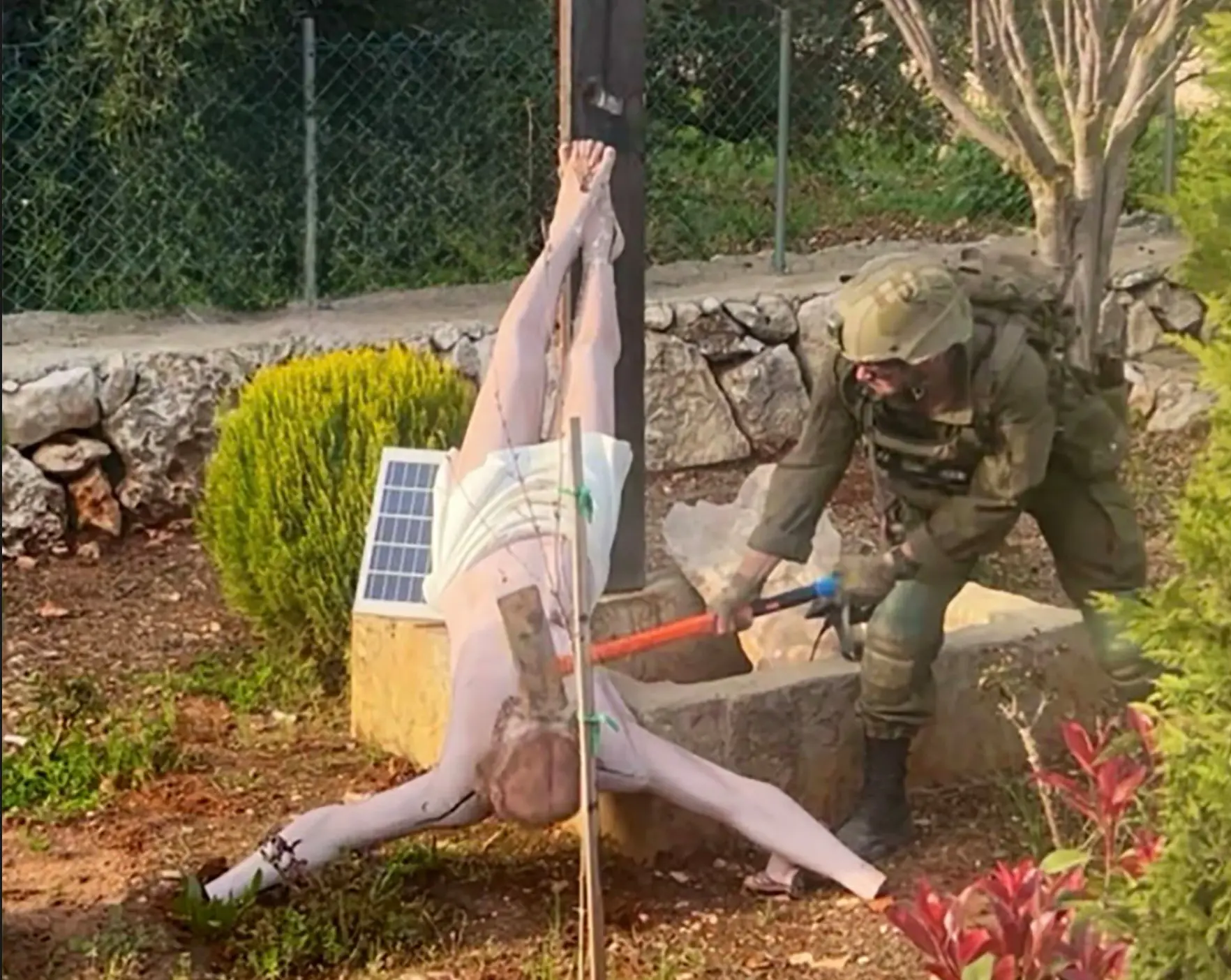
Another example came in the Christian village of Debel in southern Lebanon, where Israeli soldiers were jailed after one was filmed smashing a statue of Jesus with a sledgehammer while another recorded the act.
According to the Israel Defense Forces, the soldiers were removed from combat duty and sentenced to 30 days in prison after investigators concluded their actions completely deviated from IDF orders and values.
Images circulating online showed the statue of the crucified Jesus broken apart beside a family home, prompting outrage among Christian communities and religious leaders.
The IDF later stated that six additional soldiers were present during the destruction and did not act to stop the incident or report it. The military said those soldiers would face further review and claimed that procedures concerning conduct around religious institutions and symbols had been reinforced for troops operating in the area.
Israel later replaced the destroyed crucifix and said it had done so in coordination with the local community. Yet for many observers, the replacement did not erase the symbolism of the original act.
Cardinal Pierbattista Pizzaballa, the Latin Patriarch of Jerusalem, expressed deep indignation and unreserved condemnation over what church leaders described as a grave affront to the Christian faith.
Archbishop Vincenzo Paglia drew a direct contrast between Christian teaching and military destruction, reminding audiences that Jesus himself went to Tyre and Sidon in southern Lebanon not to kill, but to heal, feed, and perform miracles.
Even figures closely aligned with Israel expressed outrage. Mike Huckabee, the U.S. ambassador to Israel and a Baptist minister, argued that swift, severe, and public consequences were necessary.
The incident mattered not simply because a religious statue was destroyed, but because many Christians saw it as part of a wider pattern. Critics point to repeated reports of harassment against clergy in Jerusalem, vandalism of churches and cemeteries, damage to Christian symbols, and hostility toward Christian traditions as evidence that anti-Christian sentiment cannot be dismissed as a handful of isolated episodes.
For many believers, the image of a soldier destroying a statue of Jesus carries meaning beyond military misconduct. It reinforces the perception that Christian identity and sacred symbols are not always treated with respect in areas affected by Israeli military operations.
The plus sign and the cross
The debate also touches a deeper question of religious culture.
Critics have pointed to reports that in some Israeli religious schools, the plus sign is avoided in mathematics because it resembles a cross. Instead, an inverted T or alternative symbol is sometimes used.
That detail may appear minor, but it is revealing. The cross is the central symbol of Christianity. If even a mathematical sign resembling a cross is considered offensive in certain religious environments, Christians may reasonably ask what that indicates about attitudes toward their faith among some segments of Israeli society.
Every religious community has the right to its beliefs and sensitivities. Jews have every right to reject Christian theology, just as Christians and Muslims disagree with one another on central doctrines. The issue is not theological disagreement. The issue is whether contempt for Christian symbols becomes normalised and then appears in public harassment, church vandalism, or military desecration.
Evangelical Christians who fund, defend, and politically support Israel should at least be aware of these realities. They should not be shielded from them by religious media or political organisations that present Israel only as a biblical ally and never as a state with factions that may view Christianity itself with hostility.
The evangelical narrative and its limits
These incidents matter because they directly challenge the narrative many evangelicals have been given.
Israel is often portrayed as a natural Christian ally, a protector of biblical heritage, a democratic outpost, and a moral counterweight to hostile forces in the Middle East. In some churches, support for Israel is preached with such force that questioning Israeli policy is treated almost as questioning scripture itself.
Yet critics argue that this image becomes difficult to reconcile with repeated reports of hostility toward Christian communities, especially when those reports come from clergy, local Christians, church authorities, human rights organisations, journalists, and even some Israeli Jewish groups monitoring extremist behaviour.
Supporters of Israel may argue that isolated incidents should not define an entire country. That is true. Every nation contains extremists, and no society should be judged only by its worst actors.
But critics counter that patterns matter.
When incidents involving harassment, desecration, restricted access, damaged churches, killed parishioners, and hostility toward Christian symbols occur repeatedly, particularly in Jerusalem and the wider Holy Land, they raise legitimate questions about why evangelical support remains so unconditional.
This is especially important because the Christian communities most directly affected are often not listened to by the evangelicals who claim to love the Holy Land.
Palestinian Christians, Lebanese Christians, Arab Christians, and clergy serving in Jerusalem frequently describe a reality shaped by occupation, military power, settler pressure, religious hostility, emigration, poverty, and fear. Their testimony rarely receives the same platform in global evangelical circles as pro-Israel advocacy groups.
That absence matters.
If evangelicals see themselves as part of a worldwide body of believers, they should listen not only to politicians, donors, lobbyists, or television preachers, but also to Christians living in Bethlehem, East Jerusalem, Gaza, Lebanon, and the West Bank.
Their experiences complicate the simplified narrative many evangelicals receive.
Gaza, churches, and the question of accountability
The repeated damage to Christian sites in Gaza raises a central question of accountability.
When Israel denies responsibility, then later describes incidents as accidental, critics ask what consequences follow. If churches are damaged, parishioners killed, crosses struck, or Christian compounds hit, who is punished? Who resigns? Who is prosecuted? Who is named?
Too often, critics argue, the answer appears to be no one.
This is where the moral frustration deepens. Evangelical Christians are often told to defend Israel because Israel is supposedly defending the values of the West and preserving the biblical inheritance of Christians. But when actual Christians in Gaza are killed or churches are damaged, many of those same evangelical defenders appear unwilling to demand accountability.
That contradiction is difficult to ignore.
If Christians believe their faith requires them to defend Israel, does it not also require them to defend Christians harmed by Israeli actions?
If Christian symbols matter when they are invoked in sermons, fundraising appeals, and prophecy conferences, should they not matter when they are damaged in Gaza or Lebanon?
If the Holy Land is sacred, are its living Christians not part of that holiness?
These are not anti-Israel questions. They are Christian questions.
The Vatican ambulance that never reached Gaza
Another symbolically powerful example concerns a humanitarian project linked to the Vatican.
Before his death, Pope Francis reportedly supported the conversion of one of his former popemobiles into a medical vehicle intended for Gaza. The ambulance was designed to transport wounded civilians in an area where hospitals had repeatedly collapsed under the pressure of war.
The vehicle was reportedly retrofitted with medical equipment and prepared for humanitarian deployment. Yet despite the symbolic significance of the gesture, it never reached Gaza.
For critics, the story represents more than a logistical failure. They argue it highlights what they see as a broader disregard for Christian appeals, even when those appeals come from one of the most influential religious figures in the world.
The symbolism is powerful. A pope’s final humanitarian effort intended to relieve suffering remained stalled, unable to reach civilians in desperate need.
For Christians troubled by the conflict, the episode raises difficult questions. If a Vatican-backed ambulance cannot pass through the barriers surrounding Gaza, what does that suggest about the weight given to Christian concerns in a region where churches, clergy, and Christian communities already report feeling increasingly marginalised?
Whether one views the delay as bureaucracy, wartime restriction, or political obstruction, critics argue the outcome remains the same. A humanitarian mission associated with the dying wishes of a pope failed to materialise in one of the world’s most devastated conflict zones.
Christian Zionism and political power
Many evangelicals who reflexively support Israel do so because they believe the country reflects shared values. They are told Israel is a natural ally, a nation rooted in biblical history, surrounded by hostile neighbours, and committed to defending Western ideals.
Yet that image increasingly clashes with reports from Christians who live in the region and from critics who argue that the reality is more complicated than the polished narrative promoted in many churches.
At the heart of the debate is a basic moral question. Should Christians automatically support a government whose policies, critics argue, frequently conflict with Christian teachings?
Supporters of Israel often frame the relationship in geopolitical terms. Israel is seen as a democratic ally in a volatile region and a strategic partner of Western governments. But critics contend that evangelical support has evolved into something deeper than political alliance. For many religious leaders, support has become unconditional, leaving little room for scrutiny or moral consistency.
This creates a difficult tension.
Christianity places heavy emphasis on compassion, humility, reconciliation, mercy, and concern for the vulnerable. Yet critics argue that many evangelical leaders overlook actions by the Israeli government that they would condemn immediately if committed by another state.
Among the issues frequently raised are reports of damage to Christian sites, harassment of clergy, restricted access to holy places, settler violence, discrimination against Palestinian Christians, and tensions between Christian communities and Israeli authorities.
Some Palestinian Christians and church leaders have spoken publicly about what they describe as displacement, unequal treatment, and pressure under occupation. Their voices rarely receive the same platform in evangelical circles as pro-Israel advocates.
That imbalance shapes belief.
If evangelicals hear constantly from Israeli officials, lobbyists, prophecy teachers, and Christian Zionist campaigners, but rarely from Palestinian priests, Gaza parishioners, Lebanese Christians, or clergy in Jerusalem, then the moral picture they receive is incomplete.
Theological consistency
Another issue is theological consistency.
Critics question whether Christianity requires political alliance with a modern secular state. While many evangelicals interpret biblical prophecy as mandating strong support for Israel, others argue that Christianity centres on universal ethics rather than national loyalty.
This disagreement is not merely academic. It shapes how millions of Christians understand war, diplomacy, occupation, civilian suffering, and foreign policy.
Some commentators have criticised the way scripture is invoked to justify modern conflicts. Biblical references are sometimes used to frame military action as divinely sanctioned or morally necessary. Yet many theologians argue that Christianity’s central teachings place peace, mercy, forgiveness, and love of enemies at the forefront.
The New Testament repeatedly stresses reconciliation, humility, concern for prisoners, care for strangers, and mercy toward the suffering. For critics, that raises serious concerns when faith is used to endorse violence, excuse civilian harm, or silence criticism of a state.
Would evangelicals excuse similar allegations if they emerged from another country? Would they remain silent if another military power were accused of degrading prisoners, restricting clergy, damaging churches, or humiliating civilians?
Critics argue that Christian faith cannot be selective. If Christians are willing to condemn abuse elsewhere, they may also be called to apply the same moral standards to a state they have long viewed as an ally.
That does not require denying Jewish history, ignoring Israeli security concerns, or dismissing the suffering of Israeli civilians. But it does require asking whether reflexive support risks placing political identity above spiritual principles.
Allegations of detainee abuse and moral collapse
The debate becomes even more difficult when Christians confront allegations involving detainee abuse, torture, and degrading treatment.
Recent reporting and human rights investigations have documented allegations that Palestinian detainees held in Israeli facilities were subjected to humiliation, forced nudity, assaults, sexual violence, violence involving military dogs, and other forms of abuse. Some testimonies included in human rights reports describe allegations of sexual torture involving dogs, which critics argue move beyond intimidation into acts of extreme degradation and alleged rape.
Human rights organisations argue that these practices may not represent isolated misconduct but part of a broader detention environment shaped by secrecy, restricted oversight, wartime emergency powers, and a culture of impunity.
Whether every allegation is ultimately proven in court is a separate question. But the existence of such documented claims forces a deeper moral examination.
For Christians who believe faith should guide political loyalty, the issue is not merely geopolitical. It becomes theological.
If compassion, mercy, dignity, and protection of the vulnerable sit at the heart of Christian teaching, then believers may reasonably ask whether unconditional support for any state accused of such conduct remains consistent with those values.
Christian ethics are built around principles that extend beyond nationality or political allegiance. The teachings of Jesus place unusual emphasis on how societies treat prisoners, strangers, the powerless, and those living under suffering.
That raises a difficult but unavoidable question. If documented allegations describe detainees being humiliated, abused, degraded, or treated as less than human, can support for the state responsible remain morally uncomplicated for Christians?
For many believers, support for Israel has become tied to identity, prophecy, or political loyalty. Yet Christianity also requires moral consistency.
The Charlie Kirk moment
There is also a wider political lesson in what happened around Charlie Kirk.
Kirk was widely known as a Christian conservative and a prominent supporter of Israel. Yet before his assassination in September 2025, reporting suggested that even he had begun to express unease about the rigidity of pro-Israel politics inside conservative circles.
In a letter to Benjamin Netanyahu, Kirk reportedly warned that Israel was losing support among conservatives and complained that he felt he was defending Israel in public more forcefully than Israel’s own government.
That does not mean Kirk had become anti-Israel. But it does suggest that even one of Israel’s most prominent Christian conservative defenders saw a growing crisis in the way Israel’s conduct was being perceived by its own political base.
After Kirk was killed, speculation spread online alleging Israeli involvement. Those claims were not substantiated, and U.S. authorities charged a suspect in connection with the shooting.
Yet the reaction itself was revealing. Netanyahu issued public denials, reportedly more than once, insisting that Israel had nothing to do with Kirk’s death.
For Christians watching from the outside, the episode showed how unstable the old consensus has become. When even a figure as closely associated with Christian Zionist politics as Kirk could be drawn into controversy over Israel’s conduct, it demonstrated that support for Israel among evangelicals is no longer as uncomplicated as it once appeared.
Selective outrage and the disappearing Christians of the Holy Land
Evangelicals often speak passionately about religious persecution abroad. Churches and Christian organisations regularly highlight the suffering of believers in hostile countries, especially where Christians are targeted by militant groups, authoritarian governments, or anti-Christian mobs.
Yet critics ask why the struggles of Palestinian Christians, Lebanese Christians affected by Israeli military operations, and Christian clergy in Jerusalem receive comparatively little attention.
Churches in historic Christian areas have shrunk dramatically over decades, as many families leave due to conflict, economic hardship, land pressure, occupation, emigration, and political instability.
The Christian population of the Holy Land has declined significantly over the last century, creating concern among clergy who fear that some of Christianity’s oldest communities may continue to disappear.
For critics, the issue is not whether Israel should exist, nor whether Jews deserve security and protection. They do. The issue is whether evangelicals have become too reluctant to apply the same moral standards to Israel that they apply elsewhere.
No nation is beyond criticism. Every government should be subject to ethical scrutiny, particularly when it receives billions of dollars in Western aid, enjoys diplomatic protection from powerful states, and occupies a uniquely influential place in global evangelical politics.
Evangelicals are not required to abandon support for Israel. But they may be called to examine whether that support has become reflexive, politically driven, or detached from the teachings they claim to follow.
What solidarity with Christians actually requires
A more honest conversation would not begin with slogans or loyalty tests. It would begin with questions.
What does solidarity with fellow Christians actually require?
Does loving the Holy Land mean ignoring the testimony of Christians who live there?
What role should theology play in foreign policy?
Can Christians support a nation while still criticising its actions?
Should a government be shielded from scrutiny because it occupies a central place in some interpretations of biblical prophecy?
And perhaps most importantly, are evangelicals willing to listen to Christians in the Holy Land even when their experiences challenge the narrative they have long accepted?
These questions are uncomfortable because they force believers to separate faith from political conditioning. They require evangelicals to ask whether they have confused loyalty to Israel with loyalty to God, and whether they have allowed political alliances to override concern for the vulnerable.
Christianity does not teach that governments are beyond judgement. It does not teach that power should be excused because it is useful to one’s political camp. It does not teach that suffering becomes irrelevant when the victims complicate a favoured narrative.
The Gospel tradition repeatedly elevates mercy over domination, compassion over humiliation, forgiveness over vengeance, and human dignity over tribal loyalty.
That is why this debate matters. It is not only about Israel. It is about whether evangelicals still believe their own moral teachings apply universally.
If Christians condemn the persecution of Christians in one country but ignore it in another because the second country is politically favoured, that is not moral clarity. It is selective outrage.
If Christians defend churches as sacred when they are attacked by enemies but remain silent when churches are damaged by allies, that is not faithfulness. It is political convenience.
If Christians claim to love the Holy Land but refuse to hear the cries of the Christians who still live there, that love has become abstract, sentimental, and detached from reality.
The debate surrounding Israel and Christianity increasingly centres not on whether evangelicals should care about Israel, but whether they are willing to care about truth, justice, and fellow Christians with the same intensity.
For believers who take their faith seriously, that may become one of the defining theological and political questions of the modern era. Christians may find that the hardest questions are the ones they have been encouraged not to ask.
Is Your Pastor Working for Israel? Evangelical Support Faces Growing Scrutiny Amid Testimony from Holy Land Christians
A deepening controversy is emerging at the intersection of religion, politics, and foreign policy, as prominent evangelical leaders and Western politicians face mounting criticism over their relationship with the state of Israel and its impact on Christian communities in the Middle East.
At the heart of the debate lies what critics describe as a profound contradiction. Millions of Christians across the world continue to offer unwavering support to Israel, often framing that support as a theological obligation. Yet testimony from clergy, local believers, and recent high-profile interviews suggests that Christian communities in the Holy Land are facing increasing pressure, marginalisation, and in some cases direct harm.
This contradiction was brought into sharp focus in a recent interview hosted by Tucker Carlson, titled “Is Your Pastor Working for Israel?”, which has intensified scrutiny of the relationship between evangelical networks and Israeli state policy.
“An unholy alliance”
During the interview, a Middle Eastern Christian minister delivered a striking critique of Western political and religious leaders, accusing them of enabling policies that harm fellow Christians while invoking the name of Jesus.
“You wind up with Christian politicians constantly invoking Jesus while supporting the murder of their fellow Christians in the Levant,” he said, describing the situation as morally indefensible and spiritually dangerous.
The minister went further, alleging that many American politicians and evangelical leaders appear “under a spell,” unable or unwilling to critically examine their support for Israel, even in private conversations.
Central to his claims was a December summit in Jerusalem reportedly organised by Israel’s foreign ministry, where approximately 1,000 U.S. pastors were invited for what were described as military briefings. According to the interviewee, attendees were effectively “commissioned” not as ambassadors of Christianity, but as advocates for the Israeli state.
Most controversially, guidelines issued for the summit allegedly instructed participants not to speak the name of Jesus while in Jerusalem.
“Preaching is not allowed,” the minister said, describing the directive as a direct contradiction of Christian mission and even likening it to biblical accounts in which early Christians were ordered to remain silent about their faith.
For critics, this detail has become emblematic of a broader concern: that evangelical leaders are aligning themselves politically in ways that dilute or even suppress their religious identity.
Symbolism over substance
The interview also highlighted what critics see as a pattern of symbolic gestures replacing meaningful engagement with local Christian communities.
Carlson himself questioned why visiting pastors and politicians frequently prioritise sites such as the Western Wall while neglecting central Christian locations like the Church of the Holy Sepulchre, widely believed to mark the site of Jesus Christ’s crucifixion and resurrection.
The minister confirmed that, to his knowledge, many visiting pastors did not visit Christian churches or meet with local believers during the summit.
“They go and pray over dead stones,” he said, “but they forget the living stones,” referring to the shrinking Christian population in the region.
This criticism extends to senior U.S. officials, including Mike Johnson, who during a visit to Israel reportedly prayed at the Western Wall, visited settlements in the West Bank, and publicly affirmed Israeli territorial claims on religious grounds.
According to the interview, Johnson did not engage with local Christian communities or visit major Christian holy sites, a pattern critics say reflects a broader neglect of Palestinian Christians.
Christianity “on the brink of extinction”
The interviewee, who was born in 1980 and has lived and worked under Israeli governance, described the situation for Christians in the region as dire.
“The Christian presence in the Middle East is at the brink of extinction,” he warned, particularly highlighting conditions in Bethlehem and surrounding areas.
This claim echoes long-standing concerns among church leaders about emigration, economic pressure, political instability, and conflict driving Christians out of the Holy Land.
The minister framed his own work as a response to this crisis, explaining that he left a successful career in Washington, D.C., to focus on empowering young people in Palestinian territories, Jordan, and Egypt to become “agents of change” and “peacemakers.”
A broader pattern of tension
The Carlson interview aligns with a growing body of reports describing tensions between Israeli authorities, segments of Israeli society, and Christian communities.
In Jerusalem, clergy have reported harassment, including incidents of ultra-Orthodox individuals spitting at priests and pilgrims. Church leaders have raised concerns about vandalism, intimidation, and a deteriorating atmosphere for Christian life.
Recent events have further heightened concern. In March 2026, Israeli police reportedly blocked Cardinal Pierbattista Pizzaballa from entering the Church of the Holy Sepulchre to conduct Palm Sunday Mass, forcing the service to be relocated, a move criticised internationally as a violation of religious tradition.
In Gaza, one of the world’s oldest Christian communities has endured war, displacement, and the destruction of church property. The killing of two Christian women inside a church compound drew particular attention, though critics note that reaction among pro-Israel evangelical networks was muted.
In southern Lebanon, incidents involving Israeli soldiers damaging Christian symbols and entering churches have added to the perception of a wider pattern of disrespect toward Christian heritage.
Silence and selective outrage
One of the most striking themes emerging from both the interview and wider reporting is what critics describe as selective outrage among evangelical leaders.
Across the world, Christian organisations regularly mobilise in response to persecution in countries such as China, Nigeria, or Iran. Yet when Palestinian Christians face violence, displacement, or restrictions, the response is often far more subdued.
This silence, critics argue, is not accidental. Evangelical political influence, particularly in the United States, plays a significant role in sustaining diplomatic and financial support for Israel. Challenging Israeli policy therefore carries political as well as theological consequences.
Theology, power, and moral consistency
At its core, the debate is not simply political but theological.
The interviewee framed his intervention as a moral obligation rooted in Christian teaching, emphasising that Jesus called his followers to be “peacemakers” and agents of reconciliation.
“How much reconciliation are we actually doing?” he asked, criticising the flow of billions of dollars into settlements while peace initiatives receive minimal support.
For critics, this question strikes at the heart of the issue. Christianity emphasises compassion, mercy, and justice, yet many evangelical leaders appear willing to overlook actions by Israel that they would condemn elsewhere.
The result is a growing tension between faith and politics, one that is becoming increasingly difficult to ignore.
A fracturing consensus
For decades, evangelical support for Israel has been a cornerstone of Western political alignment in the Middle East. But that consensus is beginning to show signs of strain.
As testimony from local Christians, clergy, and interviews like Carlson’s gain wider attention, more believers are being confronted with a complex and often uncomfortable reality.
The question is no longer whether Christians should support Israel.
It is whether that support can remain unconditional in the face of mounting evidence that fellow Christians in the Holy Land are being marginalised, ignored, or harmed.
For many believers, that may become one of the defining moral and theological questions of the modern era.