
With Israel enforcing an outright ban on independent foreign media access to Gaza since October 7, 2023, human rights monitors warn that rubble containing human remains, weapons fragments and the physical record of alleged war crimes is being crushed, mixed and taken to undisclosed locations before it can be examined.
Nearly 100 Israeli trucks are reportedly leaving the Gaza Strip every day carrying the remains of destroyed homes, hospitals, shelters and entire neighbourhoods. The loads contain the possessions of the people who lived there, fragments of the weapons used against them and the physical evidence capable of showing investigators how they were killed.
They are also being taken from unsurveyed ruins beneath which thousands of Palestinians remain missing. Given the scale of the operation and the number of bodies still unaccounted for, it is virtually certain that the clearance programme as a whole is disturbing, scattering or transporting human remains. Israel’s refusal to allow independent inspection makes it impossible to determine which trucks contain them or whose remains have been moved, but that imposed uncertainty must not be mistaken for evidence that the loads are free of the dead.
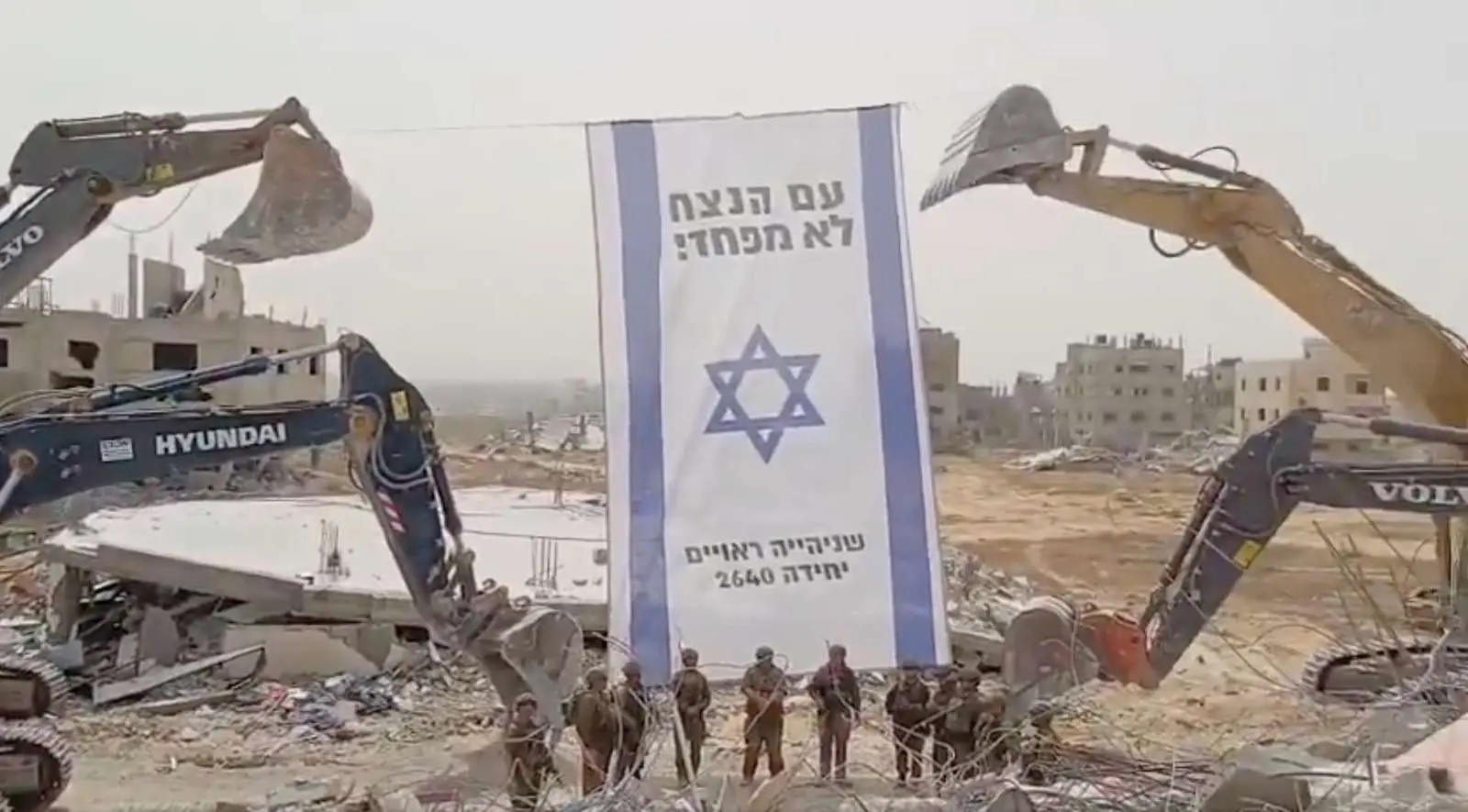
The trucks are part of a vast operation taking place behind Israel’s so called Yellow Line, in territory from which Palestinian rescue teams and international forensic specialists are excluded. Since October 7, 2023, no foreign journalist has been permitted to enter Gaza and report independently. Buildings that survived the bombardment are being demolished, while the ruins of neighbourhoods already destroyed are being crushed, mixed together and transported to undisclosed sites in Israel and the southern occupied West Bank.
By the time any international commission, criminal investigator or media organisation is permitted to enter these areas, many of the crime scenes may no longer exist.
That is the central warning contained in an August 3 investigation by Euro-Med Human Rights Monitor, which says it tracked almost 100 trucks a day leaving Gaza in recent weeks. The Geneva based organisation estimates that at least 10 million tonnes of debris have already been removed, crushed or displaced from their original locations within areas under Israeli military control, encompassing approximately two thirds of the Strip.
The practical effect, the organisation warns, is to pre-empt the investigation of the people who carried out the destruction. Once material from one home, hospital, shelter or suspected mass grave is pulverised and combined with debris from many other sites, the relationship between an object and the place where it was found is severed. Once the mixture crosses the boundary into an undisclosed destination, the chain of custody on which a criminal prosecution depends may be impossible to reconstruct.
The evidence is not merely being hidden from view. It is being physically transformed into something that may no longer be capable of giving evidence at all.
A convoy carrying Gaza out of Gaza
The scale of the operation cannot be measured only by the daily procession of trucks. Euro-Med Monitor says about 400 excavators, bulldozers, crushers and transport vehicles, operated by Israeli civilian companies under military protection, are working across eastern and southern Gaza.
According to the organisation, this is not a coordinated humanitarian programme to recover the missing, clear roads or prepare Palestinian led reconstruction. The work is taking place unilaterally inside closed military zones, without independent monitoring of the sorting, weighing or movement of the material. Israeli authorities have not published comprehensive records identifying how much has been taken, the routes used, the final destinations, the contractors involved or the eventual commercial use of Gaza’s stone, steel and concrete.
The quantity involved is immense. A Gaza Rapid Damage and Needs Assessment issued jointly by the World Bank, the United Nations and the European Union in April estimated that more than 68 million metric tonnes of debris had been generated, with removal and management costs alone exceeding $1.7 billion. That calculation was based on damage recorded up to October 2025 and therefore may not include later demolitions.
The same international assessment says debris clearance, explosive ordnance management and protection of housing, land and property rights are prerequisites for reconstruction. Euro-Med Monitor alleges that the Israeli operation reverses that order. Instead of first securing each location, searching for bodies, removing unexploded munitions, recording land boundaries and preserving evidence, heavy machinery is altering the sites before independent specialists can reach them.
Gaza’s Civil Defence estimated in July that about 8,500 people remained missing beneath the ruins, while other estimates cited during the war have exceeded 10,000. These are not marginal cases outside the headline death toll. They are a central reason the hospital based figure can never represent the full number killed. Many people cannot be formally added to the record until their bodies are recovered and identified, while entire families may have been killed without a surviving relative able to report them missing.
The figure of more than 73,000 deaths reported by Gaza’s Health Ministry is therefore a documented minimum, not a complete accounting of the dead. It also does not distinguish civilians from combatants and should not be described as a definitive civilian toll. A Max Planck Institute for Demographic Research analysis, which modelled underreporting and other uncertainties, concluded that direct conflict related deaths had probably already surpassed 100,000 by October 6, 2025. The researchers called their estimate a likely lower limit because it excluded indirect deaths caused by the destruction of health care, deprivation, disease and other consequences of the war. Palestinians killed after that date add further to the toll.
Nobody can know precisely how many missing people are dead, how many bodies remain identifiable or how many were buried deep inside bomb craters, collapsed apartment blocks and bulldozed streets. What is already clear is that the true number killed is substantially higher than the official recorded total and is credibly estimated at well over 100,000.
What can be said with certainty is that a rubble crusher is not a forensic instrument. It cannot distinguish a concrete fragment from a human bone, a length of reinforcing steel from a projectile, or an ordinary household object from the possession that gives a body its name.
“The soil of Gaza is now a mass grave”
Eyal Weizman, the founder and director of the investigative research agency Forensic Architecture, described the implications in stark terms during a lengthy Electronic Intifada livestream interview with Ali Abunimah and Nora Barrows-Friedman.
“The soil of Gaza is now a mass grave,” Weizman said.
Large bombs do not simply bring a building down onto the people inside it. They can excavate enormous craters and drive bodies, building material and earth deep below the former surface. In that setting, Weizman argued, the phrase “removal of evidence” is almost too technical. Before the material is evidence in a courtroom, it is earth containing the dead.
Moving it without a controlled recovery process risks crushing, scattering and transporting Palestinian bodies to locations their families may never discover. It may separate remains from identity documents, jewellery, clothing and personal effects, turning the agony of bereavement into a permanent uncertainty about where a relative lies.
For families, the injury is therefore repeated. The first loss is the killing. The second is the denial of a recognisable grave, a death certificate, an identified body and the right to mourn. The third may be the destruction of the evidence needed to establish who killed the victim, with what weapon and under what circumstances.
Euro-Med Monitor says the machinery threatens the families’ right to know the fate of missing relatives and to recover and bury them with dignity. It also warns that the operation conflicts with the Minnesota Protocol, the United Nations standard governing investigations into potentially unlawful deaths. The protocol requires investigators to secure and document a scene, recover remains scientifically, safeguard exhibits and maintain a continuous record of who handled each item.
None of that can be done retrospectively after the site has been flattened and its contents dispersed across several unknown dumping or processing grounds.
How a crime scene is made to disappear
Every destroyed building can contain a record of the attack that destroyed it. The distribution of blast damage may indicate the direction and power of an explosion. Fragments can help identify a weapon. Bullet impacts may establish where a shooter stood and the range from which shots were fired. Biological traces, spent cartridges, clothing and the position of bodies can reveal the sequence of events.
The location of each item is inseparable from its evidential value. A piece of metal found inside a particular room, at a recorded depth and in a measured relationship to a victim may support a legal conclusion. The same fragment after it has been crushed with ten buildings, loaded onto a truck and dumped in another jurisdiction may establish almost nothing.
Aerial photographs and satellite images remain valuable, as do videos, witness statements and intercepted communications, but they cannot replace every form of physical evidence. Images may show that a building was struck; they may not reveal which munition produced a particular wound, whether victims were moved, or what happened inside a structure before it collapsed.
This is why the removal operation is so consequential for the international community. South Africa’s genocide case against Israel remains before the International Court of Justice, while the International Criminal Court continues its separate investigation into the situation in Palestine. National prosecutors may also pursue cases under universal jurisdiction.
The ICJ determines state responsibility and has not yet delivered a final ruling on South Africa’s allegation that Israel has violated the Genocide Convention. The ICC investigates the potential criminal responsibility of individuals. Both processes may take years, which makes the preservation of evidence during the conflict indispensable.
Euro-Med Monitor argues that deliberate destruction or interference with evidence relevant to the ICC could engage Article 70 of the Rome Statute, which criminalises intentional obstruction of the Court’s evidence gathering. Establishing such an offence would require proof of intent and the necessary connection to the Court’s work, but the warning underscores what is at stake. A legal process scheduled to continue for years can be deprived of decisive material in a matter of days.
The organisation also raises the possibility of unlawful confiscation or pillage. Gaza’s debris includes reusable stone, steel and concrete, along with municipal records, private documents and personal property. Removing and commercially exploiting that material without the owners’ consent or compensation could, depending on the circumstances and intention, violate the Fourth Geneva Convention and the Rome Statute.
The investigation that may never be allowed to begin
The strongest conclusion is not that all future inquiry has already become impossible. Investigators can still work with satellite imagery, digital records, testimony and evidence preserved elsewhere. It is that the people controlling the suspected crime scenes are changing them on an industrial scale before independent investigators or journalists have had the opportunity to inspect them.
The resulting asymmetry is profound. Israel and its contractors can enter the sites, decide what to demolish, select what to move and determine where it goes. Palestinian families, Civil Defence teams, international forensic experts and the foreign press cannot independently observe the process. The authority accused of committing grave crimes consequently controls access to much of the physical record through which those allegations might be tested.
The press blockade extends across the entire Gaza Strip, not merely the military zones containing the worst destruction. Reporters Without Borders said in April 2026 that not a single foreign journalist had been allowed to enter Gaza to report independently since the war began. Israel has permitted a small number of outside reporters to join tightly controlled military embeds, but those escorted visits are not independent access.
Research by the Committee to Protect Journalists found that reporters taken into Gaza on escorted tours faced restricted movement, curated encounters, military review before publication and staged scenes. They could not choose their routes, remain in the territory, move without soldiers, freely interview survivors or independently inspect suspected crime scenes. On June 3, 2026, the Israeli state told the country’s Supreme Court that it would maintain its ban on unaccompanied entry by foreign and local journalists, citing security concerns.
For almost three years, Palestinian journalists trapped inside Gaza have therefore carried the burden of showing the world what is happening around them while enduring bombardment, displacement, hunger and the deaths of colleagues and relatives. Hundreds of journalists and media workers have been killed. Their reporting has supplied much of the visual evidence available outside Gaza, yet the international news organisations publishing their work remain prohibited from sending correspondents to corroborate it independently.
The prohibition is central to the threatened loss of evidence. No independent international reporter has been free to walk through a destroyed neighbourhood, choose which witnesses to interview, compare an Israeli account with the physical scene or document what is being placed in the trucks. By the time the ban is eventually lifted, the landscape presented to the world may bear little resemblance to the one Palestinian journalists have been recording throughout the assault.
Israel rejects accusations that it has committed genocide, saying its military campaign followed the Hamas led attack of October 7, 2023, which killed about 1,200 people in Israel, and that its operations target Hamas and other armed groups rather than Gaza’s civilian population. In response to concerns about the Yellow Line, the Israeli military has said its deployments are defensive, that the boundary is being marked to reduce contact between troops and civilians, and that the security zone is intended to prevent attacks.
That explanation does not answer the specific questions raised by the debris operation: why material is being removed from Gaza before forensic inspection, what safeguards exist for human remains and evidence, which companies are involved, where the loads are taken, and why no independent Palestinian or international authority is supervising the work.
Nor does it explain why humanitarian access to the same territory remains so restricted. Reuters reported in July that Israel effectively controlled about 64 per cent of Gaza by late April and that Prime Minister Benjamin Netanyahu had said it intended to expand that area to 70 per cent. Nearly all of Gaza’s roughly two million residents were concentrated into the remaining coastal territory, many living in damaged structures or makeshift shelters.
The Yellow Line is therefore more than a military marker. It separates the population from large areas containing their homes, farms, family graves and the ruins beneath which relatives remain missing. It also separates the world from potential evidence.
“Ungrounding” a people
Weizman describes the larger process as “ungrounding,” the central idea of his 2026 book, Ungrounding: The Architecture of Genocide. The term describes more than destruction. Even after an ordinary urban bombardment, roads, plot lines, foundations and paths often remain legible. A former resident can point to where a home stood, where a garden ended and where a street began.
Ungrounding erases those reference points. Rubble is pushed away, the surface is compacted, elevations are changed and an artificial topography is imposed. The result is not a recognisably damaged neighbourhood awaiting reconstruction, but an unfamiliar open space from which the social and physical map of Palestinian life has been removed.
The erasure has legal and political consequences. A foundation marks the location of a home. A boundary wall records the division between properties. A road connects a family to a school, market, cemetery or field. When all are crushed into one undifferentiated surface, Palestinians lose physical anchors that support ownership, memory and return.
Weizman told the Electronic Intifada that evidence in Palestine has a meaning broader than material prepared for a court. It is also proof of presence: the cemetery, field, well, orchard, path or building to which a displaced community can return. In that sense, the removal of evidence attacks both a future prosecution and a people’s relationship to place.
He situated today’s levelling of Gaza within a longer history stretching back to the Nakba, when more than 700,000 Palestinians were expelled or fled from their homes during the creation of Israel. In his account, Zionist and later Israeli planners understood that preventing return involved transforming the landscape after its inhabitants had been removed. Roads and village traces were ploughed over, agricultural patterns were changed, and new settlements were positioned to monitor and stop refugees attempting to go home.
The contemporary machinery is far more powerful, but the political logic, Weizman argues, is recognisable. First the population is driven out; then the material signs of its life are removed; finally the remade territory is presented as empty, available and detached from the people who inhabited it.
Gaza’s geography turned into a weapon
The history matters because Gaza is not naturally the featureless expanse often presented in military maps. Its narrow territory contains distinct ecological zones shaped by sand carried from the Nile, fertile clay and loess soils flowing from the uplands, seasonal watercourses, coastal dunes and an aquifer beneath the surface.
Salah al-Din Road follows the ancient route known as the Via Maris near the meeting point between dunes to the west and more fertile land to the east. Wadi Gaza connects the Hebron hills, the Beersheba region and the coast, crossing political boundaries that have divided an older environmental system into Israel, the occupied West Bank and the Gaza Strip.
Before 1948, Palestinian farmers used the moisture retaining qualities of loess soil to cultivate wheat and barley with relatively little rainfall, helping make the region a breadbasket. During the Nakba, many were driven from fertile land towards refugee camps constructed largely on coastal sand. Weizman describes that displacement as movement not only from one point to another, but from one environmental condition to another: from land capable of sustaining agriculture to dunes on which refugees were made dependent.
The current territorial arrangement reproduces that movement on a compressed and devastating scale. Israel’s military zone encompasses much of eastern Gaza, including fertile agricultural areas, while most Palestinians are crowded westward onto the sandy coastal strip. The destruction of farms, water systems, roads, hospitals and homes removes what Article II(c) of the Genocide Convention calls the “conditions of life” necessary for a group’s survival.
Weizman argues that this is how an environment itself can become an instrument of destruction. People may be killed directly by bombs and gunfire, while many more are placed in conditions where shelter, health care, clean water, food production and social life can no longer be sustained.
The latest United Nations humanitarian reporting said an estimated 1.98 million people, representing about 94 per cent of Gaza’s population, required shelter assistance. It found that 58 per cent faced critical or catastrophic shelter needs, while Israeli access restrictions continued to place much of the land beyond the Yellow Line off limits.
Artificial hills and a moving military frontier
The heavy machinery does more than clear what bombs have destroyed. According to Weizman, bulldozers create large earth berms and artificial hills on which the Israeli military places roads, outposts, tanks and sniper positions. The army can advance these formations, reshaping the ground as its zone of control moves westward.
This “artificial topography” gives military forces elevation in an otherwise relatively flat territory. It also leaves returning residents disoriented. A person taken blindfolded from a familiar district may later find that the buildings, roads and contours through which they understood the place have vanished.
The changing landscape accompanies a changing boundary. Residents in several Gaza districts told Reuters in July that Yellow Line markers had advanced, forcing families to move yet again. Israel said the line was being clearly marked, but residents described a frontier that repeatedly reached farther into ruined neighbourhoods.
Weizman places this within the history of Israeli buffer zones, which he argues have repeatedly become territories of permanent expansion. A zone is emptied in the name of security, occupied and fortified; settlements or military infrastructure then appear at its new edge, after which another buffer is demanded beyond it. What is presented as temporary protection becomes a mechanism through which the area available for Palestinian life steadily contracts.
The battle beneath the ruins
The subsoil is also central to Weizman’s account because Gaza’s tunnels have been used to justify destruction across the surface. Israeli officials have often described a vast, interconnected “Gaza Metro” running beneath civilian areas. Weizman argues that this image falsely suggests a single modern transport network in which every entrance connects to every exit.
Based on publicly available information, he describes a more fragmented architecture, with separate tunnels connecting trusted groups and particular locations, interwoven with buildings, alleys, roofs and short above ground passages. The tunnel system, in his interpretation, resembles a materialised social network rather than one continuous subterranean city.
Its development also reflects indigenous knowledge of Gaza’s geology. Palestinian well diggers had long learned how to descend through layers of sand, sandstone and clay, reinforce unstable sections, ventilate deep shafts and find water in the coastal aquifer. Displaced farming communities carried that expertise into the refugee camps, where knowledge once used to sustain agriculture was adapted to movement and resistance under blockade and occupation.
Clay can form a relatively self supporting passage, while sand requires reinforcement. Tunnel builders therefore navigate an underground landscape of ridges, layers and water just as people on the surface navigate roads and neighbourhoods.
The political importance of Israel’s “Metro” image is that an invisible tunnel can be alleged beneath almost any target. Once the surface has been bombed and the alleged passage buried under metres of debris, independent verification becomes exceptionally difficult. A claim that a tunnel existed can consequently justify the destruction that makes checking the claim impossible.
Crushing and removing the ruins completes that circle. The asserted military objective disappears together with the physical evidence needed to test whether it was present, whether the weapon used was proportionate, and whether civilians were knowingly placed at excessive risk.
Erasure does not end when the bombing stops
More than 73,000 Palestinians have been formally recorded as killed since October 2023, according to Gaza’s Health Ministry, but this is the administratively documented toll from a territory where hospitals, morgues, civil records and communications have been devastated. It excludes many of those still missing beneath the rubble and is far below the Max Planck researchers’ estimate that direct conflict related deaths had already exceeded 100,000 by October 2025. It also omits the uncounted indirect deaths produced by hunger, disease, displacement and the collapse of medical care.
The number continues to rise as bodies are recovered and Palestinians are killed in continuing strikes. On August 31 alone, Reuters reported that Israeli air attacks killed at least five Palestinians in Gaza City. Israel said both strikes targeted Hamas militants but supplied no further detail.
The eventual toll cannot be established simply by adding hospital records. Some bodies remain inaccessible, some were reduced to fragments, and others have never been recovered. If the earth containing them is now moved without forensic supervision, an unknown number may never enter any official count.
The trucks therefore represent a new stage of the same catastrophe. Bombardment killed people and destroyed the places in which they lived. Whether a victim’s body remains entombed beneath a ruin or has already been recovered, the rubble still contains that person’s home, possessions, family records and the physical environment of the killing. Bulldozers and crushers can now remove the human remains, the crime scenes, the ownership markers, the record of civilian life and the material from which survivors might rebuild.
Each load taken out of Gaza increases the risk that a future investigator will arrive with a mandate but no intact site to inspect; that a foreign journalist will finally be allowed to enter only after the ground has been sanitised; that a family will be told there is no longer any way to locate a missing child; and that a court will be asked to judge events after critical exhibits have been converted into anonymous aggregate.
This is why the operation cannot credibly be treated as ordinary debris management. Responsible clearance is necessary to protect civilians from unstable buildings, asbestos and unexploded ordnance, and to make reconstruction possible. It must also be Palestinian led, transparent and sequenced around the recovery of human remains, documentation of property and preservation of evidence.
Euro-Med Monitor has called for the immediate suspension of Israel’s removal operation until independent forensic and criminal teams can enter the affected areas. It is demanding disclosure of weighing records, routes, destinations, contractors, vehicle registrations, payments, purchasers and any recycling or sale of material already taken. It also says states connected to implicated companies or machinery should preserve contracts and communications and investigate the responsibility of corporate directors and employees.
Those demands are urgent because reconstruction and accountability are not competing tasks. Gaza’s roads must be opened, unstable ruins removed and millions of displaced people housed, but rebuilding on top of unidentified bodies and undocumented crime scenes would lock destruction into the new foundations.
The first obligation is to stop the evidence from leaving. The second is to give Palestinian recovery teams, families, international investigators and independent journalists immediate access to what remains. Without that intervention, the convoy of 100 trucks a day may accomplish what years of legal delay and an outright media ban have so far failed to make explicit: a Gaza emptied not only of much of its population and built environment, but of the physical record required to prove precisely how that destruction was carried out.