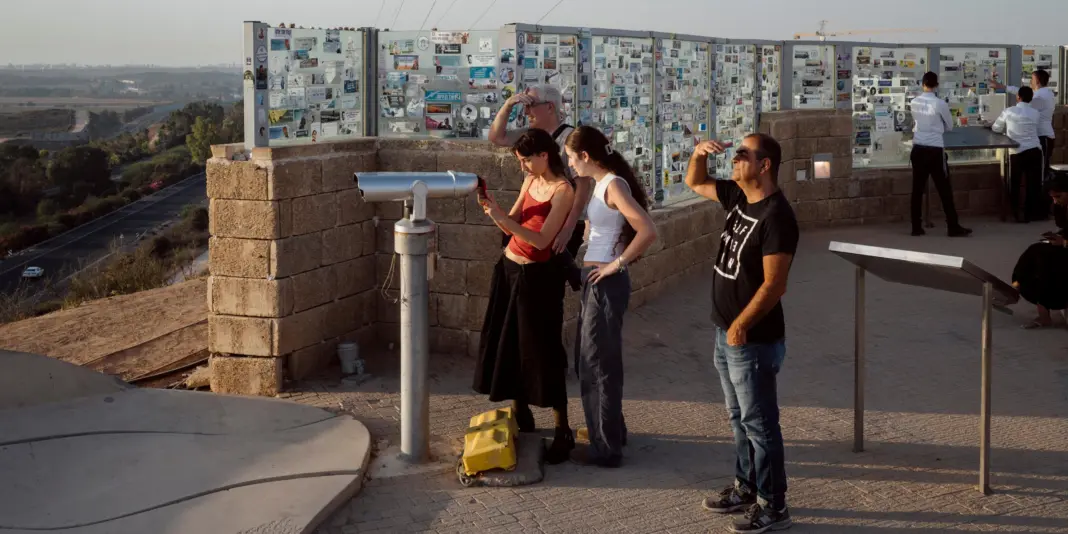

The World Happiness Report did not ask Israelis whether they approved of Palestinian deaths. It documented a more unsettling fact: exceptional satisfaction with life endured while a society only miles away was being destroyed. Analysis and reporting based on Gallup data, United Nations documentation, Israeli opinion polling and eyewitness accounts. Visitors gather around a fixed telescope at the Kobi Hill viewing platform in Sderot during the present Gaza war. A yellow step rests against the base of the viewer, while one young visitor appears to position a smartphone beside its eyepiece.
The telescope points towards Gaza. A small yellow step rests against its pedestal, positioned in a way that would help a shorter visitor reach the eyepiece. Two young people stand beside it, and one appears to hold a red smartphone immediately behind the viewer, consistent with photographing or filming through it. Another man raises his phone towards the horizon.
The photograph cannot establish what was recorded, whether anything was posted online, or what any individual in the frame felt. It does show how the observation of Gaza has moved from the improvised couches of 2014 into a permanent, paved and tourist style viewing environment.
Twelve years later, the World Happiness Report 2026 placed Israel eighth among 147 countries. Finland ranked first, followed by Iceland, Denmark and Costa Rica, while Israel appeared immediately after the Netherlands and ahead of Luxembourg and Switzerland.
The ranking was based on surveys conducted between 2023 and 2025, the same period in which Gaza was subjected to mass bombardment, displacement, siege, hunger and the destruction of much of its civilian infrastructure. [1]
The juxtaposition is stark enough to sound implausible: a country remained among the world’s highest rated places for personal wellbeing while more than 20,000 children were reported killed only a short distance from its southern communities.
Yet the ranking is genuine. The harder question is what it proves, what it does not prove, and what other evidence reveals about the moral distance between Israeli daily life and Palestinian catastrophe.
What the happiness ranking actually measures
The popular description of Israel as the world’s eighth happiest country is technically consistent with the report’s language, but it can easily be misunderstood.
Gallup does not ask respondents whether they felt cheerful during the previous day, whether they supported their government, or whether they approved of a war. It asks them to imagine a ladder numbered from zero to ten, with the worst possible life at the bottom and the best possible life at the top, and then to say where they believe they stand. [2]
The resulting Cantril Ladder score is an assessment of life as a whole. The World Happiness Report normally combines approximately 1,000 interviews per country per year into a three year average.
The six factors often displayed beside the ranking, including income, social support, healthy life expectancy, freedom, generosity and perceptions of corruption, are used to help explain differences. They do not determine the position on the table. The ranking comes from residents’ answers to the single life evaluation question.
This distinction prevents one claim that the evidence cannot sustain. Israel’s eighth place does not show that survey respondents said they were happy because Palestinian children were dying. Gallup never asked that question.
Happiness during an atrocity and happiness about an atrocity are different propositions, and responsible reporting must not collapse them into one.
The report does not prove that Israelis were happy because Gaza was being destroyed. It shows that exceptionally high evaluations of Israeli life survived while Gaza was being destroyed.
That correction does not dissolve the moral problem; it sharpens it.
A national population can experience fear, bereavement and trauma while still judging its overall life favourably. It can also protect that judgment by placing the suffering of another population outside the boundaries of its own moral and social world.
The happiness result records the durability of the first population’s wellbeing. It is silent about the human cost imposed on the second.
The report itself warns that catastrophic events are softened by its methodology. The 2024 edition said the Israeli survey in 2023 was conducted after the Hamas led attack and hostage taking of 7 October, but before much of the warfare that followed.
Israeli life evaluations fell by 0.9 points on the ten point scale, yet only one third of that annual result entered the three year average used in the 2024 ranking.
By 2026, the averaging window had advanced to 2023, 2024 and 2025, but averaging still reduced the visibility of sudden shocks. [3]
The catastrophe outside the survey frame
The assault on Gaza followed the Hamas led attacks of 7 October 2023, in which approximately 1,200 Israelis and foreign nationals were killed and about 250 people were taken hostage.
Those killed included serving soldiers, police officers and other security personnel, alongside people classified by Israeli authorities and casualty databases as civilians. That classification does not establish that every person placed in the civilian category had never served in the IDF or had no reserve affiliation.
Under international humanitarian law, a person who has completed active service and returned to civilian life, including a deactivated reservist, is legally a civilian. A serving member of the regular armed forces does not become a civilian merely by being off duty. “Civilian” therefore describes a person’s legal status at the relevant time, rather than establishing that the person has never received military training or served in an army.
The attacks struck Israeli military positions, residential communities and a music festival. [4]
The scale and character of what followed cannot be captured by the phrase “military response” alone.
UNICEF reported that, between 7 October 2023 and 3 February 2026, 71,803 Palestinians had been reported killed in the Gaza Strip, including at least 21,289 children. A further 171,230 Palestinians had been reported injured, including 44,500 children.
UNICEF also said that no hospital in Gaza was fully functional, while access to medicine, shelter, water and sanitation remained severely constrained. [5]
The word genocide is no longer confined to campaign slogans or newspaper commentary.
In September 2025, the United Nations Independent International Commission of Inquiry concluded that Israeli authorities and security forces had committed genocide against Palestinians in Gaza.
Amnesty International reached the same conclusion in December 2024 after examining killings, serious bodily and mental harm, forced displacement, destruction of life sustaining infrastructure, obstruction of aid and statements by senior officials. [6]
B’Tselem, one of Israel’s best known human rights organisations, published its own report in July 2025 under the title Our Genocide.
Its conclusion is particularly significant because it came from an organisation staffed by Jewish Israelis and Palestinians working inside the society whose conduct it was examining. [7]
Legal precision remains necessary. The case brought by South Africa against Israel under the Genocide Convention was still before the International Court of Justice in 2026.
The court issued binding provisional measures intended to protect claimed rights and prevent irreparable harm, but it had not delivered a final judgment on the merits.
Israel has rejected genocide accusations, argues that it is fighting Hamas rather than the Palestinian people, and says its critics disregard Hamas’s use of civilian areas and Israel’s efforts to facilitate aid. [8]
A news feature can therefore state that a United Nations commission, Amnesty International and B’Tselem concluded that Israel committed genocide, while also recording that Israel denies the accusation and that the International Court of Justice has not yet issued its final merits judgment.
What cannot reasonably be disputed is the extraordinary scale of Palestinian death, injury, displacement and destruction documented during the same period used to calculate Israel’s high life evaluation.
The polling that happiness alone cannot provide
The Happiness Report cannot answer whether Israelis supported the destruction of Gaza, but surveys that asked about the war directly provide a more disturbing picture.
In a Pew Research Center poll published in May 2024, 39 percent of Israelis said the military response had been about right, 34 percent said it had not gone far enough, and 19 percent said it had gone too far.
The aggregate concealed an enormous division: 74 percent of Arab Israelis believed the response had gone too far, compared with only 4 percent of Jewish Israelis. [9]
By May 2025, the Israel Democracy Institute found that roughly two thirds of Jewish respondents opposed increasing the flow of humanitarian aid into Gaza. More than three quarters of Arab respondents supported an increase.
The division was not peripheral to the data. It ran through the centre of Israeli political identity, with the Jewish left far more supportive of aid than the right. [10]
The most direct evidence arrived in another Israel Democracy Institute survey conducted between 27 and 31 July 2025.
Asked whether reports of famine and Palestinian suffering personally troubled them, 79 percent of Jewish respondents said they were not so troubled or not at all troubled. Eighty six percent of Arab respondents said they were somewhat or very troubled.
The same poll found that 78 percent of Jewish respondents believed Israel was making substantial efforts to avoid unnecessary Palestinian suffering, while only 22.5 percent of Arab respondents agreed. [11]
Not being troubled is not the same as taking pleasure. It is nevertheless direct evidence of widespread indifference, denial or moral disengagement at a moment of documented famine and mass civilian suffering.
Those findings still do not license the claim that every Israeli celebrated Palestinian deaths. They do something more precise.
They show that, within the Jewish Israeli majority, reports of famine and suffering failed to produce personal concern in a very large share of respondents.
When considered alongside the happiness ranking, the polling suggests a society capable of sustaining high evaluations of its own life while insulating that evaluation from the devastation imposed on people living nearby.
How wellbeing can survive war and moral catastrophe
High life evaluation should not be confused with an absence of fear, grief or psychological distress.
The Cantril Ladder asks people to stand back from immediate emotion and judge the architecture of their lives: family, income, community, purpose, status, health, belonging and expectations.
A population can feel anxious about security and still believe that its life remains comparatively good. It can mourn its own dead, fear for hostages and support devastating violence against an out group without perceiving a contradiction in its assessment of personal wellbeing.
Israel also possesses unusually strong internal networks. A chapter of the 2025 World Happiness Report found that young adults in Israel ranked highest among the countries studied for the quality of social connections, measured by confidence that relatives or friends would provide help when needed.
Social support is among the strongest correlates of high life evaluation. In wartime, those bonds may provide real resilience and mutual care within the protected group. [12]
The same mechanism has a darker possibility. Solidarity can be expansive, drawing strangers into a common circle of care, or restrictive, reinforcing a boundary between lives treated as valuable and lives treated primarily as threats.
The Happiness Report does not test which form is operating. The extreme differences between Jewish and Arab Israeli responses to Gaza, however, show that national averages can hide radically unequal moral realities inside the same state.
When bombardment becomes spectacle
The earlier photographs from Sderot cannot prove what every person on those couches felt. An image records posture, setting and direction of attention, not an interior state.
Contemporary eyewitness reporting nevertheless provides context.
During the 2014 assault, The Guardian described groups gathering on Sderot hills with drinks, snacks and smartphones, cheering explosions a few miles away. One spectator reportedly responded to a blast with the words: “What a beauty.” [13]
The spectacle did not disappear with the earlier war.
In July 2025, The Irish Times reported from a Sderot viewing platform where tour groups paid five shekels to look through binoculars at Gaza’s ruined neighbourhoods.
Smoke from strikes was visible beyond a landscape in which supermarkets, cafés and abundant food remained available on the Israeli side.
Holocaust and genocide scholar Omer Bartov told the newspaper that the scene recalled what he called “execution tourism.” [14]
The details in the newer photograph deepen that continuity. The yellow step at the telescope’s base appears designed to make the eyepiece reachable for a shorter visitor, while a young woman appears to position a smartphone behind the viewer.
The image alone cannot establish whether she was recording, what she shared, or whether her purpose was celebratory. Reporting from the same lookout supplies what the photograph cannot.
Le Monde described a 20 year old man bringing children aged five and eight and saying that he was showing them what remained of Gaza.
El País later reported a father calling his son to see the smoke and rubble, and a group of adolescents celebrating that they could record a TikTok video.
The evidence therefore establishes that children and social media recording formed part of the site’s wartime culture, even though no photograph can reveal the motives of every person within its frame. [15]
These scenes are evidence of a recurring phenomenon, not a statistical portrait of every Israeli.
Their importance lies in what they make visible: the physical proximity of radically different realities. On one side of the boundary, people could sit, eat, travel and observe. On the other, families were displaced repeatedly, children were killed or maimed, hospitals were dismantled and hunger spread.
The border was geographical, military and psychological at the same time.
The world outside was not silent
Claims of total ignorance are particularly difficult to sustain because Gaza’s destruction generated immediate and continuing protest across the world.
ACLED recorded approximately 4,200 demonstrations connected to Israel and Palestine in almost 100 countries and territories during the first three weeks after 7 October 2023.
About 86 percent of the demonstrations recorded in the early period were pro Palestinian. [16]
The movement continued rather than disappearing with the news cycle.
ACLED reported that pro Palestine demonstrations increased by 43 percent between May and September 2025 compared with the preceding five months.
Protesters filled streets in London, Washington, Istanbul, Cape Town, Jakarta and scores of other cities, demanding a ceasefire, humanitarian access, an arms embargo or accountability under international law. [17]
Street protests are not a binding referendum on Israeli policy, and their existence does not tell us what any particular Israeli citizen saw or believed.
Their scale does eliminate one possible alibi: that nobody outside Israel raised the alarm.
Palestinian journalists, humanitarian agencies, international courts, medical workers and demonstrators repeatedly described what was happening. The dispute was less about the availability of information than about whether it was believed, justified, minimised or excluded from moral concern.
The danger of treating Israelis as a single mind
Collective language can obscure as much as a national average.
Israeli citizens include Jewish and Palestinian communities whose responses to Gaza diverged sharply. There were Israelis who opposed the war, documented abuses, defended Palestinian rights or campaigned for a ceasefire.
B’Tselem’s genocide finding itself demonstrates that dissent existed within Israeli society, while the polling shows much higher concern among Arab citizens and the Jewish left.
The distinction is ethically and journalistically necessary.
Responsibility is not distributed equally among the political leaders who designed policy, the military commanders and personnel who implemented it, the citizens who demanded harsher action, those who looked away, those who believed official claims, and those who resisted.
The phrase “the Israelis” may be rhetorically convenient, but it risks erasing Palestinian citizens of Israel and Jewish Israelis who rejected the dominant consensus.
That caution should not become another method of avoiding the evidence.
The presence of dissent does not cancel the documented views of the majority in repeated surveys. A society need not be unanimous for widespread indifference or dehumanisation to become politically decisive.
Governments require permission, participation or passivity from enough people, not moral agreement from everyone.
The postwar comparison and the defence of not knowing
The comparison with postwar claims of ignorance about Nazi crimes carries emotional and historical force, but it must be made carefully.
Gaza is not a replica of the Holocaust, and analogy should never replace factual analysis. The useful parallel concerns the language of the bystander and the construction of innocence after mass atrocity.
The United States Holocaust Memorial Museum notes that many ordinary Germans and other Europeans later described themselves as uninvolved bystanders.
That description, the museum explains, can conceal the many levels of participation, approval, tolerance and benefit that existed throughout society.
The museum also stresses that few people knew the full extent of the Final Solution, even though many witnessed persecution, violence and deportations. [18]
The contemporary information environment makes absolute ignorance of Gaza harder to claim.
The devastation was filmed, counted, argued over in courts, broadcast through social media and protested in thousands of public demonstrations.
Israeli authorities and media could contest the casualty figures, attribute deaths to Hamas, frame international criticism as hostility, or insist that military necessity justified the campaign.
Those narratives may explain disbelief or moral disengagement, but they are different from having no opportunity to know.
The historical warning is therefore not that every Israeli is equivalent to a German perpetrator, nor that two genocides are identical.
It is that societies living alongside mass violence often develop vocabularies that protect ordinary life from unbearable knowledge.
People may deny the evidence, redefine the victims as dangerous, transfer all responsibility to the enemy, or insist that their personal decency is unrelated to what their state does in their name.
What eighth place finally tells us
Israel’s position in the World Happiness Report should neither be dismissed as fabricated nor misrepresented as a survey of pleasure in Palestinian suffering.
It is a narrower and, in another sense, more consequential finding.
Residents of Israel evaluated their own lives so highly during 2023 to 2025 that the country remained eighth in the world, even as Gaza endured destruction that major human rights organisations and a United Nations commission classified as genocide.
The ranking alone cannot establish approval, sadism or culpability. The public opinion evidence adds what the happiness survey lacks.
Only 4 percent of Jewish Israelis in the 2024 Pew poll said the military response had gone too far. Roughly two thirds opposed increasing humanitarian aid in the May 2025 Israel Democracy Institute survey.
By July, 79 percent said reports of famine and suffering did not personally trouble them.
The most defensible indictment is not that Israelis told Gallup they were happy about genocide. It is that an exceptionally high sense of national and personal wellbeing remained compatible with mass Palestinian death, and that large majorities reported little concern about the suffering next door.
That is the moral chasm exposed by eighth place.
The figure describes the strength of life on one side of a border. The casualty lists, ruined hospitals and famine reports describe the destruction of life on the other.
The two realities are not contradictory within the survey’s mathematics. Their coexistence is precisely the story.
Sources and Notes
Full source details appear below. All online sources were accessed on 1 September 2026.
1. John F. Helliwell, Richard Layard, Jeffrey D. Sachs, Jan Emmanuel De Neve, Lara B. Aknin and Shun Wang, editors, “International Evidence on Happiness and Social Media,” Chapter 2, World Happiness Report 2026, University of Oxford Wellbeing Research Centre, 2026. The chapter ranks Israel eighth and states that the ranking uses self assessed life evaluations averaged across 2023 to 2025. Read the source
2. World Happiness Report, “Frequently Asked Questions: How is your ranking calculated?” The FAQ describes the Cantril Ladder, typical annual samples of approximately 1,000 people per country, population weighting and three year averaging. Read the source
3. World Happiness Report 2024, Chapter 2, “Happiness of the Younger, the Older, and Those in Between.” The report says Israel’s 2023 survey occurred after the 7 October hostage taking but before much of the subsequent warfare, and that life evaluations fell by 0.9 points, only one third of which entered that edition’s three year average. Read the source
4. United Nations Office for the Coordination of Humanitarian Affairs, “Secretary General’s Remarks to the Security Council on the Middle East,” 23 January 2024. The Secretary General said that more than 1,200 Israelis and others were killed during the Hamas led attacks of 7 October 2023 and more than 250 people were taken hostage. Read the OCHA source
Action on Armed Violence, “An Analysis of the 7th of October 2023 Casualties in Israel,” 20 December 2023. The report divided casualties into civilian, military, police and emergency service categories, while acknowledging incomplete biographical data and reliance on publicly available reporting. Its categories do not establish that every person described as a civilian had never served in the IDF or had no reserve affiliation. Read the AOAV analysis
International Committee of the Red Cross, Interpretive Guidance on the Notion of Direct Participation in Hostilities. The guidance states that members of regularly constituted armed forces are not civilians, while civilian protection is restored when a person disengages from active duty and reintegrates into civilian life, including through full discharge or as a deactivated reservist. Read the ICRC guidance
United Nations Independent International Commission of Inquiry, report A/HRC/56/26, 27 May 2024. The report examines attacks carried out on 7 October 2023 against civilian locations and Israeli military outposts. Read the UN report
5. UNICEF State of Palestine, “Humanitarian Situation Update,” reporting period 5 February 2026. UNICEF reported 71,803 Palestinians killed in Gaza through 3 February 2026, including at least 21,289 children, and 171,230 injured, including 44,500 children. Read the source
6. United Nations Office of the High Commissioner for Human Rights, “Israel Has Committed Genocide in the Gaza Strip, UN Commission Finds,” 16 September 2025. Read the UN source
Amnesty International, “Amnesty International Investigation Concludes Israel Is Committing Genocide Against Palestinians in Gaza,” 5 December 2024, with a link to the underlying report, You Feel Like You Are Subhuman. Read the Amnesty source
7. B’Tselem, Our Genocide, July 2025, and related press release dated 28 July 2025. Read the source
8. International Court of Justice, Application of the Convention on the Prevention and Punishment of the Crime of Genocide in the Gaza Strip, South Africa v Israel, Case 192. The case page showed continuing proceedings and no final merits judgment as of the date of access. Read the ICJ case materials
State of Israel, Ministry of Foreign Affairs, “Opening Statement of MFA Legal Adviser Dr Tal Becker at the International Court of Justice,” 12 January 2024. Israel argued that it was engaged in a defensive war against Hamas, rejected the genocide allegation and said it sought to mitigate civilian harm. Read Israel’s submission
9. Pew Research Center, “Israeli Views of the Israel Hamas War,” 30 May 2024. The survey found that 39 percent said the military response was about right, 34 percent said it had not gone far enough and 19 percent said it had gone too far. Seventy four percent of Arab Israelis, but only 4 percent of Jewish Israelis, said it had gone too far. Read the source
10. Israel Democracy Institute, “Israelis Unsure Current Military Operation Will Bring Hostages Home or Topple Hamas,” 6 June 2025. The survey found that around two thirds of the Jewish public opposed increasing humanitarian aid to Gaza, while more than three quarters of Arab respondents supported an increase. Read the source
11. Israel Democracy Institute, “Large Majority of Jewish Israelis: Israel Making Substantial Efforts to Avoid Palestinian Suffering; Majority of Arab Israelis Disagree,” 5 August 2025. The representative survey of 601 Jewish and 152 Arab adults was conducted between 27 and 31 July 2025. Read the source
12. Rui Pei and others, “Connecting With Others: How Social Connections Improve the Happiness of Young Adults,” Chapter 5, World Happiness Report 2025. The chapter reports that Israel ranked highest among the countries studied for young adults’ perceived quality of social connections. Read the source
13. Harriet Sherwood, “Israelis Gather on Hillsides to Watch and Cheer as Military Drops Bombs on Gaza,” The Guardian, 20 July 2014. Read the source
14. Sally Hayden, “From a Viewing Platform in Israel, Observers Watch Gaza’s Destruction Through Binoculars,” The Irish Times, 27 July 2025. Read the source
15. Lucas Minisini, “The Best Show in Town: From a Hilltop in Israel, Observers Have a Sinister View of Gaza Bombings,” Le Monde, 23 July 2025. The report described a 20 year old visitor bringing children aged five and eight and saying that he was showing them what remained of Gaza. Read the Le Monde report
Antonio Pita, “La sociedad israelí, ante la masacre de Gaza: entre la indiferencia y el entusiasmo,” El País, 6 October 2025. The report described adolescents celebrating the possibility of recording a TikTok video and a father calling his son to see smoke and rubble. Read the El País report
16. Armed Conflict Location and Event Data, “Global Demonstrations in Response to the Israel Palestine Conflict,” 7 November 2023. ACLED recorded approximately 4,200 related demonstrations in almost 100 countries and territories during the first three weeks. Read the source
17. Ciro Murillo and Christina De Paris, “Two Years of Global Demonstrations in Support of Palestine,” Armed Conflict Location and Event Data, 3 October 2025. Read the source
18. United States Holocaust Memorial Museum, Holocaust Encyclopedia, “Bystanders.” The article discusses postwar claims of non involvement and the differing levels of approval, tolerance and participation among ordinary people. Read “Bystanders”
United States Holocaust Memorial Museum, “How and Why Did Ordinary People Across Europe Contribute to the Persecution of Their Jewish Neighbors?” The museum notes that many witnessed persecution and deportations, although few knew the full extent of the Nazi Final Solution. Read the source