
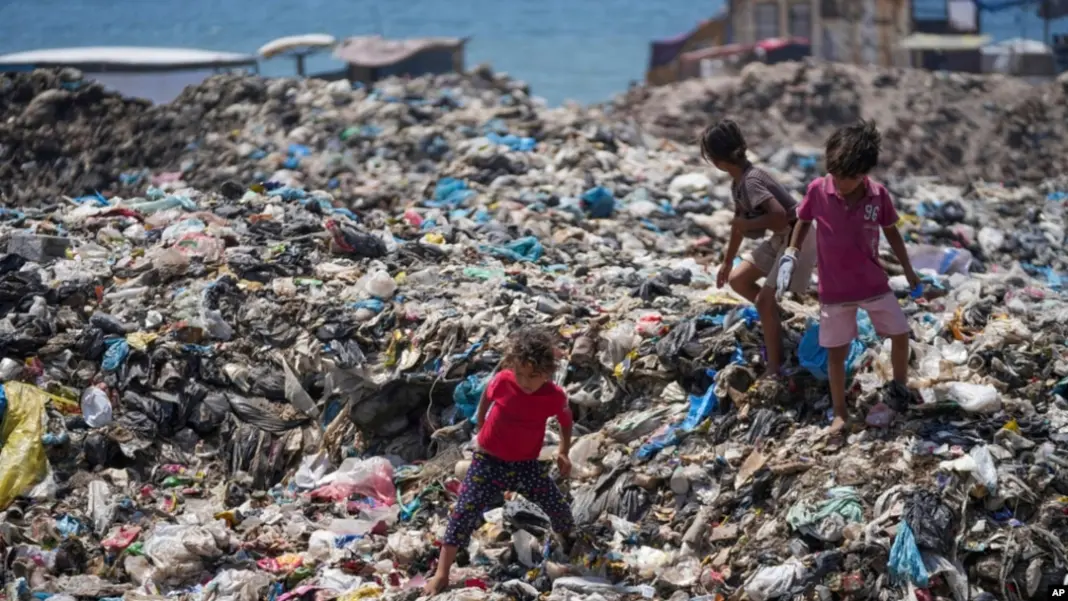

The destruction of Gaza’s sanitation has polluted a shared coastline. Reports of rat infestations in Israeli border communities add to the alarm over an environmental catastrophe that cannot be contained by walls and fences.
Israel’s destruction of the infrastructure that sustains life in Gaza has helped turn a shared stretch of the Mediterranean into an outlet for untreated sewage. Along a coastline where Israel draws seawater to produce much of its drinking water, dismantling the systems that protect Palestinian health also undermines safeguards on which Israelis depend.
Now rats and mice are adding to the alarm. Israeli communities beside Gaza have reported rodents entering homes, droppings near children’s beds and infestations that residents and sanitation workers describe as unlike anything they have seen in decades. Hundreds of traps have been distributed, with reports of injuries requiring hospital treatment.
The origin of that outbreak remains less certain than the documented history of sewage crossing the boundary. Some residents believe demolition and excavation inside Gaza have driven rodents towards Israeli communities. Weather and favourable breeding conditions have also been suggested. The reports establish an infestation; they do not establish where every animal came from.
What is already clear is that the collapse of Gaza’s sanitation has created conditions in which vermin flourish, while leaving Palestinian families with desperately limited means of protecting themselves.
Motke Hai, a maintenance worker at a kibbutz near Gaza, described collecting “traps packed with these rodents”.
“It is simply terrible,” he said.
Hai linked the problem to Gaza, citing accounts from soldiers of infestations in camps and bases. Other explanations reported alongside his account included an especially rainy winter and extensive excavation disturbing burrows. The Eshkol Regional Council said it was taking measures to tackle the problem.
Disturbance of habitats and growth in existing rodent populations can occur together. But without evidence tracking the animals’ movement, migration from Gaza remains a plausible explanation rather than a demonstrated cause. The wider environmental danger does not depend on pretending that uncertainty has been resolved.
Months before those Israeli reports, Palestinian families were already describing rats attacking them where they slept.
In April, Khalil Al-Mashharawi said he and his wife slept in shifts after rats bit him and their three-year-old son.
“They strike in our sleep,” he said.
Reinhilde Van de Weerdt, the World Health Organization’s local representative, called the wider crisis “the unfortunate but predictable consequence when people live in a collapsed living environment”.
For people living among ruined buildings and accumulated rubbish, an infestation reaches into every part of daily life. Food that is already scarce becomes harder to protect. Damaged shelters offer little separation between sleeping children and vermin. Broken drains and inadequate water supplies make cleaning difficult, while displaced families have few places to move.
Eyad Amawi, a representative of the Gaza Relief Committee, described the conditions in May as “a systematic transformation of life into something unlivable”.
He reported widespread rodent infestations inside tents and shelters, unsafe water storage and food contamination. His account placed the rats within the destruction of the essentials of survival: water, food, health, shelter and safety.
That distinction matters. Traps may catch individual animals, but they cannot restore refuse collection, rebuild a house or repair a sewer. Effective sanitation requires accessible roads, functioning machinery, fuel, clean water and equipment that workers can obtain and use safely.
Israel’s military liaison agency said in April that it had facilitated about 90 tonnes of pest-control materials and more than 1,000 mousetraps. Such deliveries cannot, by themselves, compensate for the destruction of the services that ordinarily prevent infestations from taking hold.
At sea, the evidence of consequences reaching Israel is longstanding.
In 2016, sewage discharged from Gaza forced the Ashkelon desalination plant to shut twice. Untreated waste also travelled through the Nahal Hanun watercourse, threatening groundwater reservoirs in the surrounding Israeli area. In July 2017, contamination from Gaza forced the closure of Zikim Beach.
These incidents demonstrated years ago that allowing Gaza’s sewage system to fail could affect Israeli water supplies and public health. The Mediterranean does not separate its currents according to the political boundaries imposed on the people living beside it.
The 2017 electricity crisis involved disputes between Hamas and the Palestinian Authority as well as Israeli decisions. At the Palestinian Authority’s request, Israel reduced electricity supplies to Gaza, further restricting essential services. The resulting pollution illustrated how decisions over power could become problems for sewage treatment, coastal waters and communities on both sides.
That vulnerability returned to attention in late August and early September 2026, when an algae bloom forced five of Israel’s six major Mediterranean desalination plants offline. Large desalination facilities supply about 80 per cent of municipal drinking water, leaving the country heavily dependent on a small number of installations drawing from the same marine environment.
“Desalination is supposed to complement, not replace, natural sources,” said Professor Dror Avisar of Tel Aviv University.
During the disruption, officials supplemented supplies with groundwater, reservoirs and water from the Sea of Galilee. Microscopic algae and suspended material obstructed treatment and threatened the membranes used in desalination. Conditions outside the plants had compromised production even though the facilities themselves remained standing.
For a country of more than ten million people, prolonged disruption would carry consequences far beyond the inconvenience of a closed beach. If alternative supplies proved inadequate, an extended loss of production could require severe rationing and disrupt agriculture, industry and public services. The extent of such an emergency would depend on reserves, backup capacity and the speed of repairs.
Gaza’s precise contribution to the recent algae bloom remains unresolved. Oceanographic researchers believed the algae appeared to originate near Egypt’s Nile Delta and travel north with Mediterranean currents. Untreated sewage from Gaza may have supplied nutrients that intensified the bloom, but the available evidence did not establish it as the cause. Israeli energy minister Eli Cohen rejected the Gaza connection on 7 September.
That uncertainty needs to remain explicit, just as it does in the rat story. Neither episode justifies claiming that every recent Israeli environmental problem originated in Gaza. The established record of sewage pollution, however, already demonstrates the danger of treating the territory’s sanitation as an issue that can be confined to Palestinians.
Nor does a desalination shutdown establish that sewage has reached household taps. On 4 September, Israel’s Energy and Water Ministry said drinking water remained safe. The demonstrated vulnerability concerns the reliability of producing clean water from a troubled marine environment.
Israel’s response to the algae crisis raised further questions. Authorities dispersed substances including copper sulphate offshore in an attempt to tackle the bloom. The Health Ministry recommended a temporary fishing ban as a precaution, while officials said the treatment did not endanger bathers.
Professor Nadav Davidovitch, a public-health specialist at Ben-Gurion University, warned that “neglect of the marine environment and the failure to address the root causes of pollution come back to bite us like a boomerang”.
The destruction of Gaza’s sanitation gives that warning a particular force.
On 9 October 2023, then defence minister Yoav Gallant announced the siege in explicit terms: “There will be no electricity, no food, no water, no fuel, everything is closed.”
Subsequent satellite analysis identified the destruction by Israeli bulldozers of solar arrays serving at least four wastewater treatment plants: North Gaza, Central Gaza, Khan Younis and Sheikh Ejleen. Human Rights Watch found patterns indicating deliberate destruction, including bulldozer tracks and the razing of equipment in areas apparently already under Israeli military control. It said Israeli authorities did not answer its requests for an explanation concerning those facilities.
The organisation concluded that deliberate water deprivation amounted to extermination and acts of genocide. Israel disputes those findings and denies genocidal intent.
Removing power from wastewater treatment has consequences well beyond the damaged equipment. Pumps stop, sewage accumulates or escapes untreated, and contamination spreads through places where people must still live. Destroying such infrastructure also removes a layer of protection from the wider coastal environment.
By July 2024, an Oxfam assessment found that Israeli military attacks had damaged or destroyed water and sanitation sites at an average rate of five every three days. Its estimate, using water-supply data current to late May, put the decline in available water at 94 per cent, leaving 4.74 litres per person per day for needs extending far beyond drinking.
“Now we are witnessing its weaponizing of water, which is already having deadly consequences,” said Lama Abdul Samad, an Oxfam water and sanitation specialist.
The destruction included water-quality laboratories, while restrictions obstructed the entry of testing equipment. Families were losing access both to sufficient water and to the means of checking whether the water they could obtain was safe.
The UN environmental assessment published in September 2025 reported that no wastewater treatment facility in Gaza was operational during the period it examined. Broken pipe networks and increasing reliance on cesspits had compounded contamination of groundwater, marine and coastal areas.
The assessment called for urgent restoration of sewage collection and treatment to protect health. These are services that must operate continuously. Each day without them adds waste to an already damaged environment.
In April 2026, Médecins Sans Frontières described water deprivation as a systematic pattern of collective punishment and part of what it characterised as Israel’s genocide. It connected the denial of water with the destruction of homes and health facilities, and the displacement of civilians into conditions that progressively undermined their ability to survive.
The rats belong within that same account of cumulative destruction. Homes, waste services, drainage, food storage and healthcare ordinarily work together to reduce exposure to pests and disease. When several fail at once, a family cannot compensate simply by setting another trap.
The consequences remain profoundly unequal. Israeli communities can seek help from functioning councils, pest-control services and hospitals. Displaced Palestinians are often trying to protect children and food inside tents or damaged buildings, surrounded by the wreckage of the systems that should protect them.
Concern about Israeli beaches, water supplies or homes must therefore remain connected to the people already living inside Gaza’s environmental catastrophe. Palestinian survival is sufficient reason to restore sanitation, regardless of whether pollution or animals subsequently cross the boundary.
Environmental advocates have made the regional case for years. EcoPeace director Gidon Bromberg has urged urgent cooperation to repair Gaza’s wastewater treatment facilities, including to protect Israel’s own water security. Shira Efron, a RAND adviser, described the obstacle facing repeated warnings about Gaza’s sanitation: “But the politics get in the way, and nothing has been done.”
Repair requires power, fuel, spare parts, safe access for workers, functioning municipal services and the ability to bring in equipment. Clearing rubbish and rebuilding sewage treatment would reduce the conditions that sustain infestations while limiting further pollution of the coast.
The bitter irony is that infrastructure destroyed in Gaza was helping protect the sea from which Israel makes drinking water. Its loss has also left Palestinian families living among waste and vermin, while neighbouring Israeli communities face infestations whose causes still require investigation.
Walls can restrict people. They cannot turn a shared coast and adjoining landscape into separate ecological worlds. Destroying the systems that sustain Palestinian life creates dangers that military boundaries cannot reliably contain.
Sources
- The Jerusalem Post, 20 July 2026: rodent infestations near Gaza.
- Reuters, 30 April 2026: rats in Gaza’s displacement camps.
- Greatreporter, 8 May 2026: Eyad Amawi on Gaza’s environmental collapse.
- EcoPeace Middle East, May 2018: Gaza on the Edge.
- The Times of Israel, 2 September 2026: desalination dependence and backup water sources.
- Engineering News-Record, September 2026: algae disruption and the unresolved contribution of Gaza’s sewage.
- The Times of Israel, 4 September 2026: offshore algae treatment and drinking-water assurances.
- Human Rights Watch, 19 December 2024: Extermination and Acts of Genocide.
- Oxfam International, 17 July 2024: water supply and sanitation destruction.
- UN Environment Programme, 23 September 2025: second environmental assessment of Gaza.
- Médecins Sans Frontières, 28 April 2026: Water as a Weapon.
- Israel Central Bureau of Statistics, 19 April 2026: population estimate.