
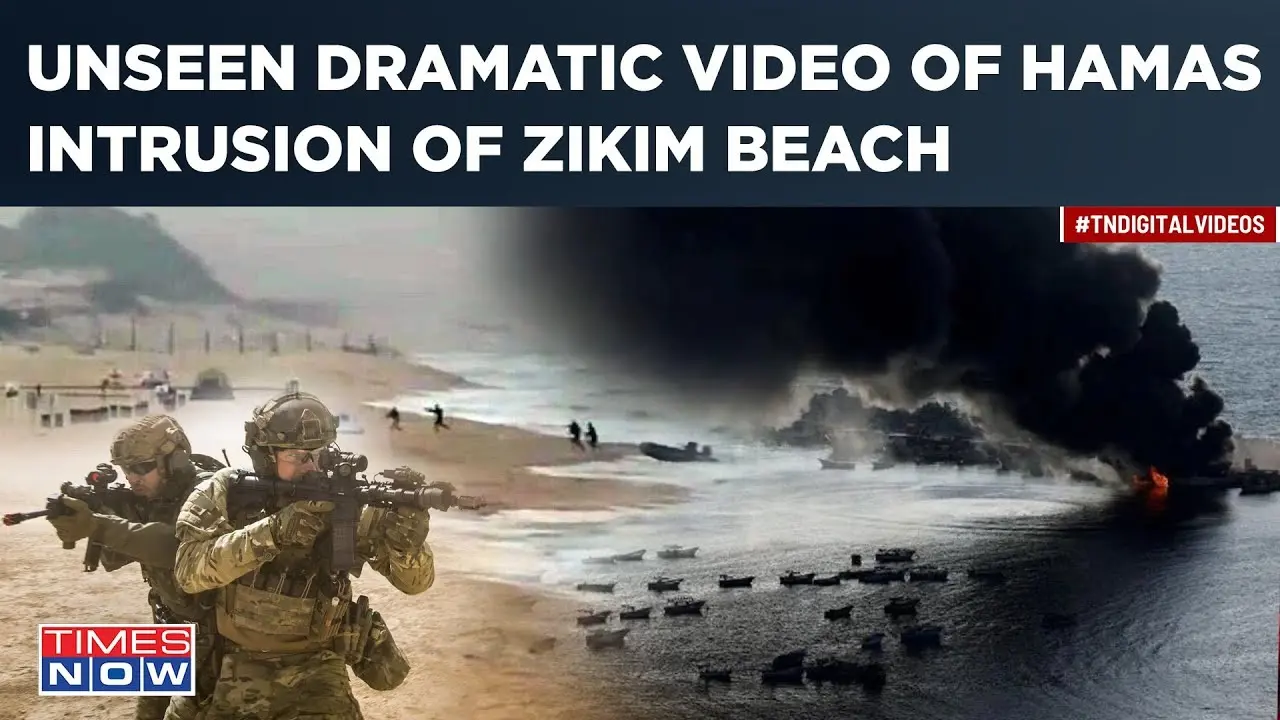

New testimony and survivor material suggest Israeli civilians may have come under Israeli fire on Zikim Beach during the chaotic first hours of October 7, 2023 — a possibility journalist Max Blumenthal of The Grayzone says fits a broader pattern of the Hannibal Directive being used to prevent hostage-taking “by any means necessary.”
Blumenthal alleges that an Israeli naval craft swept the shoreline with gunfire as Palestinian commandos came ashore near the adjacent naval base, potentially killing large numbers of Israelis in the process. He further claims that some of the most revealing phone videos from the scene were subsequently wiped by the authorities.
“At around 6:00 a.m., when al-Qassam fighters arrived by sea, an Israeli naval boat began opening fire on the entire beach and slaughtered possibly dozens of Israeli civilians,” Blumenthal said, adding that the military “refuses to release” raw footage while showing curated reels abroad.
Israeli official probes have so far described Zikim differently — stating that naval infiltrators killed 17 civilians amid a breakdown in local force protection — but those inquiries also concede serious command failures on the day.
The new evidence and operational reconstructions suggest that the October 7 assault by Palestinian naval commandos was aimed specifically at Bahad 4, the Zikim military training base, rather than at nearby civilian areas. The base, situated just south of Ashkelon and adjacent to Zikim Beach, serves as the Israeli army’s principal training ground for new conscripts — many of whom are later deployed to enforce the blockade of Gaza, man checkpoints, and participate in operations inside the occupied territories. As such, the facility forms an integral part of Israel’s military infrastructure sustaining the occupation.
According to both Israeli and independent reports, Nukhba commando units launched a coordinated amphibious operation before dawn, crossing the sea to strike at the base’s perimeter and engage Israeli soldiers. Their objective, according to later testimonies and intercepted communications, was to capture enemy combatants — Israeli soldiers — and exchange them for thousands of Palestinians held in Israeli prisons and detention centers, including women and minors, many detained without charge under administrative orders.
Under international humanitarian law, the capture of enemy soldiers during an armed conflict is not a war crime but a recognized act of war, provided those captured are treated humanely as prisoners of war. This stands in contrast to the taking of civilians as hostages, which is explicitly prohibited. Given that Israel is the belligerent occupier of Gaza and the West Bank — a status affirmed by the United Nations and the International Court of Justice — the Palestinians’ operation to infiltrate an active military base and seize soldiers can be interpreted as a lawful act of armed resistance against an occupying power, rather than terrorism.
By contrast, Israeli forces reportedly responded with overwhelming and indiscriminate fire — including naval gunfire and aerial bombardment — across Zikim Beach, killing both Palestinian fighters and Israeli civilians in what appears to have been a Hannibal Directive incident intended to prevent soldiers from being taken captive. This reaction, critics argue, transformed what began as a legitimate military engagement into a massacre concealed under the fog of war.
What We Know — and What’s Disputed
Blumenthal says Zikim Beach may be a major, under-examined friendly-fire episode tied to Hannibal, and he argues the incident reflects a wider pattern on Oct. 7 in which Israeli forces used overwhelming fire in mixed civilian–militant environments to stop abductions.
Israeli reports, by contrast, state that Palestinian naval commandos reached the shore despite interceptions at sea and killed civilians before being neutralized. These accounts fault force posture and delayed responses but make no mention of Israeli fire on the beach.
Independent and Israeli reporting, however, indicate that the Hannibal Directive — a controversial protocol allowing lethal force to prevent hostage-taking — was invoked at multiple sites on October 7. Investigations and U.N. findings have noted widespread use of Hannibal orders that day, which critics say risked the lives of Israeli hostages and civilians alike.
‘A Strange Order’: Stand-Down Testimony Adds to Doubt
On July 17, 2025, Golani Brigade reservist Shalom Sheetrit told a Knesset forum for reserve personnel that routine pre-dawn border patrols near Kibbutz Be’eri were suddenly canceled until 9 a.m. on October 7 — an order he called “strange.” His remarks suggested a dangerous gap in early warning and readiness just before the onslaught.
Sheetrit also said senior officers were reportedly away in Eilat despite recent alerts, and he stressed the failure was “at higher levels,” not among front-line fighters — several of whom died trying to defend Be’eri.
His testimony followed growing evidence that the Israeli military received clear warnings but either ignored or dismissed them.
The Warnings That Went Unheeded
A growing body of documentation shows that Israel’s security establishment received multiple, specific warnings — then discounted them:
- Detailed Gaza-Division alert dismissed: Weeks before the attack, female surveillance soldiers and an intelligence unit warned of Hamas training that mirrored the eventual assault — border breaches, hostage-taking, and kibbutz raids. A senior officer allegedly dismissed a detailed report as an “imaginary scenario.”
- ‘Jericho Wall’ plan: Israel’s elite cyber-intelligence unit Unit 8200 reportedly produced a document, nicknamed Jericho Wall, laying out a Hamas battle plan resembling the October 7 assault. It was filed months earlier and never acted upon.
- Egyptian warning: Cairo’s intelligence service has claimed it warned Israel three days in advance of “something big,” but Israeli officials initially denied receiving a specific alert.
Combined, these reports paint a picture of complacency at the highest levels — and, according to critics, a leadership that either ignored or exploited the threat for political ends.
Hannibal, Be’eri and the Nova Festival
As the attacks unfolded, Apache helicopters, tanks, and drones were deployed into areas where militants and civilians were intermingled. Multiple investigations and reconstructions indicate that Hannibal was used at several IDF facilities to block kidnappings, with orders such as “no vehicles to Gaza” that may have included cars carrying captives.
Particular scrutiny has fallen on Kibbutz Be’eri, where a senior commander’s actions have been tied to the deaths of Israeli hostages, and on the Nova music festival, where air and ground fire reportedly killed both militants and civilians.
In the aftermath of the Nova massacre, hundreds of vehicles were photographed melted together, incinerated, or twisted into molten piles, forming a grim landscape of fused metal across the desert floor. Structural collapses in nearby kibbutzim showed the same signature of high-temperature blast damage — conditions impossible to produce with the small arms, RPGs, or improvised explosives used by Palestinian attackers.
Weapons experts have pointed out that such destruction could only have resulted from high-explosive munitions such as Hellfire missiles fired from Apache gunships, or 120mm tank shells, both used by the IDF that day. The intense heat required to liquefy car chassis or vaporize interiors far exceeds what could be achieved by Hamas’s weaponry, which consisted mostly of AK-pattern rifles, RPG-7s, and limited anti-tank ordnance.
Survivors and first responders have claimed that many festivalgoers were killed by Israeli fire as helicopters and tanks struck vehicles moving toward Gaza, apparently under Hannibal orders. Despite these accounts, Israeli authorities quickly cleared and buried the site before a full forensic investigation could take place. The burned-out vehicles were removed, and the official narrative attributed all casualties to Hamas without distinction.
To this day, Israel has refused to mount any independent investigation into how many of its own people may have been killed by its forces on October 7. Military reviews remain classified, and survivor testimonies describing friendly fire have been largely ignored.
“The real scandal of October 7,” Blumenthal said, “is how many Israeli civilians were killed by their own military under the Hannibal Directive — and how determined the government is to prevent anyone from finding out.”
How the Breach Happened
Blumenthal argues Israel underestimated the capabilities of al-Qassam Brigades and Palestinian Islamic Jihad. He highlights the role of Yahya Sinwar, whose long imprisonment, fluent Hebrew, and counter-espionage background allegedly informed a plan to exploit Israel’s hostage sensitivity and doctrinal rigidity.
Fighters bypassed Israel’s expected tunnel scenario by physically breaching the fence, then rapidly overwhelmed undermanned bases and moved into nearby communities before a coordinated response could form.
“Israel was prepared for a tunnel attack,” Blumenthal said. “Instead, al-Qassam fighters went straight through the fence and pounced on sleepy conscripts. Once they knocked out the nearby bases, they entered kibbutzim and took captives before Israeli forces could respond.”
The Politics of Accountability
The events have fractured politics in Israel and abroad. In the United States, figures on the right — including Steve Bannon — now publicly demand a full inquiry, accusing Prime Minister Benjamin Netanyahu of blocking any investigation into October 7.
Blumenthal sees a widening America-First skepticism toward Israel’s war aims and influence as details of the day — including the use of Hannibal — continue to surface.
“Figures like Bannon and Matt Gaetz have begun to see Israel not as an ally but as a protectorate,” Blumenthal said. “The alienation is spreading. First it was Tucker Carlson asking how a tiny country could dominate a superpower, and now pro-Israel conservatives are asking the same thing.”
Why Zikim and Nova Matter
If Blumenthal’s allegation about Israeli fire on Zikim Beach proves correct, it would mark one of the worst friendly-fire tragedies in Israel’s history and intensify debate over Hannibal’s legality and oversight.
Together with the Nova festival’s burned-out aftermath and the unanswered questions surrounding Be’eri, the Zikim episode forms part of a larger pattern of state secrecy and impunity.
Official Israeli accounts continue to blame Hamas for all civilian deaths on October 7, yet the admitted command failures, the evidence of heavy Israeli fire, the melted vehicles and structural collapses, and the refusal to release unedited footage or launch a full inquiry keep the question open.
“The Israeli military has suppressed this footage, but survivors exist, and eventually the truth will surface,” Blumenthal said. “The Hannibal Directive killed Israelis that day — maybe hundreds. And that’s the story the world isn’t being allowed to see.”