
Two foreign activists seized from a Gaza-bound flotilla in international waters have emerged from Israeli custody alleging treatment more commonly associated with wartime detainees than civilian aid workers, transforming what began as a maritime interception near Crete into a wider confrontation over torture allegations, diplomatic silence and the increasingly contested boundaries of Israel’s blockade enforcement.
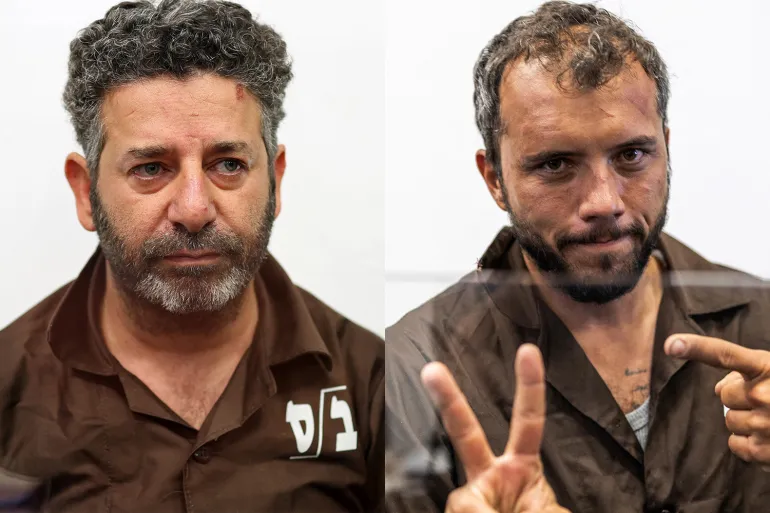
Spanish activist Saif Abu Keshek and Brazilian campaigner Thiago Ávila appeared before an Israeli court in Ashkelon days after Israeli forces intercepted a flotilla carrying activists, clergy members, doctors, journalists and legal observers attempting to reach Gaza.
What might otherwise have remained a dispute over maritime law has instead become something more politically volatile.
According to lawyers who met the men inside Shikma prison, both detainees described being blindfolded, restrained and physically abused after Israeli forces seized the vessels in international waters west of Crete.
The allegations emerged through the legal rights organisation Adalah, which said the two activists described severe mistreatment after being transferred to Israel.
Ávila allegedly told lawyers he was subjected to what he described as “extreme brutality.” According to Adalah, he said he was dragged face-down across the floor during the boarding operation and beaten so severely that he lost consciousness twice.
Since arriving in Israeli custody, he reportedly said he had been held in isolation while blindfolded.
Abu Keshek described a similar pattern.
Lawyers said he alleged he was hand-tied and blindfolded from the moment of interception and forced to remain face-down during much of the transfer process into Israeli detention.
Adalah said both men began a hunger strike in protest while continuing to drink water.
The allegations have not been independently verified, and Israeli authorities have not publicly addressed the specific claims.
Yet the accusations have rapidly changed the meaning of the flotilla story.
The issue is no longer confined to whether Israel can stop a vessel at sea.
It now raises questions about how civilian activists are treated once detained, whether detention conditions violated international law, and whether foreign nationals attempting to challenge the Gaza blockade are increasingly being processed under a security framework similar to that used for Palestinian prisoners.
For critics of Israeli detention practices, the similarities are difficult to ignore.
Human rights organisations have for years documented allegations involving blindfolding, stress positioning, prolonged restraint, sensory deprivation, isolation and physical violence during Israeli security detentions linked to Gaza and the occupied Palestinian territories.
Those allegations have historically centred on Palestinians.
What makes the flotilla case politically explosive is that the detainees are foreign nationals intercepted far from Gaza itself.
The implication, critics argue, is that methods associated with wartime detention are now being extended beyond the battlefield and beyond Palestinian detainees.
That allegation has sharpened international scrutiny.
Spain and Brazil Move Beyond Diplomatic Concern
The court proceedings in Ashkelon did not unfold in a diplomatic vacuum.
Spain and Brazil have both moved quickly to condemn the detention of their citizens, elevating the case beyond routine consular access requests.
Spanish Foreign Minister José Manuel Albares publicly challenged the legality of Abu Keshek’s detention.
“This is an illegal arrest in international waters outside the jurisdiction of the Israeli authorities,” Albares said, while demanding his immediate release.
Spain’s foreign ministry later reinforced the position in an official statement.
“The government of Spain demands his immediate release.”
That language is notable because governments rarely move so quickly from diplomatic caution to explicit accusations of illegality unless they believe a significant jurisdictional threshold has been crossed.
Brazil has also adopted an unusually strong posture.
Brazilian officials reportedly coordinated with Spain in condemning the detention and demanding access to Ávila.
Reports indicated the two governments characterised the seizure of their citizens as unlawful and sought immediate clarification regarding detention conditions.
Brazil’s involvement adds further diplomatic sensitivity because Ávila is not an unknown activist quietly swept into a maritime operation.
He has been publicly involved in solidarity campaigns and flotilla initiatives, making his detention a visible political issue inside Brazil.
The involvement of two sovereign governments changes the frame of the story.
This is no longer merely an activist confrontation with Israeli forces.
It becomes a dispute involving state jurisdiction, diplomatic responsibility and the treatment of foreign nationals captured beyond Israeli territorial waters.
The Israeli foreign ministry has defended the detention.
Officials said the two men were linked to the Popular Conference for Palestinians Abroad, an organisation sanctioned by the U.S. Treasury and accused by Washington of acting on behalf of Hamas.
Israel alleged Abu Keshek held a senior position in the organisation, while Ávila was described as linked to it and suspected of illegal activity.
Neither government accepted those allegations at face value.
Spain rejected Israel’s accusation outright.
Brazil has pressed for legal transparency.
That divide matters because it determines whether the detainees are viewed as security suspects or humanitarian activists.
The distinction lies at the centre of the legal battle now unfolding.
The Crete Raid Reopened a Fifteen-Year Legal Dispute
The detention hearings cannot be understood separately from the interception itself.
Last week, Israeli forces intercepted a large flotilla west of Crete in international waters hundreds of miles from Gaza.
Organisers of the Global Sumud Flotilla said the convoy included vessels departing from Spain, France and Italy with the declared purpose of delivering humanitarian supplies and challenging Israel’s blockade.
Israel said approximately 175 activists were removed from boats and transferred during the operation.
Organisers claimed the interception occurred more than 600 miles from Gaza.
That distance has become legally significant.
Unlike earlier flotilla confrontations that took place near Gaza’s coastline, the Crete interception occurred deep inside the Mediterranean.
For critics, the location makes the operation appear less like immediate blockade enforcement and more like extraterritorial policing.
Israel maintains the blockade gives it authority to stop vessels attempting to reach Gaza even in international waters.
That position relies heavily on principles reflected in the San Remo Manual on International Law Applicable to Armed Conflicts at Sea.
Under that framework, a lawful naval blockade may be enforced beyond territorial waters if it has been legally established.
Israel therefore argues geography is not decisive.
If the flotilla intended to breach the blockade, interception remains lawful regardless of distance.
Critics dispute the premise entirely.
They argue the legality of the blockade itself remains unresolved.
If the blockade is unlawful, they contend, then any enforcement measures built upon it become equally vulnerable to legal challenge.
That dispute has existed for more than fifteen years.
It began most visibly with the 2010 Mavi Marmara raid.
Israeli commandos boarded a Gaza-bound vessel in international waters during that operation, killing ten activists and triggering global condemnation.
The aftermath produced two competing legal narratives that continue to shape every flotilla confrontation.
A United Nations Human Rights Council fact-finding mission concluded the interception was unlawful and questioned the legality of the blockade itself.
The inquiry also suggested the blockade could amount to collective punishment against Gaza’s civilian population.
Collective punishment is prohibited under Article 33 of the Fourth Geneva Convention.
A second process, the Palmer Report, reached a different conclusion.
Commissioned under the authority of the UN Secretary-General, the Palmer panel accepted the legality of the blockade in principle while criticising aspects of Israel’s use of force.
The Palmer findings became politically important because they provided Israel with a UN-associated legal reference supporting blockade enforcement.
Critics, however, argue the Palmer process was diplomatic rather than judicial and lacked the independence of a formal legal proceeding.
That contradiction remains unresolved.
There has never been a universally accepted court ruling definitively settling the legality of the blockade.
The result is a legal grey zone in which flotilla operations repeatedly return to the same unresolved question.
Can Israel lawfully intercept civilian vessels in international waters because of a blockade whose legal status remains disputed?
The Crete operation has reopened that question in dramatic form.
The Allegations of Torture Change the Legal Landscape
The legal implications extend beyond interception.
International humanitarian law draws a distinction between lawful maritime detention and abusive treatment.
Even if a blockade interception is considered permissible, detainees remain protected by international standards prohibiting torture, degrading treatment and arbitrary detention.
That is where the allegations made by Abu Keshek and Ávila become central.
Blindfolding, forced face-down restraint, isolation and alleged beatings are not simply matters of discomfort.
They touch upon legal standards governing detainee treatment.
Human rights lawyers argue that coercive restraint or violence against civilians detained during maritime operations may violate obligations under international humanitarian law and human rights law.
The allegations also create a narrative continuity with claims made by Palestinian detainees held during the Gaza war.
Since October 2023, numerous rights groups have documented allegations that detainees held in Israeli military facilities experienced prolonged blindfolding, humiliation, forced positions, sleep deprivation and physical abuse.
Israeli authorities have rejected or disputed many such claims.
Yet the flotilla allegations are politically sensitive precisely because they involve foreign nationals rather than Palestinians.
If the same treatment is alleged against Europeans and Latin Americans intercepted at sea, critics argue, the issue becomes harder for Western governments to ignore.
The activists were not seized inside a combat zone.
They were detained during a civilian maritime mission.
That distinction changes the optics.
It also changes the legal pressure.
The ‘Don’t Be Too Careful’ Debate Returns
The flotilla case also revives a broader argument about diplomatic permissiveness.
During the first weeks of the Gaza war in October 2023, Israeli newspaper Haaretz reported that senior Israeli officials claimed U.S. Secretary of State Antony Blinken privately reassured Israeli leaders not to be “too careful” during the early phase of military operations.
The report relied on anonymous Israeli officials familiar with wartime discussions.
The U.S. State Department immediately denied the claim.
Spokesperson Matthew Miller called the report “absolutely false” and insisted that Washington had consistently stressed civilian protection and respect for international humanitarian law.
No transcript or recording of the alleged conversation has ever emerged.
Yet the phrase survived politically because it came to symbolise what critics believed was the practical effect of U.S. policy.
Public statements stressed humanitarian concern.
Military and diplomatic backing remained firm.
The phrase became shorthand for a perceived contradiction between rhetoric and consequence.
That debate now returns in a different setting.
The question is no longer limited to Palestinians inside Gaza.
Instead, critics argue, the same permissive diplomatic environment may now apply to foreign civilians attempting to challenge the blockade.
The United States’ own rhetoric surrounding the flotilla intensified that perception.
Before and around the interception, the State Department reportedly described the Global Sumud Flotilla as a “pro-Hamas initiative” and characterised it as a counterproductive effort undermining regional diplomacy.
Washington reportedly encouraged allied governments to deny vessels port access, refuelling and logistical support.
To critics, that language helped establish a political frame in which the flotilla was treated less as a humanitarian action and more as a security threat.
Once that framing existed, they argue, interception became easier to justify and allegations of mistreatment became easier to minimise.
That does not prove coordination.
It does, however, reinforce a larger argument about diplomatic tone.
The concern among critics is not that anyone repeated the words “don’t be too careful.”
The concern is that a broader structure of permissiveness may still be operating.
Israel presents an action as security enforcement.
Western governments adopt or tolerate that framing.
Humanitarian concerns emerge afterward rather than shaping the response beforehand.
A Test of Whether Humanitarian Activism Can Be Criminalised
The case now raises a deeper question.
Can humanitarian activism itself become grounds for security detention?
Israel says it is investigating serious allegations tied to Hamas-linked organisations.
Spain and Brazil say their citizens were unlawfully seized.
Adalah says the detainees described treatment amounting to abuse.
No charges have yet been filed.
That uncertainty matters.
If the men are released without prosecution, critics may argue the detention was punitive and political.
If Israel files security charges, the courts may become a testing ground for whether foreign activists seized in international waters can be prosecuted under terrorism-related allegations.
Either outcome keeps the controversy alive.
The flotilla itself was not simply about delivering aid.
Participants openly described the mission as an attempt to challenge the blockade and force international attention onto Gaza.
That symbolic dimension makes the legal response more politically sensitive.
The treatment of activists sends a message not only to those already detained but to anyone considering similar actions in the future.
If humanitarian missions risk ending in blindfolding, beatings, isolation and prolonged detention, critics argue, the effect may be deterrence through fear.
That is why the allegations carry significance beyond the individual case.
They speak to how power is exercised at the intersection of security policy, maritime law and political solidarity.
The Mediterranean Is Becoming an Extension of the Gaza Conflict
The Crete raid has reopened questions Israel has spent years attempting to stabilise.
Is the blockade lawful?
Can it be enforced hundreds of miles from Gaza?
Do civilians attempting to challenge it retain ordinary legal protections?
The allegations from Ashkelon introduce another dimension.
They suggest enforcement may not stop at interception.
Instead, critics argue, it may continue through detention practices that resemble wartime incarceration.
For Israel’s allies, the case presents an increasingly difficult dilemma.
Diplomatic restraint can appear cautious and strategic.
But critics argue that restraint becomes harder to distinguish from tacit permission when allegations of abuse continue to emerge without meaningful public consequence.
Spain and Brazil have moved beyond quiet concern.
Israel continues to defend the operation as lawful.
The detainees say they were subjected to “extreme brutality.”
No final legal resolution yet exists.
What does exist is a growing sense that the Gaza conflict no longer ends at Gaza’s shoreline.
It extends outward into the Mediterranean, into diplomatic relationships, into courts, and into the treatment of civilians who attempt to intervene.
The flotilla case may ultimately become remembered not only as a maritime interception, but as a moment when the boundaries between war, humanitarian activism and international law became increasingly difficult to separate.