
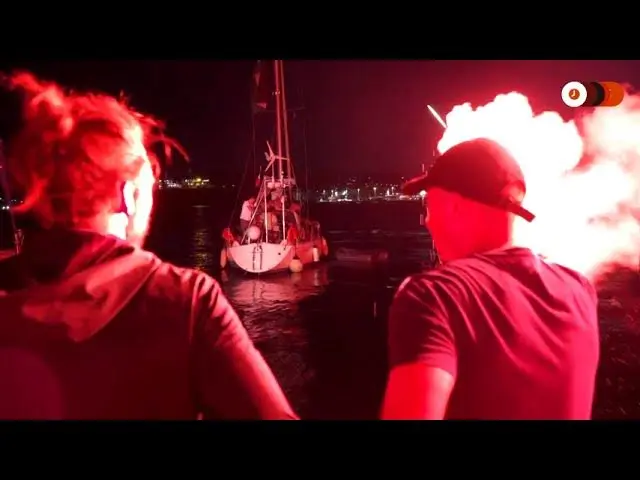

Israeli naval forces intercepted a Gaza-bound flotilla near the Greek island of Crete on 30 April, detaining activists and seizing vessels in international waters more than 600 miles from Palestine, according to flotilla organisers, international media reports and statements released by Israel’s foreign ministry.
Organisers of the Global Sumud Flotilla said at least 22 vessels were intercepted during an overnight operation west of Crete, while Israel said approximately 175 activists from more than 20 boats were abducted by the IDF and transported to Israeli territory. The flotilla had spent two weeks crossing the Mediterranean after vessels joined from Spain, France and Italy, and by the time Israeli forces intervened, organisers said 58 boats had taken part in the mission, with dozens still sailing near Crete’s southern coast after the first wave of interceptions.
Participants described the convoy as one of the largest civilian maritime attempts to reach Gaza since the original Freedom Flotilla movement, with activists, doctors, legal observers, aid workers, journalists, clergy members and campaigners from multiple countries insisting that the objective was not merely to deliver humanitarian supplies but to challenge the blockade imposed on Gaza since 2007. Israel rejected that framing, with the foreign ministry dismissing the convoy as a “PR stunt” and arguing that the operation was required to prevent what it called a breach of a lawful naval blockade.
Yet the geography of the interception has transformed the latest flotilla raid into something far more politically and legally combustible than earlier incidents. The interception did not occur near Gaza’s coastline, nor close to Israeli territorial waters, but rather west of Crete in international waters hundreds of miles from Palestine and significantly closer to Europe than to Gaza itself. That geographic reality has given the operation a contentiousness absent from previous interdictions, because it raises the question of whether a state can seize civilian vessels, detain their passengers and transport them to its own territory while relying upon a contested legal doctrine whose legitimacy remains disputed. The answer turns almost entirely upon one unresolved premise: whether Israel’s blockade of Gaza can genuinely be considered lawful under international law.
The Raid in International Waters
The Global Sumud Flotilla said Israeli naval forces “intercepted, boarded, and systematically disabled and destroyed various boats” during the overnight operation in international waters west of Crete, describing the action as a coordinated raid carried out against civilian vessels whose passengers included aid workers, legal observers, doctors, journalists, clergy members and activists. Video released by participants appeared to show passengers raising their hands while Israeli forces boarded vessels, reinforcing the organisers’ portrayal of the operation as a forcible detention rather than a consensual maritime inspection.
Organisers said communications were jammed, engines damaged and civilians detained, with some vessels allegedly left disabled during worsening weather conditions. One statement from the flotilla accused Israel of “kidnapping participants or intentionally leaving civilians stranded on powerless, broken vessels directly in the path of a massive approaching storm” – language that reflected the intensity of the reaction among those involved.
Tariq Ra’ouf, a Palestinian American writer and activist aboard one of the flotilla’s support vessels in Greek waters, told BBC Arabic that participants were “shocked and dismayed at the impunity of Israel’s actions” and accused Israel of repeatedly violating international law. “Spirits on board are high,” he said. “We are determined to keep doing what we can to support the ending of Israel’s illegal siege on Gaza.”
Israel’s foreign ministry defended the operation, arguing that the number of vessels involved, the possibility of confrontation and what it called “the risk of escalation” had necessitated early intervention to prevent a breach of the naval blockade. The ministry said the operation had been carried out peacefully and without casualties, while also alleging that inspections had uncovered materials that “appear to be drugs and contraceptives”, although no detailed evidence was immediately released to support those claims. Israeli officials further accused flotilla organisers of cooperating with Hamas and of attempting to sabotage what they described as President Trump’s Gaza peace plan transition – an allegation that organisers strongly rejected while insisting that the convoy was civilian, humanitarian and politically independent.
International reaction was immediate and unusually broad. Italian Prime Minister Giorgia Meloni condemned the seizure and demanded the release of detained Italians, with Italian media reporting that at least 24 Italian citizens were among those intercepted. The European Union’s foreign affairs spokesman, Anouar El Anouni, reiterated calls for Israel to respect international humanitarian law and maritime law, while Greek opposition politician Dimitris Mantzos called on his government to explain what it knew about what he described as “this illegal act”. Turkey reportedly characterised the operation as piracy, reflecting how quickly the incident escalated into a wider diplomatic dispute over legality, jurisdiction and the limits of maritime enforcement.
Israel previously intercepted another flotilla organised by the same movement in October 2025, arresting and deporting more than 470 people, including the Swedish climate activist Greta Thunberg.
The Legal Question That Never Went Away
Israel’s defence of the Crete operation rests on a legal argument that has remained largely unchanged for more than fifteen years: that Gaza is under a lawful naval blockade and that, under international naval warfare doctrine, a state enforcing a lawful blockade may stop ships attempting to breach it, including in international waters. That principle is reflected in the San Remo Manual on International Law Applicable to Armed Conflicts at Sea, which permits interception beyond territorial waters provided a blockade has been validly established. Israel therefore argues that the location of the interception does not matter; if the flotilla intended to reach Gaza, Israel had authority to stop the vessels before arrival.
Critics counter that this interpretation grants near unlimited maritime reach, because the further from Gaza an interception occurs, the more the action begins to resemble a projection of state power across international waters rather than a narrowly defined security measure. Legal scholars critical of Israel’s position note, moreover, that Hamas does not possess a conventional navy. The organisation has had maritime units, small boats and alleged smuggling networks, but it does not possess warships, maritime commerce fleets or naval infrastructure comparable to those of a state. Critics therefore question whether a sweeping naval blockade affecting millions of civilians can be justified under legal frameworks originally designed for interstate naval warfare.
That argument becomes stronger when the blockade’s humanitarian consequences are considered, and the United Nations has repeatedly warned that Gaza’s civilian population faces extreme hardship. The BBC cited remarks by UN Assistant Secretary General Khaled Khiari, who told the Security Council that Gaza’s 2.1 million residents continued to face deadly strikes and worsening humanitarian conditions, warning that essential services such as water, sanitation and health care were again close to collapse, that food insecurity remained severe, and that restrictions on items deemed “dual use” by Israel continued to limit aid delivery. Those humanitarian realities are not separate from the legality debate; they are central to it.
The First UN Investigation Was Damaging for Israel
The modern legal battle over flotillas began with the 31 May 2010 interception of the Mavi Marmara, part of the Gaza Freedom Flotilla. Commandos boarded the vessel in international waters and ten activists were slaughtered by the IDF, an event that generated immediate international condemnation and triggered multiple investigations into both the conduct of the raid and the legality of the blockade itself.
The first major United Nations inquiry came from the Human Rights Council, whose fact-finding mission produced conclusions that were deeply damaging to Israel’s legal position. The mission concluded that Israel’s interception of the flotilla in international waters had been unlawful, questioned the legality of the Gaza blockade itself, identified evidence of excessive force, and emphasised that the passengers retained civilian protections under international humanitarian law. Perhaps most significantly, the report suggested that the blockade amounted to collective punishment imposed on Gaza’s civilian population – a conclusion that carried enormous legal consequences, because if the blockade itself were unlawful, then any enforcement measures carried out under its authority would also become unlawful.
The Human Rights Council mission argued that the blockade’s effects on civilians could not be reconciled with international humanitarian law, particularly because the restrictions affected an entire population rather than a clearly defined military threat. The International Committee of the Red Cross later summarised the mission’s reasoning by noting that collective punishment is prohibited under Article 33 of the Fourth Geneva Convention.
The Second Inquiry That Changed the Narrative
The legal story did not end with the Human Rights Council report, because a second process soon emerged under the authority of the United Nations Secretary General. In September 2011, a separate panel released what became known as the Palmer Report, chaired by former New Zealand prime minister Sir Geoffrey Palmer and supported by vice chair Álvaro Uribe, the former president of Colombia. The panel also included an Israeli representative, Joseph Ciechanover, and a Turkish representative, Süleyman Özdem Sanberk.
Unlike the Human Rights Council mission, the Palmer process was diplomatic rather than judicial in character. It did not function as a court, did not assign criminal responsibility, and did not operate as an adversarial legal proceeding in which evidence was tested through competing legal argument. Nevertheless, its conclusions became decisive, because the report accepted Israel’s argument that the naval blockade of Gaza was lawful in principle and could be justified as a security measure intended to prevent weapons from reaching Hamas. At the same time, the panel criticised the force used during the Mavi Marmara boarding as excessive and unreasonable, creating a distinction that proved politically and legally significant.
The Human Rights Council report had challenged the legality of the blockade itself, whereas the Palmer Report accepted the blockade while criticising aspects of how it was enforced. That difference reshaped the diplomatic landscape, because it meant Israel could point to a UN-associated panel that had accepted the legality of the blockade even while other investigations remained sharply critical. Instead of facing a single dominant international finding against its legal position, Israel now had an alternative narrative that could be cited whenever criticism intensified.
The Controversy Over Palmer’s Composition
For critics of Israel’s blockade, the Palmer Panel has always represented more than a legal disagreement; it represents a dispute about legitimacy. Critics argue that Israel did not get the outcome it wanted from the first UN investigation and therefore benefited from a second process that reached a more favourable conclusion.
Questions have long surrounded the composition of the panel itself. Joseph Ciechanover served as Israel’s representative, while the Turkish representative later dissented from key conclusions. The inclusion of Álvaro Uribe has remained especially controversial: during his presidency in Colombia, Uribe cultivated close ties with Israel, was publicly recognised by the American Jewish Committee, and was often described as a strong supporter of Israel’s security policies. Supporters of the panel argue that diplomatic experience does not amount to bias, while critics counter that the appearance of political sympathy toward Israel mattered enormously in a process that was not judicially independent.
The Turkish member, Süleyman Özdem Sanberk, formally disagreed with key aspects of the report, particularly the finding that the blockade was lawful – a dissent that is significant because it demonstrates that the panel did not produce a unified legal consensus. The Palmer findings were contested from within. Yet in public discourse the report often functions as if it were a definitive judicial ruling, when in reality it was a diplomatic panel whose findings have been used repeatedly to support the legality of Israel’s maritime enforcement.
The Report That Became a Legal Shield
The Palmer Report occupies a unique place in debates surrounding Gaza, because it functions less as a universally accepted legal ruling and more as a counterweight to the findings that preceded it. Without Palmer, Israel’s legal defence would appear markedly weaker when set against the accumulation of criticism from human rights organisations, legal scholars, UN rapporteurs and humanitarian agencies. Amnesty International has described the blockade as collective punishment, Human Rights Watch has criticised restrictions that affect civilians rather than combatants, and UN officials have repeatedly warned that Gaza’s humanitarian collapse raises profound questions about proportionality and legality. The Human Rights Council inquiry into the Mavi Marmara raid strongly criticised both the blockade and its enforcement.
The Palmer Report did not erase those findings, yet it complicated them by introducing a competing legal interpretation that could be invoked whenever allegations of illegality intensified. Instead of a largely unified narrative condemning the blockade, international discussion became divided between competing legal frameworks, with Israel able to cite Palmer in support of its position while critics pointed to the Human Rights Council findings, humanitarian law analysis and broader concerns about collective punishment. No universally accepted court has resolved that contradiction, which means the debate remains suspended between two incompatible interpretations.
That ambiguity became politically valuable, because it prevented a single legal narrative from hardening into consensus. Rather than confronting a settled judgment, Israel gained a counter-narrative supported by a UN-affiliated diplomatic process, allowing it to argue that the legality of the blockade remained open to interpretation.
The Abduction Debate
The Crete raid has revived another unresolved issue that sits alongside the blockade debate itself: whether the detention of flotilla participants constitutes lawful custody or unlawful seizure. Israel detained approximately 175 activists and transported them to Israeli territory after intercepting their vessels in international waters – an action that organisers describe as kidnapping while Israeli authorities frame as a lawful maritime detention linked to blockade enforcement. The legal distinction matters because it determines whether those detained were temporarily held under recognised wartime authority or arbitrarily deprived of liberty outside any accepted jurisdictional framework.
If the blockade is lawful, then interception and temporary detention may also be lawful. If the blockade is unlawful, then the legal foundation beneath the operation begins to collapse, turning the detention into an arbitrary seizure of civilians whose only apparent offence was attempting to reach Gaza by sea.
The distance from Palestine intensifies the controversy. In 2010, the Mavi Marmara was intercepted approximately 72 nautical miles from Gaza; in 2026, the flotilla vessels were reportedly intercepted nearly 600 miles away. That geographic difference fundamentally changes the optics, and potentially the legal framing, of the action, because the operation appears less like immediate tactical enforcement and more like a projection of state power across a broad stretch of international waters. Critics argue that intercepting civilians near Crete stretches blockade doctrine beyond recognition and raises the question of whether Israel is effectively asserting unilateral policing authority across parts of the Mediterranean.
A Conflict Over Narrative as Much as Law
Language matters in this dispute. Israel describes flotillas as provocations, while activists describe them as humanitarian missions; Israel speaks of detention, while organisers speak of abduction; Turkey reportedly used the word piracy, while European officials invoked international law. The choice of language shapes public understanding, because maritime law is unusually dependent on classification: a lawful interdiction looks very different from an unlawful seizure, and the same event can be interpreted as security enforcement or state overreach depending on which legal framework is accepted.
Israel’s problem is that the facts increasingly strain the limits of the legal cover it has relied upon. A blockade is only lawful if it is proportionate, militarily necessary and not designed to punish civilians, and as Gaza’s humanitarian crisis deepens, the argument that the blockade is a narrowly tailored security measure becomes harder to sustain. That contradiction sits at the centre of every flotilla confrontation: Israel claims wartime necessity while critics point to civilian suffering; Israel invokes maritime doctrine while opponents invoke humanitarian law.
The Crete interception has now brought those unresolved arguments into one of the most dramatic legal settings yet – not off Gaza, not near Israeli waters, but hundreds of miles away, in the Mediterranean, where a civilian convoy sailing toward Palestine became the latest test of how far a state can extend its military reach before enforcement begins to resemble impunity.